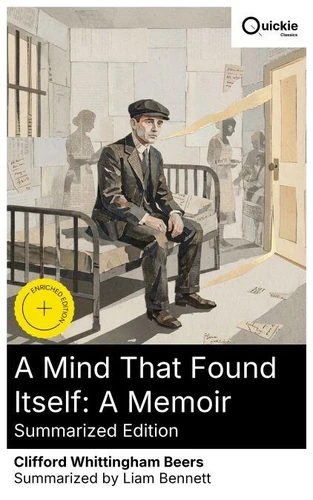
A Mind That Found Itself: A Memoir (Summarized Edition). Enriched edition. Asylums, Recovery, and the Birth of the Mental Hygiene Movement in the Progressive Era
Par : ,Formats :
Disponible dans votre compte client Decitre ou Furet du Nord dès validation de votre commande. Le format ePub est :
- Compatible avec une lecture sur My Vivlio (smartphone, tablette, ordinateur)
- Compatible avec une lecture sur liseuses Vivlio
- Pour les liseuses autres que Vivlio, vous devez utiliser le logiciel Adobe Digital Edition. Non compatible avec la lecture sur les liseuses Kindle, Remarkable et Sony
 , qui est-ce ?
Notre partenaire de plateforme de lecture numérique où vous retrouverez l'ensemble de vos ebooks gratuitement
Pour en savoir plus sur nos ebooks, consultez notre aide en ligne ici
C'est si simple ! Lisez votre ebook avec l'app Vivlio sur votre tablette, mobile ou ordinateur :

- Nombre de pages94
- FormatePub
- ISBN859-65--4787696-0
- EAN8596547876960
- Date de parution10/01/2026
- Protection num.Digital Watermarking
- Taille780 Ko
- Infos supplémentairesepub
- ÉditeurQUICKIE CLASSICS
Résumé
A Mind That Found Itself: A Memoir recounts Clifford W. Beers's confinement in turn-of-the-century asylums and the arduous path of recovery that followed. Written in lucid, unsensational prose, the book blends first-person narrative with the diagnostic clarity of a case history, documenting neglect, mechanical restraints, and misguided therapies alongside moments of humane care. Situated within the Progressive Era's literature of social reform, it stands as an early mental-health memoir that doubles as institutional critique, arguing for prevention, aftercare, and respect for patient dignity.
Beers, a Yale graduate whose breakdowns were precipitated by family tragedy and an attempted suicide, drew upon his years of hospitalization in Connecticut and New England to craft both testimony and blueprint for change. Supported and later endorsed by leading figures such as William James and Adolf Meyer, he transformed his ordeal into the mental hygiene movement, founding organizations that evolved into Mental Health America and reshaped public and clinical attitudes.
Scholars of disability studies, historians of medicine, clinicians, and general readers will find in this memoir not only an engrossing narrative but a foundational text for ethical reform. Read it for its historical witness, its stylistic restraint, and its still-urgent insistence that treatment begin with empathy, insight, and the premise that a suffering mind can, indeed, find itself. Quickie Classics summarizes timeless works with precision, preserving the author's voice and keeping the prose clear, fast, and readable-distilled, never diluted.
Enriched Edition extras: Introduction · Synopsis · Historical Context · Brief Analysis · 4 Reflection Q&As · Editorial Footnotes.
Beers, a Yale graduate whose breakdowns were precipitated by family tragedy and an attempted suicide, drew upon his years of hospitalization in Connecticut and New England to craft both testimony and blueprint for change. Supported and later endorsed by leading figures such as William James and Adolf Meyer, he transformed his ordeal into the mental hygiene movement, founding organizations that evolved into Mental Health America and reshaped public and clinical attitudes.
Scholars of disability studies, historians of medicine, clinicians, and general readers will find in this memoir not only an engrossing narrative but a foundational text for ethical reform. Read it for its historical witness, its stylistic restraint, and its still-urgent insistence that treatment begin with empathy, insight, and the premise that a suffering mind can, indeed, find itself. Quickie Classics summarizes timeless works with precision, preserving the author's voice and keeping the prose clear, fast, and readable-distilled, never diluted.
Enriched Edition extras: Introduction · Synopsis · Historical Context · Brief Analysis · 4 Reflection Q&As · Editorial Footnotes.
A propos de Clifford Whittingham Beers

A Mind That Found Itself
E-book
2,99 €