
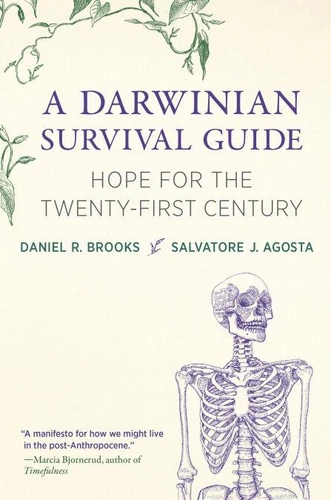
A Darwinian Survival Guide. Hope for the Twenty-First Century
Par : ,Formats :
Disponible dans votre compte client Decitre ou Furet du Nord dès validation de votre commande. Le format ePub protégé est :
- Compatible avec une lecture sur My Vivlio (smartphone, tablette, ordinateur)
- Compatible avec une lecture sur liseuses Vivlio
- Pour les liseuses autres que Vivlio, vous devez utiliser le logiciel Adobe Digital Edition. Non compatible avec la lecture sur les liseuses Kindle, Remarkable et Sony
- Non compatible avec un achat hors France métropolitaine
 , qui est-ce ?
Notre partenaire de plateforme de lecture numérique où vous retrouverez l'ensemble de vos ebooks gratuitement
Pour en savoir plus sur nos ebooks, consultez notre aide en ligne ici
C'est si simple ! Lisez votre ebook avec l'app Vivlio sur votre tablette, mobile ou ordinateur :

- Nombre de pages360
- FormatePub
- ISBN978-0-262-37746-1
- EAN9780262377461
- Date de parution06/02/2024
- Protection num.Adobe DRM
- Taille1 Mo
- Infos supplémentairesepub
- ÉditeurThe MIT Press
Résumé
How humanity brought about the climate crisis by departing from its evolutionary trajectory 15, 000 years ago-and how we can use evolutionary principles to save ourselves from the worst outcomes. Despite efforts to sustain civilization, humanity faces existential threats from overpopulation, globalized trade and travel, urbanization, and global climate change. In A Darwinian Survival Guide, Daniel Brooks and Salvatore Agosta offer a novel-and hopeful-perspective on how to meet these tremendous challenges by changing the discourse from sustainability to survival.
Darwinian evolution, the world's only theory of survival, is the means by which the biosphere has persisted and renewed itself following past environmental perturbations, and it has never failed, they explain. Even in the aftermath of mass extinctions, enough survivors remain with the potential to produce a new diversified biosphere. Drawing on their expertise as field biologists, Brooks and Agosta trace the evolutionary path from the early days of humans through the Late Pleistocene and the beginning of the Anthropocene all the way to the Great Acceleration of technological humanity around 1950, demonstrating how our creative capacities have allowed humanity to survive.
However, constant conflict without resolution has made the Anthropocene not only unsustainable, but unsurvivable. Guided by the four laws of biotics, the authors explain how humanity should interact with the rest of the biosphere and with each other in accordance with Darwinian principles. They reveal a middle ground between apocalypse and utopia, with two options: alter our behavior now at great expense and extend civilization or fail to act and rebuild in accordance with those same principles.
If we take the latter, then our immediate goal ought to focus on preserving as many of humanity's positive achievements-from high technology to high art-as possible to shorten the time needed to rebuild.
Darwinian evolution, the world's only theory of survival, is the means by which the biosphere has persisted and renewed itself following past environmental perturbations, and it has never failed, they explain. Even in the aftermath of mass extinctions, enough survivors remain with the potential to produce a new diversified biosphere. Drawing on their expertise as field biologists, Brooks and Agosta trace the evolutionary path from the early days of humans through the Late Pleistocene and the beginning of the Anthropocene all the way to the Great Acceleration of technological humanity around 1950, demonstrating how our creative capacities have allowed humanity to survive.
However, constant conflict without resolution has made the Anthropocene not only unsustainable, but unsurvivable. Guided by the four laws of biotics, the authors explain how humanity should interact with the rest of the biosphere and with each other in accordance with Darwinian principles. They reveal a middle ground between apocalypse and utopia, with two options: alter our behavior now at great expense and extend civilization or fail to act and rebuild in accordance with those same principles.
If we take the latter, then our immediate goal ought to focus on preserving as many of humanity's positive achievements-from high technology to high art-as possible to shorten the time needed to rebuild.