
John Horman received his Ph. D. from McMaster University in 1973 and is an independent scholar from Waterloo, ON. He has published in Novum Testamentum, and this is his first book.
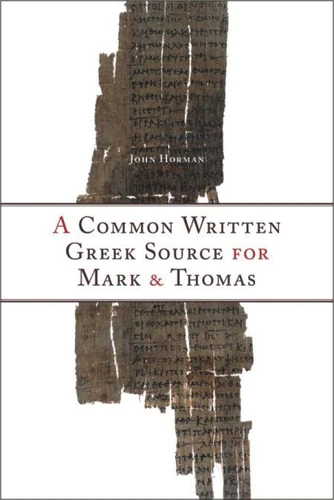
A Common Written Greek Source for Mark and Thomas
Par :Formats :
Disponible dans votre compte client Decitre ou Furet du Nord dès validation de votre commande. Le format ePub est :
- Compatible avec une lecture sur My Vivlio (smartphone, tablette, ordinateur)
- Compatible avec une lecture sur liseuses Vivlio
- Pour les liseuses autres que Vivlio, vous devez utiliser le logiciel Adobe Digital Edition. Non compatible avec la lecture sur les liseuses Kindle, Remarkable et Sony
 , qui est-ce ?
Notre partenaire de plateforme de lecture numérique où vous retrouverez l'ensemble de vos ebooks gratuitement
Pour en savoir plus sur nos ebooks, consultez notre aide en ligne ici
C'est si simple ! Lisez votre ebook avec l'app Vivlio sur votre tablette, mobile ou ordinateur :

- Nombre de pages270
- FormatePub
- ISBN978-1-55458-343-0
- EAN9781554583430
- Date de parution25/02/2011
- Protection num.Digital Watermarking
- Taille29 Mo
- Infos supplémentairesepub
- ÉditeurWilfrid Laurier University Press
Résumé
This book uncovers an early collection of sayings, called N, that are ascribed to Jesus and are similar to those found in the Gospel of Thomas and in Q, a document believed to be a common source, with Mark, for Matthew and Luke. In the process, the book sheds light on the literary methods of Mark and Thomas. A literary comparison of the texts of the sayings of Jesus that appear in both Mark and Thomas shows that each adapted an earlier collection for his own purpose.
Neither Mark nor Thomas consistently gives the original or earliest form of the shared sayings; hence, Horman states, each used and adapted an earlier source. Close verbal parallels between the versions in Mark and Thomas show that the source was written in Greek. Horman's conclusion is that this common source is N. This proposal is new, and has implications for life of Jesus research. Previous research on sayings attributed to Jesus has treated Thomas in one of two ways: either as an independent stream of Jesus sayings written without knowledge of the New Testament Gospels and or as a later piece of pseudo-Scripture that uses the New Testament as source.
This book rejects both views.
Neither Mark nor Thomas consistently gives the original or earliest form of the shared sayings; hence, Horman states, each used and adapted an earlier source. Close verbal parallels between the versions in Mark and Thomas show that the source was written in Greek. Horman's conclusion is that this common source is N. This proposal is new, and has implications for life of Jesus research. Previous research on sayings attributed to Jesus has treated Thomas in one of two ways: either as an independent stream of Jesus sayings written without knowledge of the New Testament Gospels and or as a later piece of pseudo-Scripture that uses the New Testament as source.
This book rejects both views.
A propos de John Horman
39,99 €