
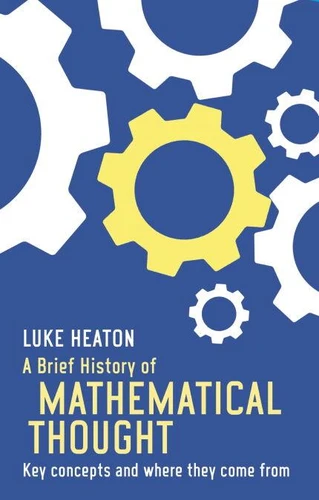
A Brief History of Mathematical Thought. Key concepts and where they come from
Par :Formats :
Disponible dans votre compte client Decitre ou Furet du Nord dès validation de votre commande. Le format ePub protégé est :
- Compatible avec une lecture sur My Vivlio (smartphone, tablette, ordinateur)
- Compatible avec une lecture sur liseuses Vivlio
- Pour les liseuses autres que Vivlio, vous devez utiliser le logiciel Adobe Digital Edition. Non compatible avec la lecture sur les liseuses Kindle, Remarkable et Sony
- Non compatible avec un achat hors France métropolitaine
 , qui est-ce ?
Notre partenaire de plateforme de lecture numérique où vous retrouverez l'ensemble de vos ebooks gratuitement
Pour en savoir plus sur nos ebooks, consultez notre aide en ligne ici
C'est si simple ! Lisez votre ebook avec l'app Vivlio sur votre tablette, mobile ou ordinateur :

- Nombre de pages336
- FormatePub
- ISBN978-1-4721-1715-1
- EAN9781472117151
- Date de parution01/04/2015
- Protection num.Adobe DRM
- Infos supplémentairesepub
- ÉditeurRobinson
Résumé
Mathematics is a product of human culture which has developed along with our attempts to comprehend the world around us. In A Brief History of Mathematical Thought, Luke Heaton explores how the language of mathematics has evolved over time, enabling new technologies and shaping the way people think. From stone-age rituals to algebra, calculus, and the concept of computation, Heaton shows the enormous influence of mathematics on science, philosophy and the broader human story.
The book traces the fascinating history of mathematical practice, focusing on the impact of key conceptual innovations. Its structure of thirteen chapters split between four sections is dictated by a combination of historical and thematic considerations. In the first section, Heaton illuminates the fundamental concept of number. He begins with a speculative and rhetorical account of prehistoric rituals, before describing the practice of mathematics in Ancient Egypt, Babylon and Greece.
He then examines the relationship between counting and the continuum of measurement, and explains how the rise of algebra has dramatically transformed our world. In the second section, he explores the origins of calculus and the conceptual shift that accompanied the birth of non-Euclidean geometries. In the third section, he examines the concept of the infinite and the fundamentals of formal logic.
Finally, in section four, he considers the limits of formal proof, and the critical role of mathematics in our ongoing attempts to comprehend the world around us. The story of mathematics is fascinating in its own right, but Heaton does more than simply outline a history of mathematical ideas. More importantly, he shows clearly how the history and philosophy of maths provides an invaluable perspective on human nature.
The book traces the fascinating history of mathematical practice, focusing on the impact of key conceptual innovations. Its structure of thirteen chapters split between four sections is dictated by a combination of historical and thematic considerations. In the first section, Heaton illuminates the fundamental concept of number. He begins with a speculative and rhetorical account of prehistoric rituals, before describing the practice of mathematics in Ancient Egypt, Babylon and Greece.
He then examines the relationship between counting and the continuum of measurement, and explains how the rise of algebra has dramatically transformed our world. In the second section, he explores the origins of calculus and the conceptual shift that accompanied the birth of non-Euclidean geometries. In the third section, he examines the concept of the infinite and the fundamentals of formal logic.
Finally, in section four, he considers the limits of formal proof, and the critical role of mathematics in our ongoing attempts to comprehend the world around us. The story of mathematics is fascinating in its own right, but Heaton does more than simply outline a history of mathematical ideas. More importantly, he shows clearly how the history and philosophy of maths provides an invaluable perspective on human nature.