Donna Stringer, the founder and former president of Executive Diversity Services, is a social psychologist with more than thirty years of experience as a cross-cultural educator and trainer. She has worked with U. S. corporations in 23 countries.
Patricia Cassiday is a cross-cultural consultant, trainer, and coach specializing in international transitions. She is the lead facilitator at Collaborative Connection, a consulting firm in the Seattle area.
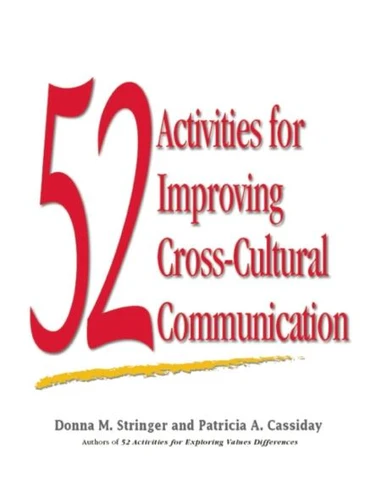
52 Activities for Improving Cross-Cultural Communication
Par : ,Formats :
Disponible dans votre compte client Decitre ou Furet du Nord dès validation de votre commande. Le format ePub protégé est :
- Compatible avec une lecture sur My Vivlio (smartphone, tablette, ordinateur)
- Compatible avec une lecture sur liseuses Vivlio
- Pour les liseuses autres que Vivlio, vous devez utiliser le logiciel Adobe Digital Edition. Non compatible avec la lecture sur les liseuses Kindle, Remarkable et Sony
- Non compatible avec un achat hors France métropolitaine
 , qui est-ce ?
Notre partenaire de plateforme de lecture numérique où vous retrouverez l'ensemble de vos ebooks gratuitement
Pour en savoir plus sur nos ebooks, consultez notre aide en ligne ici
C'est si simple ! Lisez votre ebook avec l'app Vivlio sur votre tablette, mobile ou ordinateur :

- Nombre de pages240
- FormatePub
- ISBN978-1-4736-4340-6
- EAN9781473643406
- Date de parution15/06/2009
- Protection num.Adobe DRM
- Infos supplémentairesepub
- ÉditeurJohn Murray Business
Résumé
Communication styles and patterns differ vastly among people from different cultures. Every culture has a "communication style norm" and when that style mixes with another, stereotypes and misperceptions arise. 52 Activities for Improving Cross-Cultural Communication explores cross-cultural communication issues with an eye toward increasing understanding and effectiveness. 52 Activities for Improving Cross-Cultural Communication is a practical trainer's manual that includes applications from many sectors, such as business, diversity, cross-cultural fields, and from many trainers in the U.
S., Europe, Asia, the Middle East and Latin America. Exercises are organized according to audience, time required to perform and the risk level for participants, a unique feature created by the authors, and are easily adaptable to the user's particular need and situation. Many of the exercises are written with instructions that address requirements for a specific audience (e.g., gender or generation).
There is something for everyone: those who like hands-on, practical activities; those who prefer experiential exercises; and those who learn best through reflection.
S., Europe, Asia, the Middle East and Latin America. Exercises are organized according to audience, time required to perform and the risk level for participants, a unique feature created by the authors, and are easily adaptable to the user's particular need and situation. Many of the exercises are written with instructions that address requirements for a specific audience (e.g., gender or generation).
There is something for everyone: those who like hands-on, practical activities; those who prefer experiential exercises; and those who learn best through reflection.