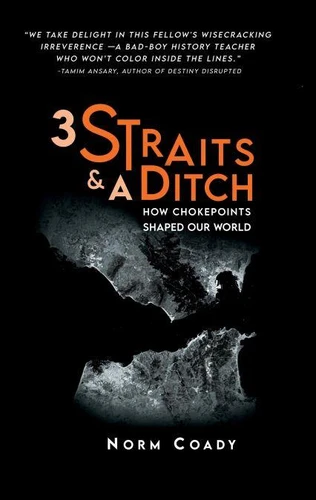
What if the most important forces in history aren't the generals, the ideologues, or the statesmen - but the narrow passages of water they're all fighting over?In 3 Straits & a Ditch, Norm Coady traces four strategic passages - the Turkish Straits, Gibraltar, the Suez Canal, and the Strait of Hormuz - and argues that the terrain calls the shots. Always has. The greatest military in the history of the world got beaten in Afghanistan by soldiers on mules with homemade explosives.
No army un-narrows a strait. The board is set, and everyone is playing the game it dictates. The evidence is everywhere once you know where to look. The closure of the Dardanelles in 1914 didn't just bottle up Russia - it set the stage for Lenin, and sent shockwaves that reached the Oklahoma plains two decades later. A nine-hour meeting at a French train station in 1940 kept a Spanish dictator in power for thirty more years.
A canal closure in 1967 contributed to the conditions that produced punk rock. And the Strait of Hormuz today is as consequential as any of them. Coady brings these stories to life the way he discovered them - through a classroom. The students' questions, their resistance, and their moments of genuine discovery pace the narrative throughout, turning dense geopolitical history into something that feels like the best conversation you've ever had about why the world works the way it does.
The result is popular history that is rigorous, funny, and genuinely surprising: a book that changes how you read the news, understand the past, and look at a map.
What if the most important forces in history aren't the generals, the ideologues, or the statesmen - but the narrow passages of water they're all fighting over?In 3 Straits & a Ditch, Norm Coady traces four strategic passages - the Turkish Straits, Gibraltar, the Suez Canal, and the Strait of Hormuz - and argues that the terrain calls the shots. Always has. The greatest military in the history of the world got beaten in Afghanistan by soldiers on mules with homemade explosives.
No army un-narrows a strait. The board is set, and everyone is playing the game it dictates. The evidence is everywhere once you know where to look. The closure of the Dardanelles in 1914 didn't just bottle up Russia - it set the stage for Lenin, and sent shockwaves that reached the Oklahoma plains two decades later. A nine-hour meeting at a French train station in 1940 kept a Spanish dictator in power for thirty more years.
A canal closure in 1967 contributed to the conditions that produced punk rock. And the Strait of Hormuz today is as consequential as any of them. Coady brings these stories to life the way he discovered them - through a classroom. The students' questions, their resistance, and their moments of genuine discovery pace the narrative throughout, turning dense geopolitical history into something that feels like the best conversation you've ever had about why the world works the way it does.
The result is popular history that is rigorous, funny, and genuinely surprising: a book that changes how you read the news, understand the past, and look at a map.

 , qui est-ce ?
