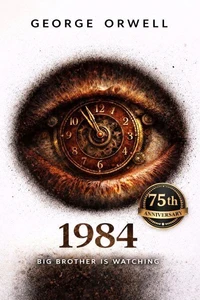
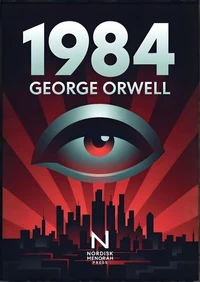
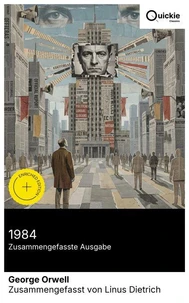
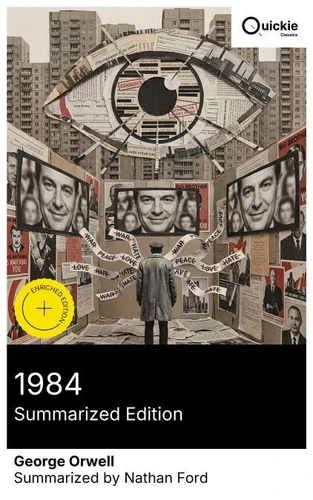
1984 (Modern Classics Series) is Orwell's stark anatomy of total power. Following Winston Smith, a clerk in the Ministry of Truth, the novel depicts a society where telescreens, Newspeak, and doublethink erase privacy and history under Big Brother. Winston's affair with Julia and his betrayal by O'Brien end in the Ministry of Love, where torture finalizes ideological conquest. In lucid, pared-down prose, Orwell fuses political fable with bleak satire, recasting the dystopian tradition for the anxieties of the postwar era.
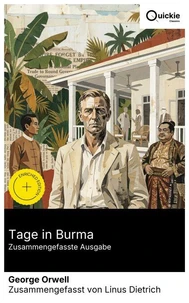
George Orwell (Eric Arthur Blair) forged this vision from hard encounters with power: service as a colonial policeman in Burma, immersion in working-class Britain, combat in the Spanish Civil War, and wartime work at the BBC amid propaganda and censorship. His essays-especially Politics and the English Language-cemented his belief that corrupted language enables tyranny. Ill and isolated on Jura while drafting the novel, he aimed a nonpartisan warning at totalitarian methods across the spectrum.
This edition situates the text within its historical debates and clarifies its linguistic and political stakes. Students, journalists, policymakers, and readers will find guidance in how institutions weaponize words, fear, and desire. Few novels more rigorously teach intellectual self-defense; none more unsparingly imagines its cost.
Quickie Classics summarizes timeless works with precision, preserving the author's voice and keeping the prose clear, fast, and readable-distilled, never diluted.
Enriched Edition extras: Introduction · Synopsis · Historical Context · Author Biography · Brief Analysis · 4 Reflection Q&As · Editorial Footnotes.
1984 (Modern Classics Series) is Orwell's stark anatomy of total power. Following Winston Smith, a clerk in the Ministry of Truth, the novel depicts a society where telescreens, Newspeak, and doublethink erase privacy and history under Big Brother. Winston's affair with Julia and his betrayal by O'Brien end in the Ministry of Love, where torture finalizes ideological conquest. In lucid, pared-down prose, Orwell fuses political fable with bleak satire, recasting the dystopian tradition for the anxieties of the postwar era.
George Orwell (Eric Arthur Blair) forged this vision from hard encounters with power: service as a colonial policeman in Burma, immersion in working-class Britain, combat in the Spanish Civil War, and wartime work at the BBC amid propaganda and censorship. His essays-especially Politics and the English Language-cemented his belief that corrupted language enables tyranny. Ill and isolated on Jura while drafting the novel, he aimed a nonpartisan warning at totalitarian methods across the spectrum.
This edition situates the text within its historical debates and clarifies its linguistic and political stakes. Students, journalists, policymakers, and readers will find guidance in how institutions weaponize words, fear, and desire. Few novels more rigorously teach intellectual self-defense; none more unsparingly imagines its cost.
Quickie Classics summarizes timeless works with precision, preserving the author's voice and keeping the prose clear, fast, and readable-distilled, never diluted.
Enriched Edition extras: Introduction · Synopsis · Historical Context · Author Biography · Brief Analysis · 4 Reflection Q&As · Editorial Footnotes.

 , qui est-ce ?