
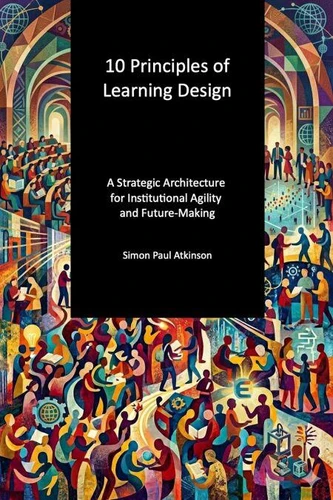
10 Principles of Learning Design: a strategic architecture for institutional agility and future-making
Par :Formats :
Disponible dans votre compte client Decitre ou Furet du Nord dès validation de votre commande. Le format ePub protégé est :
- Compatible avec une lecture sur My Vivlio (smartphone, tablette, ordinateur)
- Compatible avec une lecture sur liseuses Vivlio
- Pour les liseuses autres que Vivlio, vous devez utiliser le logiciel Adobe Digital Edition. Non compatible avec la lecture sur les liseuses Kindle, Remarkable et Sony
- Non compatible avec un achat hors France métropolitaine
 , qui est-ce ?
Notre partenaire de plateforme de lecture numérique où vous retrouverez l'ensemble de vos ebooks gratuitement
Pour en savoir plus sur nos ebooks, consultez notre aide en ligne ici
C'est si simple ! Lisez votre ebook avec l'app Vivlio sur votre tablette, mobile ou ordinateur :

- FormatePub
- ISBN978-1-0672789-3-9
- EAN9781067278939
- Date de parution07/05/2026
- Protection num.Adobe DRM
- Infos supplémentairesepub
- ÉditeurSimon Paul Atkinson
Résumé
Transform Your Curriculum for the Future of Higher EducationIn an era of rapid technological disruption and artificial intelligence, the half-life of learned professional skills has shrunk to roughly five years. The traditional model of retrospective design-teaching exactly as we were taught-is simply no longer viable. Higher education must pivot away from static, monolithic degree programmes toward dynamic, adaptable learning ecosystems.
In 10 Principles of Learning Design: A Strategic Architecture for Institutional Agility and Future-Making, Dr Simon Paul Atkinson provides a comprehensive, reflective framework to navigate the complex needs of modern tertiary education. Drawing on nearly 30 years of experience in educational strategy and curriculum design, Simon offers a practical guide to transforming learning design from a reactive administrative task into an active, multi-stakeholder act of "future-making".
This book equips educational designers and institutional leaders to move beyond mere content delivery, helping them architect pathways that foster lifelong learning and essential transversal skills. The framework systematically explores ten evidence-based principles structured around three urgent strategic needs: Pedagogical Foundations: Master constructive alignment, mitigate "expert blindness" by harnessing authoritative industry voices, and embed deeply culturally responsive learning that acts as "mirrors and windows" for diverse students.
Learner Agency & Application: Prioritise the learner's specific context over generalised cohort assumptions, navigate digital futures by debunking the "digital native" myth, design applied learning for social and vocational advancement, and foster true learner autonomy. Future-Proofing & Systems: Anticipate the evolving nature of work through formal horizon scanning, engineer courses with proactive learning analytics, and adopt Curriculum Lifecycle Management (CLM) to strategically renew and reuse learning objects.
Written as a constructive guide rather than a theoretical polemic, this volume is designed for immediate, practical application. Every principle includes ready-to-use workshop outlines and reflective questions, making it an invaluable tool for team sprints, departmental strategy sessions, and continuous curriculum improvement. Who is this book for? This is an essential resource for Senior Instructional Designers, Learning Designers, Heads of Learning Development, Subject Matter Experts (SMEs), Curriculum Managers, and University Leadership, particularly Pro-Vice-Chancellors of Learning and Teaching.
If your goal is to lay the groundwork to guard against obsolescence and ensure your institution's teaching strategy is grounded in evidence-based practice, this framework will serve as your blueprint for ongoing pedagogical excellence.
In 10 Principles of Learning Design: A Strategic Architecture for Institutional Agility and Future-Making, Dr Simon Paul Atkinson provides a comprehensive, reflective framework to navigate the complex needs of modern tertiary education. Drawing on nearly 30 years of experience in educational strategy and curriculum design, Simon offers a practical guide to transforming learning design from a reactive administrative task into an active, multi-stakeholder act of "future-making".
This book equips educational designers and institutional leaders to move beyond mere content delivery, helping them architect pathways that foster lifelong learning and essential transversal skills. The framework systematically explores ten evidence-based principles structured around three urgent strategic needs: Pedagogical Foundations: Master constructive alignment, mitigate "expert blindness" by harnessing authoritative industry voices, and embed deeply culturally responsive learning that acts as "mirrors and windows" for diverse students.
Learner Agency & Application: Prioritise the learner's specific context over generalised cohort assumptions, navigate digital futures by debunking the "digital native" myth, design applied learning for social and vocational advancement, and foster true learner autonomy. Future-Proofing & Systems: Anticipate the evolving nature of work through formal horizon scanning, engineer courses with proactive learning analytics, and adopt Curriculum Lifecycle Management (CLM) to strategically renew and reuse learning objects.
Written as a constructive guide rather than a theoretical polemic, this volume is designed for immediate, practical application. Every principle includes ready-to-use workshop outlines and reflective questions, making it an invaluable tool for team sprints, departmental strategy sessions, and continuous curriculum improvement. Who is this book for? This is an essential resource for Senior Instructional Designers, Learning Designers, Heads of Learning Development, Subject Matter Experts (SMEs), Curriculum Managers, and University Leadership, particularly Pro-Vice-Chancellors of Learning and Teaching.
If your goal is to lay the groundwork to guard against obsolescence and ensure your institution's teaching strategy is grounded in evidence-based practice, this framework will serve as your blueprint for ongoing pedagogical excellence.