Amateur astronomer and holder of a university diploma in Astronomy and Astrophysics, Olivier Garde is involved in numerous spectroscopy projects and helped found the 2SPOT association (spectral observations from Chile) and STAROS Projects (spectral database and design of a spectroheliograph, the SUNSCAN). He is also one of the validators of the BeSS spectral database at the Paris-Meudon Observatory and co-author of numerous scientific publications.
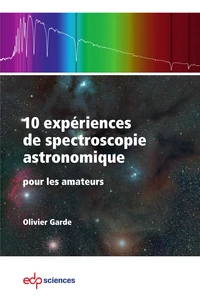
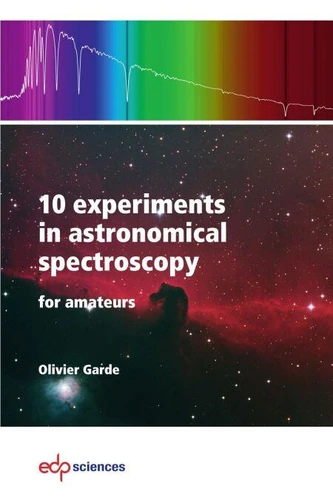
10 experiments in astronomical spectroscopy. for amateurs
Par :Formats :
Disponible dans votre compte client Decitre ou Furet du Nord dès validation de votre commande. Le format PDF est :
- Compatible avec une lecture sur My Vivlio (smartphone, tablette, ordinateur)
- Compatible avec une lecture sur liseuses Vivlio
- Pour les liseuses autres que Vivlio, vous devez utiliser le logiciel Adobe Digital Edition. Non compatible avec la lecture sur les liseuses Kindle, Remarkable et Sony
 , qui est-ce ?
Notre partenaire de plateforme de lecture numérique où vous retrouverez l'ensemble de vos ebooks gratuitement
Pour en savoir plus sur nos ebooks, consultez notre aide en ligne ici
C'est si simple ! Lisez votre ebook avec l'app Vivlio sur votre tablette, mobile ou ordinateur :

- Nombre de pages306
- FormatPDF
- ISBN978-2-7598-4010-6
- EAN9782759840106
- Date de parution04/05/2026
- Protection num.Digital Watermarking
- Taille67 Mo
- Infos supplémentairespdf
- ÉditeurEDP Sciences
Résumé
The field of investigation of astronomical spectroscopy is vast and can provide a wealth of information about the celestial objects observed (Planets, stars, nebulae, novae, supernovae, galaxies, quasars) through the light they emit. Indeed, this light can be broken down into an atomic spectrum, and based on its analysis and current knowledge of physics, it is possible to determine various characteristics of the star being studied.
This book presents methods and tools used for spectrum analysis and covers topics such as: - the measurement of velocity (radial, orbital, rotational, redshift), - the evolution over time in certain spectral lines, - the explosion of a nova or supernova, - the physical nature of an object (is it a planetary nebula? Is it a galaxy?). Spectroscopy also allows for the reconstruction of an image by digitizing the surface of a planetary nebula at a given wavelength.
It is also possible to estimate the temperature of a star and even evaluate its density. For each chapter, the author indicates the type of equipment to be used (optics, camera, spectrograph) and explains step-by-step the methodology for producing the necessary data (acquisition, data processing, etc.) using ten concrete examples that the author has tested himself. This book is intended for amateur astronomers who are curious to learn what can be gleaned from a spectrum so that they can then make their own observations and analyses sometimes rivaling those of professionals!
This book presents methods and tools used for spectrum analysis and covers topics such as: - the measurement of velocity (radial, orbital, rotational, redshift), - the evolution over time in certain spectral lines, - the explosion of a nova or supernova, - the physical nature of an object (is it a planetary nebula? Is it a galaxy?). Spectroscopy also allows for the reconstruction of an image by digitizing the surface of a planetary nebula at a given wavelength.
It is also possible to estimate the temperature of a star and even evaluate its density. For each chapter, the author indicates the type of equipment to be used (optics, camera, spectrograph) and explains step-by-step the methodology for producing the necessary data (acquisition, data processing, etc.) using ten concrete examples that the author has tested himself. This book is intended for amateur astronomers who are curious to learn what can be gleaned from a spectrum so that they can then make their own observations and analyses sometimes rivaling those of professionals!