Dernière sortie
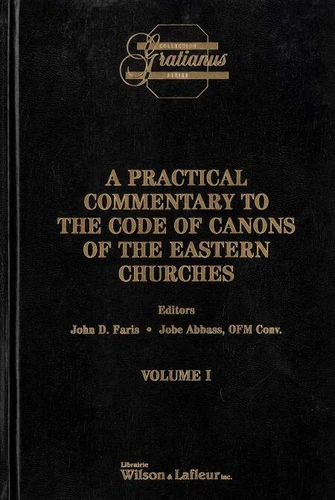
A Practical Commentary to the Code of Canons of the Eastern Churches
The two-volume A Practical Commentary on the Code of Canons of the Eastern Churches is the work of canonists and experts of the Eastern and Latin Churches. The editors are two well-known canonists, John D. Faris and Jobe Abbass, OFM Conv.
The work provides both the Latin and English translation of the 1990 Codex Canonum Eccle-siarum Orientalium and the updates of the 2015 Mitis et Misericors Iesus and takes into account the provisions of the 2016 De Concordia inter Codices.
English translations of documents relevant to the promulgation of the Eastern Code are included. Along with a canon-by-canon commentary, the Practical Commentary includes references to Nuntia and the iter of each canon, tables of corresponding canons, an analytical index, and a table indicating the sources re-ferred to in the Code. Canon law is the norm of conduct and procedure in the Church sanctioned by custom or competent authority.
The terms "canon, " "canon law, " "ecclesiastical canon, " etc. occur already in the corpus of the twenty canons of the first ecumenical council of Nicea, which defined the dogma of the divinity of Jesus Christ. This shows that faith and law go hand in hand in the life of the Church, which involves a life in conformity with faith. In fact before the close of the ninth century the universal Church had a corpus of 786 canons, which grew differently in the West and in the East.
In the West, the Pio-Benedictine code of 1917 contained 2414 canons and its postconciliar revision of 1983 has 1752 canons, whereas the 1990 Code of Canons of the Eastern Churches contains 1546 canons.
English translations of documents relevant to the promulgation of the Eastern Code are included. Along with a canon-by-canon commentary, the Practical Commentary includes references to Nuntia and the iter of each canon, tables of corresponding canons, an analytical index, and a table indicating the sources re-ferred to in the Code. Canon law is the norm of conduct and procedure in the Church sanctioned by custom or competent authority.
The terms "canon, " "canon law, " "ecclesiastical canon, " etc. occur already in the corpus of the twenty canons of the first ecumenical council of Nicea, which defined the dogma of the divinity of Jesus Christ. This shows that faith and law go hand in hand in the life of the Church, which involves a life in conformity with faith. In fact before the close of the ninth century the universal Church had a corpus of 786 canons, which grew differently in the West and in the East.
In the West, the Pio-Benedictine code of 1917 contained 2414 canons and its postconciliar revision of 1983 has 1752 canons, whereas the 1990 Code of Canons of the Eastern Churches contains 1546 canons.