- Accueil /
- Julie Martin
Julie Martin

Dernière sortie
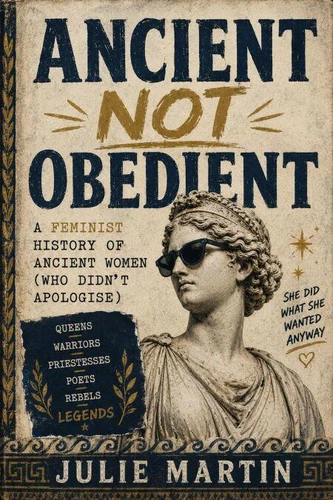
Ancient not Obedient
History has always had women in it. We just kept losing them. Meet the women history forgot, ignored, misunderstood-or, in some cases, deliberately made sound like complete nightmares. From the queens of ancient Egypt to the philosophers of Greece, the schemers of Rome, the warriors of Britain and the powerful women of Persia and beyond, Ancient, Not Obedient drags the women of the ancient world out from behind the footnotes and puts them firmly centre stage.
There's Hatshepsut, who basically said, "Fine, I'll be pharaoh then." Hypatia, the brilliant scholar who became a symbol of everything women were apparently not supposed to be. Boudicca, who went to war with Rome. Livia Drusilla, who understood that sometimes the smartest person in the room is the one quietly running it. And women such as Enheduanna, Fu Hao and Amanirenas, whose achievements deserve considerably more attention than they usually get.
And then there are the legendary women: Medusa, Helen of Troy, Isis, the Queen of Sheba and others whose stories have been retold so many times that the woman at the centre of the myth has sometimes disappeared completely. These aren't tales of perfect feminist heroines. Ancient women could be ambitious, brilliant, ruthless, compassionate, manipulative, courageous, complicated-and occasionally spectacularly bad at making sensible life choices.
In other words, they were human. Written with rigorous historical research, irreverent British humour and the occasional "are you actually kidding me?" moment, Ancient, Not Obedient asks why so many powerful women have been reduced to temptresses, monsters, victims or saints while the men around them got to be remembered as "great". Because history isn't just about what happened. It's about who got to tell the story afterwards.
So forget the dusty old image of ancient history as a parade of bearded men in sandals arguing about democracy. The women were there. They were ruling kingdoms, writing poetry, commanding armies, practising medicine, shaping politics, challenging philosophers, running households, breaking rules and occasionally causing an absolutely enormous amount of trouble. They weren't obedient. They were ancient.
And it's about bloody time we remembered them.
There's Hatshepsut, who basically said, "Fine, I'll be pharaoh then." Hypatia, the brilliant scholar who became a symbol of everything women were apparently not supposed to be. Boudicca, who went to war with Rome. Livia Drusilla, who understood that sometimes the smartest person in the room is the one quietly running it. And women such as Enheduanna, Fu Hao and Amanirenas, whose achievements deserve considerably more attention than they usually get.
And then there are the legendary women: Medusa, Helen of Troy, Isis, the Queen of Sheba and others whose stories have been retold so many times that the woman at the centre of the myth has sometimes disappeared completely. These aren't tales of perfect feminist heroines. Ancient women could be ambitious, brilliant, ruthless, compassionate, manipulative, courageous, complicated-and occasionally spectacularly bad at making sensible life choices.
In other words, they were human. Written with rigorous historical research, irreverent British humour and the occasional "are you actually kidding me?" moment, Ancient, Not Obedient asks why so many powerful women have been reduced to temptresses, monsters, victims or saints while the men around them got to be remembered as "great". Because history isn't just about what happened. It's about who got to tell the story afterwards.
So forget the dusty old image of ancient history as a parade of bearded men in sandals arguing about democracy. The women were there. They were ruling kingdoms, writing poetry, commanding armies, practising medicine, shaping politics, challenging philosophers, running households, breaking rules and occasionally causing an absolutely enormous amount of trouble. They weren't obedient. They were ancient.
And it's about bloody time we remembered them.
History has always had women in it. We just kept losing them. Meet the women history forgot, ignored, misunderstood-or, in some cases, deliberately made sound like complete nightmares. From the queens of ancient Egypt to the philosophers of Greece, the schemers of Rome, the warriors of Britain and the powerful women of Persia and beyond, Ancient, Not Obedient drags the women of the ancient world out from behind the footnotes and puts them firmly centre stage.
There's Hatshepsut, who basically said, "Fine, I'll be pharaoh then." Hypatia, the brilliant scholar who became a symbol of everything women were apparently not supposed to be. Boudicca, who went to war with Rome. Livia Drusilla, who understood that sometimes the smartest person in the room is the one quietly running it. And women such as Enheduanna, Fu Hao and Amanirenas, whose achievements deserve considerably more attention than they usually get.
And then there are the legendary women: Medusa, Helen of Troy, Isis, the Queen of Sheba and others whose stories have been retold so many times that the woman at the centre of the myth has sometimes disappeared completely. These aren't tales of perfect feminist heroines. Ancient women could be ambitious, brilliant, ruthless, compassionate, manipulative, courageous, complicated-and occasionally spectacularly bad at making sensible life choices.
In other words, they were human. Written with rigorous historical research, irreverent British humour and the occasional "are you actually kidding me?" moment, Ancient, Not Obedient asks why so many powerful women have been reduced to temptresses, monsters, victims or saints while the men around them got to be remembered as "great". Because history isn't just about what happened. It's about who got to tell the story afterwards.
So forget the dusty old image of ancient history as a parade of bearded men in sandals arguing about democracy. The women were there. They were ruling kingdoms, writing poetry, commanding armies, practising medicine, shaping politics, challenging philosophers, running households, breaking rules and occasionally causing an absolutely enormous amount of trouble. They weren't obedient. They were ancient.
And it's about bloody time we remembered them.
There's Hatshepsut, who basically said, "Fine, I'll be pharaoh then." Hypatia, the brilliant scholar who became a symbol of everything women were apparently not supposed to be. Boudicca, who went to war with Rome. Livia Drusilla, who understood that sometimes the smartest person in the room is the one quietly running it. And women such as Enheduanna, Fu Hao and Amanirenas, whose achievements deserve considerably more attention than they usually get.
And then there are the legendary women: Medusa, Helen of Troy, Isis, the Queen of Sheba and others whose stories have been retold so many times that the woman at the centre of the myth has sometimes disappeared completely. These aren't tales of perfect feminist heroines. Ancient women could be ambitious, brilliant, ruthless, compassionate, manipulative, courageous, complicated-and occasionally spectacularly bad at making sensible life choices.
In other words, they were human. Written with rigorous historical research, irreverent British humour and the occasional "are you actually kidding me?" moment, Ancient, Not Obedient asks why so many powerful women have been reduced to temptresses, monsters, victims or saints while the men around them got to be remembered as "great". Because history isn't just about what happened. It's about who got to tell the story afterwards.
So forget the dusty old image of ancient history as a parade of bearded men in sandals arguing about democracy. The women were there. They were ruling kingdoms, writing poetry, commanding armies, practising medicine, shaping politics, challenging philosophers, running households, breaking rules and occasionally causing an absolutely enormous amount of trouble. They weren't obedient. They were ancient.
And it's about bloody time we remembered them.
