Dernière sortie
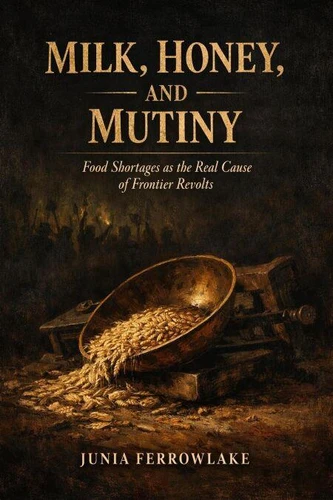
Milk, Honey, And Mutiny: Food Shortages as the Real Cause of Frontier Revolts
Every revolt in this book started the same way. Not with a manifesto. Not with a battle cry. With a scale, a granary, and a number that would not add up. In 1524, a countess asked her peasants to leave the harvest and gather snail shells for her thread spools. Within months, three hundred thousand people across the German lands were at war. In 1786, a Massachusetts farmer who had fought at Bunker Hill sold his ceremonial sword to survive a winter his own government would not forgive him for.
In 1794, thirteen thousand soldiers marched into the Pennsylvania hills to put down a tax revolt that was never really about tax at all. It was about a mountain no wagon of grain could cross without a loss. And in 1917, a line of women standing in the Petrograd cold for a loaf of bread that never came brought down three hundred years of the Romanov throne in a single week. History calls these four events a peasant war, a rebellion, a whiskey tax dispute, and a revolution.
This book calls them what the ledgers actually show: four different names for the same hunger. Milk, Honey, and Mutiny follows the empty granaries, failed harvests, and impossible arithmetic that toppled thrones and armed farmers long before any flag was raised or any ideology was named. It walks the tithe barns of Swabia, the debt courts of New England, the whiskey stills of the Alleghenies, and the bread queues of a dying empire, and it does not stop there.
It follows the same pattern into Rome, where an emperor built an entire government function just to keep a hungry capital from turning on him, and into the present day, where a single wheat shortage in 2010 rippled across an ocean and toppled a government within weeks. This is not a dry economic history. It reads like the thriller it actually was for the people living through it: farmers doing midnight arithmetic over a half empty barn, a treasury secretary who never once set foot on the mountain road he was taxing, a tsar who lost an empire because the bread simply did not arrive on time.
Every chapter is built from real historical records, real numbers, real courts, and real casualties, and every chapter asks the same question a hungry household has always asked first, before any ideology arrives to explain it to them: how much is left, and what happens when it runs out. By the final page, you will not be able to read about a bread shortage, a grain export ban, or a currency collapse in the news the same way again.
You will see the granary underneath the headline. And you will understand, in your bones, why the people who ran out of patience first were never the ones with the loudest slogans. They were the ones who had already done the math.
In 1794, thirteen thousand soldiers marched into the Pennsylvania hills to put down a tax revolt that was never really about tax at all. It was about a mountain no wagon of grain could cross without a loss. And in 1917, a line of women standing in the Petrograd cold for a loaf of bread that never came brought down three hundred years of the Romanov throne in a single week. History calls these four events a peasant war, a rebellion, a whiskey tax dispute, and a revolution.
This book calls them what the ledgers actually show: four different names for the same hunger. Milk, Honey, and Mutiny follows the empty granaries, failed harvests, and impossible arithmetic that toppled thrones and armed farmers long before any flag was raised or any ideology was named. It walks the tithe barns of Swabia, the debt courts of New England, the whiskey stills of the Alleghenies, and the bread queues of a dying empire, and it does not stop there.
It follows the same pattern into Rome, where an emperor built an entire government function just to keep a hungry capital from turning on him, and into the present day, where a single wheat shortage in 2010 rippled across an ocean and toppled a government within weeks. This is not a dry economic history. It reads like the thriller it actually was for the people living through it: farmers doing midnight arithmetic over a half empty barn, a treasury secretary who never once set foot on the mountain road he was taxing, a tsar who lost an empire because the bread simply did not arrive on time.
Every chapter is built from real historical records, real numbers, real courts, and real casualties, and every chapter asks the same question a hungry household has always asked first, before any ideology arrives to explain it to them: how much is left, and what happens when it runs out. By the final page, you will not be able to read about a bread shortage, a grain export ban, or a currency collapse in the news the same way again.
You will see the granary underneath the headline. And you will understand, in your bones, why the people who ran out of patience first were never the ones with the loudest slogans. They were the ones who had already done the math.