Dernière sortie
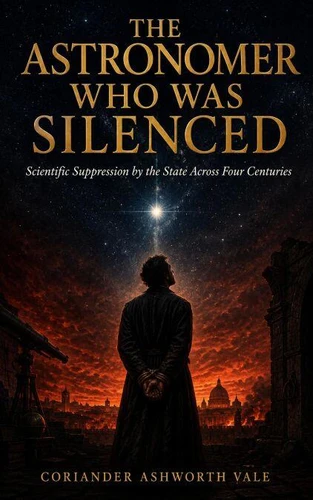
The Astronomer Who Was Silenced: Scientific Suppression by the State Across Four Centuries
He would not recant. So they bound his tongue and burned him alive in a Roman square in 1600, and for four centuries afterward, the men who came after him learned exactly what happens to a mind that refuses to shrink the universe to fit someone else's comfort. This is the story that history keeps trying to forget: the astronomers, physicists, and stargazers who were tried, exiled, imprisoned, erased, and in some cases assassinated, not for getting the science wrong, but for getting it right in front of the wrong audience.
From Giordano Bruno's stake and Galileo's forced confession, through a German eclipse expedition swallowed by the outbreak of the First World War, into Stalin's purge of an entire observatory, a Soviet genius who did his calculations from memory inside a labor camp, a rocket engineer so successful his own government hid his face from the world, a Chinese cosmologist who taught himself general relativity by lamplight in a coal mine, a nation that spent forty years making sure its own people could never become scientists at all, and a NASA researcher whose press interviews needed a stranger's permission before he could speak, this book follows the same battle across four centuries and five continents: the sky against the state.
You will meet a friar too stubborn to lie his way off the pyre. A rocket designer who launched the Soviet Union into orbit and never got to hear his own name spoken in public. A physicist who survived Mao's Cultural Revolution and later hid inside the American embassy in Beijing rather than be taken. A telescope built specifically to give a persecuted people their first astronomers in a hundred years.
None of it reads like a textbook. It reads like the true story it is, because these people lived it, paid for it, and in several unforgettable cases, won anyway. What makes this book different is what it refuses to do. It will not hand you a clean parade of martyrs and villains. It shows you the real trials, the real documents, the real politics, including the moments when the history is messier and more human than the legend, because a book about the cost of comfortable lies owes its reader the truth in full.
Every figure in these pages is real. Every date, every document, every death is drawn from the historical record, not invented for effect. By the final page you will understand something that never quite makes it into ordinary science writing: that looking up at the night sky has never been a neutral act, that the truth about the universe has been paid for in prison sentences and burned tongues and stolen decades far more often than comfortable history likes to admit, and that the people who paid it were not saints.
They were stubborn, brilliant, difficult, frightened, and astonishingly brave, all at once, exactly like anyone would have to be to keep telling the truth about the stars when the most powerful people on Earth needed them to stop. If you have ever wondered what it actually costs to say something true when the truth is inconvenient to power, this book will not let you look away. Read the first chapter.
You will not want to stop until the last page.
From Giordano Bruno's stake and Galileo's forced confession, through a German eclipse expedition swallowed by the outbreak of the First World War, into Stalin's purge of an entire observatory, a Soviet genius who did his calculations from memory inside a labor camp, a rocket engineer so successful his own government hid his face from the world, a Chinese cosmologist who taught himself general relativity by lamplight in a coal mine, a nation that spent forty years making sure its own people could never become scientists at all, and a NASA researcher whose press interviews needed a stranger's permission before he could speak, this book follows the same battle across four centuries and five continents: the sky against the state.
You will meet a friar too stubborn to lie his way off the pyre. A rocket designer who launched the Soviet Union into orbit and never got to hear his own name spoken in public. A physicist who survived Mao's Cultural Revolution and later hid inside the American embassy in Beijing rather than be taken. A telescope built specifically to give a persecuted people their first astronomers in a hundred years.
None of it reads like a textbook. It reads like the true story it is, because these people lived it, paid for it, and in several unforgettable cases, won anyway. What makes this book different is what it refuses to do. It will not hand you a clean parade of martyrs and villains. It shows you the real trials, the real documents, the real politics, including the moments when the history is messier and more human than the legend, because a book about the cost of comfortable lies owes its reader the truth in full.
Every figure in these pages is real. Every date, every document, every death is drawn from the historical record, not invented for effect. By the final page you will understand something that never quite makes it into ordinary science writing: that looking up at the night sky has never been a neutral act, that the truth about the universe has been paid for in prison sentences and burned tongues and stolen decades far more often than comfortable history likes to admit, and that the people who paid it were not saints.
They were stubborn, brilliant, difficult, frightened, and astonishingly brave, all at once, exactly like anyone would have to be to keep telling the truth about the stars when the most powerful people on Earth needed them to stop. If you have ever wondered what it actually costs to say something true when the truth is inconvenient to power, this book will not let you look away. Read the first chapter.
You will not want to stop until the last page.