Dernière sortie
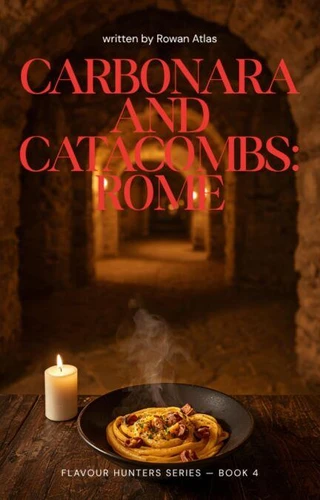
Carbonara and Catacombs: Rome
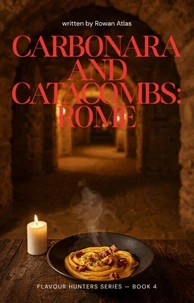
Four cities in, Pippa Henley and Pieter Doderlein have learned to recognize the particular hush that falls over a kitchen when a story is about to become something more than food. In Rome, that hush arrives at Trattoria Conti, a small family restaurant tucked near Trastevere, where twelve-year-old Giulia Conti and her grandmother, Nonna Carmela, are quietly preparing for the biggest week of the family's entire history: their hundredth anniversary.
It should be a celebration. Instead, it's a crisis. The Conti family's carbonara, rich, silken, made with a technique passed down since the trattoria's founding, has always been the restaurant's proudest claim to authenticity. But the original recipe notebook, the one that could prove the family's version predates the more commonly told postwar origin story, has been missing since the Second World War, hidden somewhere in Rome's ancient catacombs during the chaos of a bombing raid and never recovered.
Worse, a prominent, sharp-tongued food critic has just published a very public, very confident piece calling the Conti family's whole hundred-year story into question, suggesting none too gently, that Nonna Carmela's cherished history might be exactly that: a story, rather than a fact. For a family built on memory, pride, and one very old skillet, the accusation cuts deep. And so, for the first time in the whole series, Pippa and Pieter's food adventure becomes something else entirely: an actual treasure hunt, leading them down into Rome's vast, echoing underground world of catacombs, armed with fragments of an old letter, a historian's careful expertise, and Giulia's own increasingly desperate hope that her family's truth is still down there somewhere, waiting to be found.
Along the way, the group works their way through Rome at its most delicious and most historically layered, a masterclass in proper carbonara technique from Giulia's mother Elena, a reverent pilgrimage to Roscioli for the dish done exactly right, gelato from Giolitti eaten strategically between search expeditions, and long, patient conversations with Professor Ricci, a historian who helps them properly understand carbonara's real, genuinely disputed origins: is it an old shepherd's dish, built from simple, portable ingredients? Or did it take its now-familiar shape only after the Second World War, when American soldiers' rations of bacon and powdered eggs collided with Roman kitchens for the very first time? Nobody, it turns out, not even the experts, is entirely certain, and that uncertainty becomes the story's true, beating heart.
It should be a celebration. Instead, it's a crisis. The Conti family's carbonara, rich, silken, made with a technique passed down since the trattoria's founding, has always been the restaurant's proudest claim to authenticity. But the original recipe notebook, the one that could prove the family's version predates the more commonly told postwar origin story, has been missing since the Second World War, hidden somewhere in Rome's ancient catacombs during the chaos of a bombing raid and never recovered.
Worse, a prominent, sharp-tongued food critic has just published a very public, very confident piece calling the Conti family's whole hundred-year story into question, suggesting none too gently, that Nonna Carmela's cherished history might be exactly that: a story, rather than a fact. For a family built on memory, pride, and one very old skillet, the accusation cuts deep. And so, for the first time in the whole series, Pippa and Pieter's food adventure becomes something else entirely: an actual treasure hunt, leading them down into Rome's vast, echoing underground world of catacombs, armed with fragments of an old letter, a historian's careful expertise, and Giulia's own increasingly desperate hope that her family's truth is still down there somewhere, waiting to be found.
Along the way, the group works their way through Rome at its most delicious and most historically layered, a masterclass in proper carbonara technique from Giulia's mother Elena, a reverent pilgrimage to Roscioli for the dish done exactly right, gelato from Giolitti eaten strategically between search expeditions, and long, patient conversations with Professor Ricci, a historian who helps them properly understand carbonara's real, genuinely disputed origins: is it an old shepherd's dish, built from simple, portable ingredients? Or did it take its now-familiar shape only after the Second World War, when American soldiers' rations of bacon and powdered eggs collided with Roman kitchens for the very first time? Nobody, it turns out, not even the experts, is entirely certain, and that uncertainty becomes the story's true, beating heart.