SOLDES
Jusqu'à -70% sur une sélection d'articles*
Dernière sortie
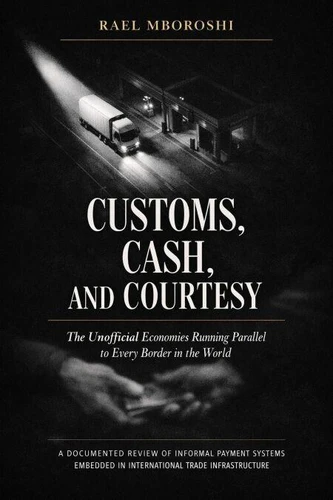
Customs, Cash, and Courtesy: The Unofficial Economies Running Parallel to Every Border in the World
Every border in the world runs on two economies. One is official, documented, and taxed. The other is not. This is the book about the second one. When a truck driver in West Africa approaches a customs checkpoint with thirty-seven more to cross before he reaches his destination, he does not think about trade law. He thinks about what the officer at the window will accept and how quickly the negotiation will go.
When a freight forwarder in Lagos clears a container through Apapa port, she builds two cost estimates: what the government charges, and what the system actually costs. When a pharmaceutical shipment meant for HIV patients sits in a bonded warehouse for six weeks because the documentation dispute will resolve faster with a payment than without, the people who suffer are not the bureaucrats exchanging the paperwork.
Customs, Cash, and Courtesy is a forensic investigation of the informal payment systems embedded in international trade infrastructure across every region of the world. Drawing on interviews conducted in fourteen countries, court records from anti-corruption prosecutions on five continents, leaked customs data, and the kind of frank conversation that only happens off the record, investigative journalist Rael Mboroshi traces these parallel economies from their ancient origins in Assyrian trading colonies to their twenty-first-century digital mutations.
The book moves continent by continent: the checkpoint culture of West Africa, where World Bank research documented thirty-seven informal payments on a single commercial route; the layered port politics of Nigeria's Apapa terminal and Ghana's Tema port, where unofficial fees have developed their own specialized vocabulary; the post-Soviet institutional inheritance that turned customs services into informal revenue machines across Eastern Europe; the wasta networks of the Middle East, where social obligation and commercial inducement have always occupied the same space; and the technology paradox of customs modernization, where electronic filing systems intended to eliminate corruption have in documented cases simply relocated it.
The hidden victims are not multinationals. They are the women traders of East Africa who lose entire perishable shipments to clearance delays they cannot afford to resolve. They are the smallholder farmers priced out of export markets by unofficial costs that fall hardest on those least equipped to absorb them. They are the patients whose medicines sit in warehouses while the paperwork finds its own resolution.
This is not a book that ends in despair. Georgia dismantled its customs service and rebuilt it clean inside a decade. Rwanda transformed one of Africa's most corrupt port environments into a regional benchmark. Estonia, Latvia, and Lithuania proved that post-Soviet institutional culture is not destiny. The conditions for genuine reform exist and are documented here. But first you have to see the system clearly.
This book makes that impossible to avoid.
When a freight forwarder in Lagos clears a container through Apapa port, she builds two cost estimates: what the government charges, and what the system actually costs. When a pharmaceutical shipment meant for HIV patients sits in a bonded warehouse for six weeks because the documentation dispute will resolve faster with a payment than without, the people who suffer are not the bureaucrats exchanging the paperwork.
Customs, Cash, and Courtesy is a forensic investigation of the informal payment systems embedded in international trade infrastructure across every region of the world. Drawing on interviews conducted in fourteen countries, court records from anti-corruption prosecutions on five continents, leaked customs data, and the kind of frank conversation that only happens off the record, investigative journalist Rael Mboroshi traces these parallel economies from their ancient origins in Assyrian trading colonies to their twenty-first-century digital mutations.
The book moves continent by continent: the checkpoint culture of West Africa, where World Bank research documented thirty-seven informal payments on a single commercial route; the layered port politics of Nigeria's Apapa terminal and Ghana's Tema port, where unofficial fees have developed their own specialized vocabulary; the post-Soviet institutional inheritance that turned customs services into informal revenue machines across Eastern Europe; the wasta networks of the Middle East, where social obligation and commercial inducement have always occupied the same space; and the technology paradox of customs modernization, where electronic filing systems intended to eliminate corruption have in documented cases simply relocated it.
The hidden victims are not multinationals. They are the women traders of East Africa who lose entire perishable shipments to clearance delays they cannot afford to resolve. They are the smallholder farmers priced out of export markets by unofficial costs that fall hardest on those least equipped to absorb them. They are the patients whose medicines sit in warehouses while the paperwork finds its own resolution.
This is not a book that ends in despair. Georgia dismantled its customs service and rebuilt it clean inside a decade. Rwanda transformed one of Africa's most corrupt port environments into a regional benchmark. Estonia, Latvia, and Lithuania proved that post-Soviet institutional culture is not destiny. The conditions for genuine reform exist and are documented here. But first you have to see the system clearly.
This book makes that impossible to avoid.