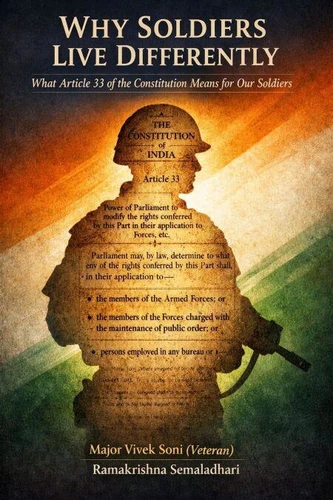
Why Soldiers Live Differently explores a question that many citizens have asked but few books have answered: Why do members of the armed forces live under rules that differ from those governing civilian life?Written by veteran Major Vivek Soni and law scholar Ramakrishna Semaladhari, this book combines lived military experience with constitutional analysis to explain the unique legal and professional framework that governs India's armed forces.
At its heart is Article 33 of the Constitution of India, a provision that empowers Parliament to modify the application of certain fundamental rights to ensure discipline, operational effectiveness, and national security. Through personal experiences, real-life military reflections, constitutional principles, landmark Supreme Court judgments, and an accessible explanation of military law, the authors bridge the gap between military service and civilian understanding.
The book examines the transformation from civilian to soldier, the meaning of discipline, the realities of service in difficult environments, the role of military families, professionalism, command responsibility, military justice, life after the uniform, and the constitutional balance between liberty and responsibility. Designed for general readers, law students, defence aspirants, public policy professionals, veterans, and anyone interested in India's constitutional framework, this book presents complex legal concepts in clear, engaging language without sacrificing depth or accuracy.
More than a book about soldiers, it is a book about the Constitution, the rule of law, public service, and the enduring relationship between freedom and responsibility in a democratic nation.
Why Soldiers Live Differently explores a question that many citizens have asked but few books have answered: Why do members of the armed forces live under rules that differ from those governing civilian life?Written by veteran Major Vivek Soni and law scholar Ramakrishna Semaladhari, this book combines lived military experience with constitutional analysis to explain the unique legal and professional framework that governs India's armed forces.
At its heart is Article 33 of the Constitution of India, a provision that empowers Parliament to modify the application of certain fundamental rights to ensure discipline, operational effectiveness, and national security. Through personal experiences, real-life military reflections, constitutional principles, landmark Supreme Court judgments, and an accessible explanation of military law, the authors bridge the gap between military service and civilian understanding.
The book examines the transformation from civilian to soldier, the meaning of discipline, the realities of service in difficult environments, the role of military families, professionalism, command responsibility, military justice, life after the uniform, and the constitutional balance between liberty and responsibility. Designed for general readers, law students, defence aspirants, public policy professionals, veterans, and anyone interested in India's constitutional framework, this book presents complex legal concepts in clear, engaging language without sacrificing depth or accuracy.
More than a book about soldiers, it is a book about the Constitution, the rule of law, public service, and the enduring relationship between freedom and responsibility in a democratic nation.