Machine learning for cybersecurity, AI threat detection, and automated defense are the most sought-after skills in the modern security landscape. This practical, hands-on guide by Lena Fontaine takes you from beginner to pro, covering anomaly detection, phishing, malware classification, and building production-ready security models. You'll learn to detect threats and automate defense with machine learning, using real datasets and Python code.
[placeholder] and [placeholder] are among the few authors who have tackled this topic, but this book goes deeper into practical implementation. From setting up your environment to deploying models at scale, each chapter builds on the last. You'll start with core ML concepts and cybersecurity fundamentals, then dive into supervised and unsupervised learning for intrusion detection, email phishing filters, and malware family classification.
Advanced chapters cover ensemble methods, deep learning for network traffic analysis, and adversarial AI. By the end, you'll have a complete toolkit to build and evaluate your own defense systems. Whether you're a security analyst, data scientist, or developer, this book empowers you to stay ahead of evolving threats.
What You'll Learn
Implement anomaly detection for network traffic and user behavior
Build phishing classifiers using natural language processing and feature engineering
Classify malware with decision trees, random forests, and neural networks
Automate incident response with reinforcement learning and rule engines
Deploy models with Docker, Flask, and cloud services
Evaluate model performance with precision, recall, and ROC curves
With over 200 pages of code examples, case studies, and exercises, this is the definitive resource for applying AI to cyber defense.
Start your journey today and transform how you protect digital assets.
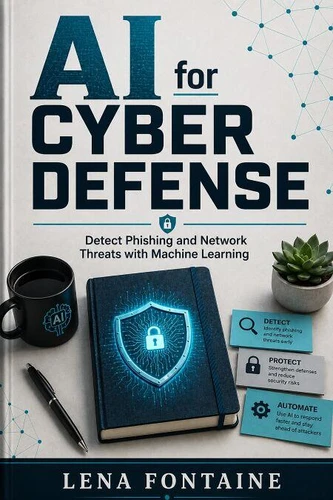
Machine learning for cybersecurity, AI threat detection, and automated defense are the most sought-after skills in the modern security landscape. This practical, hands-on guide by Lena Fontaine takes you from beginner to pro, covering anomaly detection, phishing, malware classification, and building production-ready security models. You'll learn to detect threats and automate defense with machine learning, using real datasets and Python code.
[placeholder] and [placeholder] are among the few authors who have tackled this topic, but this book goes deeper into practical implementation. From setting up your environment to deploying models at scale, each chapter builds on the last. You'll start with core ML concepts and cybersecurity fundamentals, then dive into supervised and unsupervised learning for intrusion detection, email phishing filters, and malware family classification.
Advanced chapters cover ensemble methods, deep learning for network traffic analysis, and adversarial AI. By the end, you'll have a complete toolkit to build and evaluate your own defense systems. Whether you're a security analyst, data scientist, or developer, this book empowers you to stay ahead of evolving threats.
What You'll Learn
Implement anomaly detection for network traffic and user behavior
Build phishing classifiers using natural language processing and feature engineering
Classify malware with decision trees, random forests, and neural networks
Automate incident response with reinforcement learning and rule engines
Deploy models with Docker, Flask, and cloud services
Evaluate model performance with precision, recall, and ROC curves
With over 200 pages of code examples, case studies, and exercises, this is the definitive resource for applying AI to cyber defense.
Start your journey today and transform how you protect digital assets.