Dernière sortie
THE SECOND FOUNDING
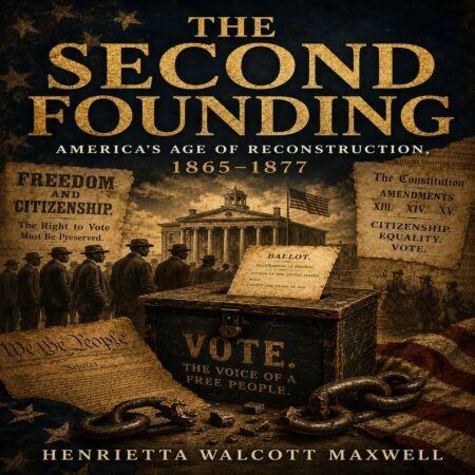
THE SECOND FOUNDING - Audiobook · Narrated by James Park.
?? Listen time: 6 hours 3 minutes
The complete narrative history of Reconstruction, 1865-1877 - the Fourteenth Amendment, Black political power, the Freedmen's Bureau, and the counterrevolution that buried America's unfinished revolution.
On January 1, 1863, the crowd at Camp Saxton, South Carolina - a contraband camp on the old Smith Plantation at Port Royal - erupted when the Emancipation Proclamation was read aloud.
Old men and women born into bondage began to sing "My Country 'Tis of Thee, " and Thomas Wentworth Higginson, commanding the First South Carolina Volunteers, the first Black regiment in the Union Army, could not make them stop. What came next was the most revolutionary period in American history, and the nation abandoned it. Henrietta Walcott Maxwell traces Reconstruction's full arc: from Andrew Johnson's 13, 500 pardons that restored Confederate land while 40, 000 freedpeople farmed Sea Island plots under Sherman's Special Field Order No.
15, through the Radical Republicans' constitutional revolution - Thaddeus Stevens, Charles Sumner, the Fourteenth Amendment, and the Fifteenth Amendment - to the Redeemer counterrevolution and the Compromise of 1877 that handed the South back to the men who had tried to destroy the Union. Inside this Reconstruction history: The promise denied - how Andrew Johnson issued 13, 500 pardons in 1865, restored confiscated land to former Confederates, and gave the former ruling class the two years it needed to reestablish control before Congress could act (Chapter 3) The Black Codes - Mississippi's vagrancy law that criminalized unemployment and handed convicted men to employers for up to a year; South Carolina's code that renamed enslaved people "servants" while preserving every mechanism of plantation labor (Chapter 4) Thaddeus Stevens's arithmetic - his September 1865 proposal to confiscate Confederate estates over 500 acres, give 40 acres to each freedman family, and sell the remainder for $4 billion in school funding - and why it failed (Chapter 5) Black political power - South Carolina's constitutional convention of 76 Black delegates out of 124, Robert Brown Elliott educated in England, Francis Cardozo educated at Glasgow; Mississippi registering 60, 167 Black voters against 46, 636 white in 1867 (Chapters 9, 7) The Fourteenth Amendment's long sleep - from the Slaughterhouse Cases (1873) and Plessy v.
Ferguson (1896) gutting its text, to Thurgood Marshall reaching for its equal protection clause in Brown v. Board (1954) (Chapter 6) The historians' reckoning - from William Dunning's "negro domination" myth to W. E. B. Du Bois's 1935 demolition in Black Reconstruction to Eric Foner's 1988 synthesis - how America forgot and remembered (Chapter 23) The Reconstruction Amendments - the Thirteenth, Fourteenth, and Fifteenth - survived the Redeemer counterrevolution as "sleeping giants, " available to every generation willing to use them.
The freedpeople built churches, schools, and mutual aid societies in a dozen years; those institutions outlasted Jim Crow and became the organizational infrastructure of the civil rights movement. Reconstruction was America's unfinished revolution. Its work is still unfinished. For listeners of the audiobook of Eric Foner's RECONSTRUCTION and Henry Louis Gates Jr.'s STONY THE ROAD.
Old men and women born into bondage began to sing "My Country 'Tis of Thee, " and Thomas Wentworth Higginson, commanding the First South Carolina Volunteers, the first Black regiment in the Union Army, could not make them stop. What came next was the most revolutionary period in American history, and the nation abandoned it. Henrietta Walcott Maxwell traces Reconstruction's full arc: from Andrew Johnson's 13, 500 pardons that restored Confederate land while 40, 000 freedpeople farmed Sea Island plots under Sherman's Special Field Order No.
15, through the Radical Republicans' constitutional revolution - Thaddeus Stevens, Charles Sumner, the Fourteenth Amendment, and the Fifteenth Amendment - to the Redeemer counterrevolution and the Compromise of 1877 that handed the South back to the men who had tried to destroy the Union. Inside this Reconstruction history: The promise denied - how Andrew Johnson issued 13, 500 pardons in 1865, restored confiscated land to former Confederates, and gave the former ruling class the two years it needed to reestablish control before Congress could act (Chapter 3) The Black Codes - Mississippi's vagrancy law that criminalized unemployment and handed convicted men to employers for up to a year; South Carolina's code that renamed enslaved people "servants" while preserving every mechanism of plantation labor (Chapter 4) Thaddeus Stevens's arithmetic - his September 1865 proposal to confiscate Confederate estates over 500 acres, give 40 acres to each freedman family, and sell the remainder for $4 billion in school funding - and why it failed (Chapter 5) Black political power - South Carolina's constitutional convention of 76 Black delegates out of 124, Robert Brown Elliott educated in England, Francis Cardozo educated at Glasgow; Mississippi registering 60, 167 Black voters against 46, 636 white in 1867 (Chapters 9, 7) The Fourteenth Amendment's long sleep - from the Slaughterhouse Cases (1873) and Plessy v.
Ferguson (1896) gutting its text, to Thurgood Marshall reaching for its equal protection clause in Brown v. Board (1954) (Chapter 6) The historians' reckoning - from William Dunning's "negro domination" myth to W. E. B. Du Bois's 1935 demolition in Black Reconstruction to Eric Foner's 1988 synthesis - how America forgot and remembered (Chapter 23) The Reconstruction Amendments - the Thirteenth, Fourteenth, and Fifteenth - survived the Redeemer counterrevolution as "sleeping giants, " available to every generation willing to use them.
The freedpeople built churches, schools, and mutual aid societies in a dozen years; those institutions outlasted Jim Crow and became the organizational infrastructure of the civil rights movement. Reconstruction was America's unfinished revolution. Its work is still unfinished. For listeners of the audiobook of Eric Foner's RECONSTRUCTION and Henry Louis Gates Jr.'s STONY THE ROAD.