OFFRE LISEUSES
Une liseuse achetée = une housse offerte* jusqu'au 21 juin
- Accueil /
- Digital Society
Digital Society

Dernière sortie
The Cognitive Disruption Loop
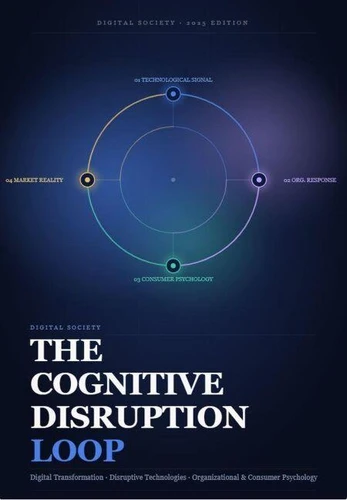
What really happens inside an organization when disruptive technology arrives? Why do intelligent executives ignore signals that, in hindsight, were obvious? And why do today's most empowered consumers report higher anxiety, lower trust, and deeper dissatisfaction than any previous generation?The Cognitive Disruption Loop answers these questions by connecting two bodies of knowledge that business literature almost never brings together: the organizational psychology of digital transformation and the behavioral psychology of the digital consumer.
Drawing on research from Daniel Kahneman's behavioral economics, Clayton Christensen's disruption theory, Ronald Heifetz's adaptive leadership framework, and Antonio Damasio's neuroscience of decision-making, this book builds an original framework for understanding why technological change consistently produces psychological resistance - at every level of the organization and in every dimension of consumer behavior.
Across eleven substantive chapters, Digital Society examines the five waves of digital transformation, the specific cognitive mechanisms through which companies practice structured avoidance of existential threats, the middle management problem that derails most transformation initiatives, the paradox of empowered helplessness that defines today's digital consumer, and the collapse of digital trust that is reshaping competitive dynamics across every industry.
The Cognitive Disruption Loop framework introduced in Chapter 10 gives leaders a practical diagnostic tool for identifying exactly where their organization is failing to adapt - and what type of intervention will actually work, as opposed to the expensive, well-intentioned transformation programs that the research shows fail approximately 70% of the time. This is not a book of generic best practices.
It is an honest, research-grounded account of what is actually happening when technology meets human psychology - in boardrooms, in organizational cultures, and in the lived experience of consumers navigating an increasingly complex digital world. For executives leading transformation initiatives, strategists mapping competitive disruption, marketers trying to build genuine consumer relationships, and anyone trying to understand why the digital age feels simultaneously more powerful and more exhausting than it was supposed to be.
Drawing on research from Daniel Kahneman's behavioral economics, Clayton Christensen's disruption theory, Ronald Heifetz's adaptive leadership framework, and Antonio Damasio's neuroscience of decision-making, this book builds an original framework for understanding why technological change consistently produces psychological resistance - at every level of the organization and in every dimension of consumer behavior.
Across eleven substantive chapters, Digital Society examines the five waves of digital transformation, the specific cognitive mechanisms through which companies practice structured avoidance of existential threats, the middle management problem that derails most transformation initiatives, the paradox of empowered helplessness that defines today's digital consumer, and the collapse of digital trust that is reshaping competitive dynamics across every industry.
The Cognitive Disruption Loop framework introduced in Chapter 10 gives leaders a practical diagnostic tool for identifying exactly where their organization is failing to adapt - and what type of intervention will actually work, as opposed to the expensive, well-intentioned transformation programs that the research shows fail approximately 70% of the time. This is not a book of generic best practices.
It is an honest, research-grounded account of what is actually happening when technology meets human psychology - in boardrooms, in organizational cultures, and in the lived experience of consumers navigating an increasingly complex digital world. For executives leading transformation initiatives, strategists mapping competitive disruption, marketers trying to build genuine consumer relationships, and anyone trying to understand why the digital age feels simultaneously more powerful and more exhausting than it was supposed to be.
What really happens inside an organization when disruptive technology arrives? Why do intelligent executives ignore signals that, in hindsight, were obvious? And why do today's most empowered consumers report higher anxiety, lower trust, and deeper dissatisfaction than any previous generation?The Cognitive Disruption Loop answers these questions by connecting two bodies of knowledge that business literature almost never brings together: the organizational psychology of digital transformation and the behavioral psychology of the digital consumer.
Drawing on research from Daniel Kahneman's behavioral economics, Clayton Christensen's disruption theory, Ronald Heifetz's adaptive leadership framework, and Antonio Damasio's neuroscience of decision-making, this book builds an original framework for understanding why technological change consistently produces psychological resistance - at every level of the organization and in every dimension of consumer behavior.
Across eleven substantive chapters, Digital Society examines the five waves of digital transformation, the specific cognitive mechanisms through which companies practice structured avoidance of existential threats, the middle management problem that derails most transformation initiatives, the paradox of empowered helplessness that defines today's digital consumer, and the collapse of digital trust that is reshaping competitive dynamics across every industry.
The Cognitive Disruption Loop framework introduced in Chapter 10 gives leaders a practical diagnostic tool for identifying exactly where their organization is failing to adapt - and what type of intervention will actually work, as opposed to the expensive, well-intentioned transformation programs that the research shows fail approximately 70% of the time. This is not a book of generic best practices.
It is an honest, research-grounded account of what is actually happening when technology meets human psychology - in boardrooms, in organizational cultures, and in the lived experience of consumers navigating an increasingly complex digital world. For executives leading transformation initiatives, strategists mapping competitive disruption, marketers trying to build genuine consumer relationships, and anyone trying to understand why the digital age feels simultaneously more powerful and more exhausting than it was supposed to be.
Drawing on research from Daniel Kahneman's behavioral economics, Clayton Christensen's disruption theory, Ronald Heifetz's adaptive leadership framework, and Antonio Damasio's neuroscience of decision-making, this book builds an original framework for understanding why technological change consistently produces psychological resistance - at every level of the organization and in every dimension of consumer behavior.
Across eleven substantive chapters, Digital Society examines the five waves of digital transformation, the specific cognitive mechanisms through which companies practice structured avoidance of existential threats, the middle management problem that derails most transformation initiatives, the paradox of empowered helplessness that defines today's digital consumer, and the collapse of digital trust that is reshaping competitive dynamics across every industry.
The Cognitive Disruption Loop framework introduced in Chapter 10 gives leaders a practical diagnostic tool for identifying exactly where their organization is failing to adapt - and what type of intervention will actually work, as opposed to the expensive, well-intentioned transformation programs that the research shows fail approximately 70% of the time. This is not a book of generic best practices.
It is an honest, research-grounded account of what is actually happening when technology meets human psychology - in boardrooms, in organizational cultures, and in the lived experience of consumers navigating an increasingly complex digital world. For executives leading transformation initiatives, strategists mapping competitive disruption, marketers trying to build genuine consumer relationships, and anyone trying to understand why the digital age feels simultaneously more powerful and more exhausting than it was supposed to be.
