Dernière sortie
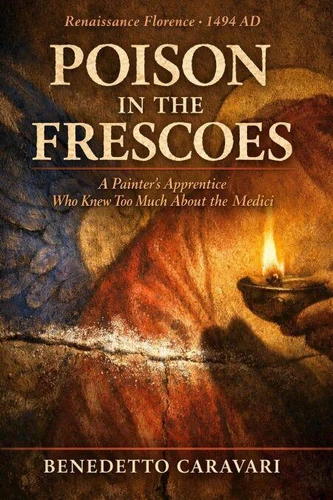
POISON IN THE FRESCOES: A Painter's Apprentice Who Knew Too Much About the Medici
Florence, October 1494. A seventeen-year-old painter's apprentice notices something wrong with the blue. The fresco in the private chapel of the Via dei Bardi had been drying for three days when Luca Bertolini first saw it: a slight dulling at the boundary between two sections of plaster, a surface anomaly invisible to anyone who had not spent four years learning to read painted walls the way a physician reads a pulse.
He touched it. A faint white residue came away on his fingertip. He recognized it from the pharmacological literature he had been reading since childhood. Arsenic trioxide. White arsenic. The poison that had no taste, no smell, and no immediate effect, but that accumulated slowly in the lungs of anyone who breathed the air of a small enclosed space, day after day, until a winter illness carried them quietly away.
Someone had poisoned the fresco. Someone had poisoned the chapel. And the man who prayed there every morning was dying by degrees, one daily prayer at a time. The city outside the chapel was in the middle of the most dramatic political transformation in a generation. Charles VIII of France was marching his army down the peninsula. Piero de' Medici was about to be driven from the city his family had ruled for sixty years.
Savonarola was preaching divine judgment in the cathedral. The institutions of Florentine governance were in the first hours of the reorganization that would remake the republic. And a boy who ground pigments and prepared plaster and mixed colors was in possession of a secret that had already gotten someone interested enough in his activities to send a man to his workshop with a warning he could not quite afford to take.
Luca Bertolini was not a detective. He was not a soldier. He was not a politician or a lawyer or anyone with any formal standing in any of the institutions that were supposed to handle exactly this kind of problem. He was an apprentice with a craft education that had given him something more useful than institutional authority: the ability to read surfaces for what they communicated about the conditions of their making, and the patience to follow what the reading revealed without looking away from what it showed him.
Drawing on the documented history of the Florentine workshop system, Cennino Cennini's fourteenth-century handbook of craft practice, the pharmacology of arsenic trioxide as documented in the medical literature of the period, the actual politics of the Pazzi family rehabilitation, and the specific texture of Florentine civic life in the autumn of the republic's transformation, Poison in the Frescoes is historical mystery at its most rigorous and most intimate: a story about what happens when technical knowledge becomes dangerous knowledge, and about the specific courage required to act on what you see when looking away would be so much safer.
The fresco is coming down. The question is what comes down with it. Essential reading for fans of The Name of the Rose by Umberto Eco, An Instance of the Fingerpost by Iain Pears, and The Birth of Venus by Sarah Dunant.
He touched it. A faint white residue came away on his fingertip. He recognized it from the pharmacological literature he had been reading since childhood. Arsenic trioxide. White arsenic. The poison that had no taste, no smell, and no immediate effect, but that accumulated slowly in the lungs of anyone who breathed the air of a small enclosed space, day after day, until a winter illness carried them quietly away.
Someone had poisoned the fresco. Someone had poisoned the chapel. And the man who prayed there every morning was dying by degrees, one daily prayer at a time. The city outside the chapel was in the middle of the most dramatic political transformation in a generation. Charles VIII of France was marching his army down the peninsula. Piero de' Medici was about to be driven from the city his family had ruled for sixty years.
Savonarola was preaching divine judgment in the cathedral. The institutions of Florentine governance were in the first hours of the reorganization that would remake the republic. And a boy who ground pigments and prepared plaster and mixed colors was in possession of a secret that had already gotten someone interested enough in his activities to send a man to his workshop with a warning he could not quite afford to take.
Luca Bertolini was not a detective. He was not a soldier. He was not a politician or a lawyer or anyone with any formal standing in any of the institutions that were supposed to handle exactly this kind of problem. He was an apprentice with a craft education that had given him something more useful than institutional authority: the ability to read surfaces for what they communicated about the conditions of their making, and the patience to follow what the reading revealed without looking away from what it showed him.
Drawing on the documented history of the Florentine workshop system, Cennino Cennini's fourteenth-century handbook of craft practice, the pharmacology of arsenic trioxide as documented in the medical literature of the period, the actual politics of the Pazzi family rehabilitation, and the specific texture of Florentine civic life in the autumn of the republic's transformation, Poison in the Frescoes is historical mystery at its most rigorous and most intimate: a story about what happens when technical knowledge becomes dangerous knowledge, and about the specific courage required to act on what you see when looking away would be so much safer.
The fresco is coming down. The question is what comes down with it. Essential reading for fans of The Name of the Rose by Umberto Eco, An Instance of the Fingerpost by Iain Pears, and The Birth of Venus by Sarah Dunant.