SOLDES
Jusqu'à -70% sur une sélection d'articles*
Dernière sortie
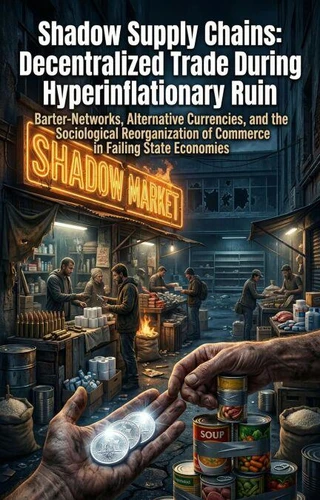
Shadow Supply Chains: Decentralized Trade During Hyperinflationary Ruin
When a national currency hyperinflates into total worthlessness, the official economy stops functioning. Grocery store shelves sit empty, supply chains collapse, and traditional paychecks cannot buy a loaf of bread. But human commerce does not end; it simply mutates. Driven by sheer biological necessity, desperate populations immediately abandon fiat currency and construct robust, decentralized shadow economies.
The transition from a highly complex, digitized market back to a primitive barter system is chaotic but incredibly structured.
In failing states, black markets instantly assign precise, fluctuating values to tangible commodities-medicines, batteries, fuel, and non-perishable foods become the new, trusted mediums of exchange. Communities organically develop underground ledgers and trusted smuggling routes, bypassing paralyzed government infrastructure entirely to secure their own survival. This book analyzes the fascinating sociology of decentralized disaster economics.
You will trace historical examples of hyperinflation, the psychology of transitioning away from paper money, and the exact mechanics of establishing trusted, local barter networks when the central banks fail. Prepare for the collapse of paper promises. Uncover the resilient architecture of the shadow supply chain and learn how communities physically reorganize commerce to survive the ruin of the state.
In failing states, black markets instantly assign precise, fluctuating values to tangible commodities-medicines, batteries, fuel, and non-perishable foods become the new, trusted mediums of exchange. Communities organically develop underground ledgers and trusted smuggling routes, bypassing paralyzed government infrastructure entirely to secure their own survival. This book analyzes the fascinating sociology of decentralized disaster economics.
You will trace historical examples of hyperinflation, the psychology of transitioning away from paper money, and the exact mechanics of establishing trusted, local barter networks when the central banks fail. Prepare for the collapse of paper promises. Uncover the resilient architecture of the shadow supply chain and learn how communities physically reorganize commerce to survive the ruin of the state.