OFFRE LISEUSES
Une liseuse achetée = une housse offerte* jusqu'au 21 juin
- Accueil /
- Robert Grimes
Robert Grimes

Dernière sortie
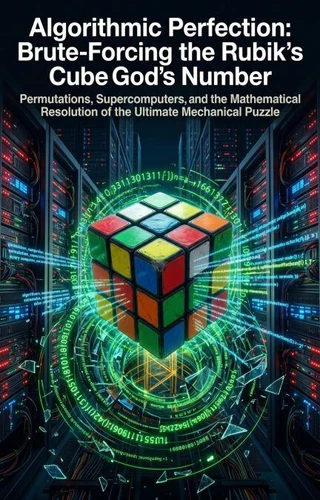
Algorithmic Perfection: Brute-Forcing the Rubik's Cube God's Number
How many moves does it take to solve a Rubik's Cube from any possible scrambled position? For over thirty years, the greatest mathematical minds on the planet desperately searched for this theoretical absolute minimum, a legendary computational ceiling reverently dubbed "God's Number."
The standard 3x3 Rubik's Cube possesses an incomprehensible 43 quintillion possible permutations. Analyzing every single state manually was mathematically impossible.
It wasn't until 2010 that a team of researchers, utilizing massive donations of idle supercomputer processing power from Google, finally cracked the code. By employing advanced group theory to cluster billions of identical mathematical states, they definitively proved that every single scramble can be solved in 20 moves or less. This rigorous mathematical breakdown chronicles the ultimate victory of computational brute force over complex geometry.
It explores the evolution of permutation algorithms, the hardware architecture required to process quintillions of variables, and the bizarrely beautiful symmetry hiding within Erno Rubik's plastic invention. Unlock the absolute limits of mechanical puzzles. The discovery of God's Number remains a breathtaking testament to the sheer power of algorithmic optimization and modern supercomputing.
It wasn't until 2010 that a team of researchers, utilizing massive donations of idle supercomputer processing power from Google, finally cracked the code. By employing advanced group theory to cluster billions of identical mathematical states, they definitively proved that every single scramble can be solved in 20 moves or less. This rigorous mathematical breakdown chronicles the ultimate victory of computational brute force over complex geometry.
It explores the evolution of permutation algorithms, the hardware architecture required to process quintillions of variables, and the bizarrely beautiful symmetry hiding within Erno Rubik's plastic invention. Unlock the absolute limits of mechanical puzzles. The discovery of God's Number remains a breathtaking testament to the sheer power of algorithmic optimization and modern supercomputing.
How many moves does it take to solve a Rubik's Cube from any possible scrambled position? For over thirty years, the greatest mathematical minds on the planet desperately searched for this theoretical absolute minimum, a legendary computational ceiling reverently dubbed "God's Number."
The standard 3x3 Rubik's Cube possesses an incomprehensible 43 quintillion possible permutations. Analyzing every single state manually was mathematically impossible.
It wasn't until 2010 that a team of researchers, utilizing massive donations of idle supercomputer processing power from Google, finally cracked the code. By employing advanced group theory to cluster billions of identical mathematical states, they definitively proved that every single scramble can be solved in 20 moves or less. This rigorous mathematical breakdown chronicles the ultimate victory of computational brute force over complex geometry.
It explores the evolution of permutation algorithms, the hardware architecture required to process quintillions of variables, and the bizarrely beautiful symmetry hiding within Erno Rubik's plastic invention. Unlock the absolute limits of mechanical puzzles. The discovery of God's Number remains a breathtaking testament to the sheer power of algorithmic optimization and modern supercomputing.
It wasn't until 2010 that a team of researchers, utilizing massive donations of idle supercomputer processing power from Google, finally cracked the code. By employing advanced group theory to cluster billions of identical mathematical states, they definitively proved that every single scramble can be solved in 20 moves or less. This rigorous mathematical breakdown chronicles the ultimate victory of computational brute force over complex geometry.
It explores the evolution of permutation algorithms, the hardware architecture required to process quintillions of variables, and the bizarrely beautiful symmetry hiding within Erno Rubik's plastic invention. Unlock the absolute limits of mechanical puzzles. The discovery of God's Number remains a breathtaking testament to the sheer power of algorithmic optimization and modern supercomputing.
