Dernière sortie
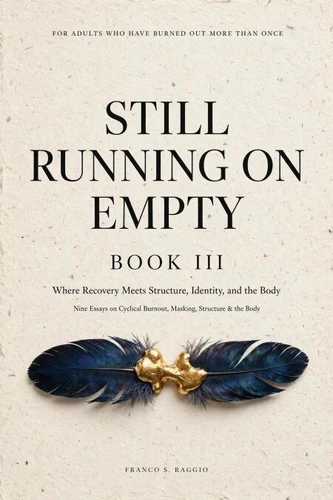
Still Running on Empty: Book III — Where Recovery Meets Structure, Identity, and the Body
Nine Chapters1 - Cyclical and Cumulative BurnoutRecurrence is the rule, not the exception. How each episode can leave you starting from a lower place - and what to do with that information.2 - IntersectionalityWhen masking has more than one axis - race, gender, sexuality, migration status - the cost compounds. The tools built for one axis undercount the real load.3 - Identity Beneath the MaskFor those who started masking so early that no "before" exists to return to.
Not a worksheet. A different question.4 - Why Self-Care Is Not EnoughIndividual tools have a ceiling. The social model of disability and the neurodiversity paradigm offer a lens that the rest of this series never fully named.5 - Neurodivergent ParentsParenting demand measured in hours hides the real cost: predictability. For two-parent households, single parents, and the still-unstudied "double demand."6 - The Trap of Not Being Able to StopThe recovery paradox, documented.
When exhaustion depletes exactly the capacity needed to recover - and financial precarity makes stopping impossible.7 - Suicide RiskWhy masking and unmet support needs are mechanistically implicated, not just correlated. Crisis resources included.8 - Substance UseWhat gets turned off to survive. Self-medication as a rational response to unsustainable demand - and when the reflection tool isn't enough.9 - Physical ComorbidityJoint hypermobility, chronic pain, gastrointestinal symptoms - the body that also runs out, and why your recovery plan might have missed it.
What Makes This Book DifferentEach chapter ends with a "Where This Connects" note, because almost no reader's situation maps to exactly one chapter. A reading route in the introduction points you toward what you need first. An afterword names this book's near-total reliance on Western research and offers adaptations for contexts where the assumptions don't fit. Three composite cases - Fabian (cyclical burnout across decades), Yusuf (intersectional masking load), Noor (identity beneath a mask worn since childhood) - join the characters from the earlier books.
Three chapters are more theoretical (Chapters 3, 4, and 6) and are honest about their different evidentiary footing. The rest extend the original workbook's tools directly. One chapter, Chapter 7, addresses suicide risk - placed so you can reach its crisis resources section in seconds, without reading the rest of the book first. Who It's ForReadersThose who've burned out more than once, or suspect they might - and who need answers the original tools couldn't provide.
Does not assume a diagnosis. CliniciansModule IV of the Expanded Edition already gave you the professional framework. This book gives you the conceptual depth for clients whose recovery stalls despite the tools, and who need language for what isn't covered elsewhere.
Not a worksheet. A different question.4 - Why Self-Care Is Not EnoughIndividual tools have a ceiling. The social model of disability and the neurodiversity paradigm offer a lens that the rest of this series never fully named.5 - Neurodivergent ParentsParenting demand measured in hours hides the real cost: predictability. For two-parent households, single parents, and the still-unstudied "double demand."6 - The Trap of Not Being Able to StopThe recovery paradox, documented.
When exhaustion depletes exactly the capacity needed to recover - and financial precarity makes stopping impossible.7 - Suicide RiskWhy masking and unmet support needs are mechanistically implicated, not just correlated. Crisis resources included.8 - Substance UseWhat gets turned off to survive. Self-medication as a rational response to unsustainable demand - and when the reflection tool isn't enough.9 - Physical ComorbidityJoint hypermobility, chronic pain, gastrointestinal symptoms - the body that also runs out, and why your recovery plan might have missed it.
What Makes This Book DifferentEach chapter ends with a "Where This Connects" note, because almost no reader's situation maps to exactly one chapter. A reading route in the introduction points you toward what you need first. An afterword names this book's near-total reliance on Western research and offers adaptations for contexts where the assumptions don't fit. Three composite cases - Fabian (cyclical burnout across decades), Yusuf (intersectional masking load), Noor (identity beneath a mask worn since childhood) - join the characters from the earlier books.
Three chapters are more theoretical (Chapters 3, 4, and 6) and are honest about their different evidentiary footing. The rest extend the original workbook's tools directly. One chapter, Chapter 7, addresses suicide risk - placed so you can reach its crisis resources section in seconds, without reading the rest of the book first. Who It's ForReadersThose who've burned out more than once, or suspect they might - and who need answers the original tools couldn't provide.
Does not assume a diagnosis. CliniciansModule IV of the Expanded Edition already gave you the professional framework. This book gives you the conceptual depth for clients whose recovery stalls despite the tools, and who need language for what isn't covered elsewhere.
Les livres de Franco S. Raggio




The SunGrass Chronicles
E-book
4,49 €

La Ciudad de los Vientos
E-book
1,99 €

The City Of Winds
E-book
1,99 €