- Accueil /
- Karim Spring
Karim Spring

Dernière sortie
The Returners
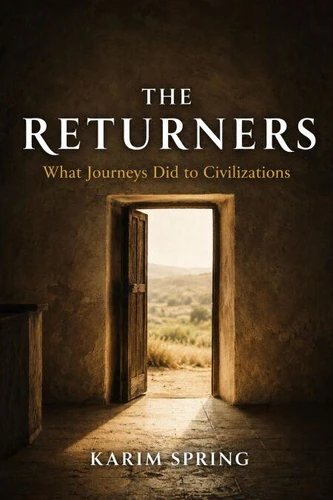
We tell ourselves that travel is ancient - that the instinct which carried our ancestors out of Africa is the same one that books a flight today. It isn't. What walked out of Africa was migration, and migration goes one way. Travel - leaving and coming back - is young, rare, and far stranger than we assume. It had to be invented. The Returners follows that invention to its consequences, and arrives somewhere unexpected: this is not really a book about travel at all.
It is a book about how civilizations learn. Everything a society is made of - its crops, its numbers, its institutions, its gods - arrived from somewhere else, carried home by someone who was sent for something narrower and came back with more than anyone ordered. Nothing that returns ever returns alone. From the first salt flat to the last space probe, from the border that asks whether you will come back to the tourist who goes only to have gone, this is a spare, unsettling argument about what journeys quietly did to every society that permitted them - and about the edge, now visible for the first time, past which nothing can any longer come home.
A short book about travel, return, and the forgotten machinery of how the world became what it is.
It is a book about how civilizations learn. Everything a society is made of - its crops, its numbers, its institutions, its gods - arrived from somewhere else, carried home by someone who was sent for something narrower and came back with more than anyone ordered. Nothing that returns ever returns alone. From the first salt flat to the last space probe, from the border that asks whether you will come back to the tourist who goes only to have gone, this is a spare, unsettling argument about what journeys quietly did to every society that permitted them - and about the edge, now visible for the first time, past which nothing can any longer come home.
A short book about travel, return, and the forgotten machinery of how the world became what it is.
We tell ourselves that travel is ancient - that the instinct which carried our ancestors out of Africa is the same one that books a flight today. It isn't. What walked out of Africa was migration, and migration goes one way. Travel - leaving and coming back - is young, rare, and far stranger than we assume. It had to be invented. The Returners follows that invention to its consequences, and arrives somewhere unexpected: this is not really a book about travel at all.
It is a book about how civilizations learn. Everything a society is made of - its crops, its numbers, its institutions, its gods - arrived from somewhere else, carried home by someone who was sent for something narrower and came back with more than anyone ordered. Nothing that returns ever returns alone. From the first salt flat to the last space probe, from the border that asks whether you will come back to the tourist who goes only to have gone, this is a spare, unsettling argument about what journeys quietly did to every society that permitted them - and about the edge, now visible for the first time, past which nothing can any longer come home.
A short book about travel, return, and the forgotten machinery of how the world became what it is.
It is a book about how civilizations learn. Everything a society is made of - its crops, its numbers, its institutions, its gods - arrived from somewhere else, carried home by someone who was sent for something narrower and came back with more than anyone ordered. Nothing that returns ever returns alone. From the first salt flat to the last space probe, from the border that asks whether you will come back to the tourist who goes only to have gone, this is a spare, unsettling argument about what journeys quietly did to every society that permitted them - and about the edge, now visible for the first time, past which nothing can any longer come home.
A short book about travel, return, and the forgotten machinery of how the world became what it is.