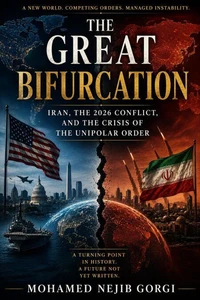
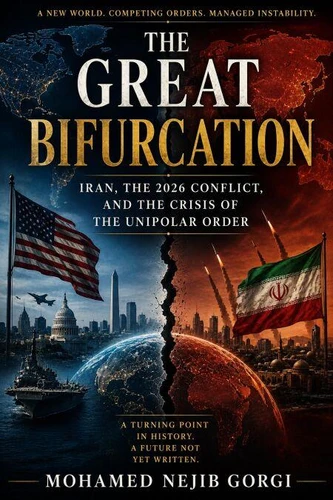
The Great Bifurcation: Iran, the 2026 Conflict, and the Crisis of the Unipolar OrderIn 2026, a war between Iran and Israel pushed the Middle East to the brink of catastrophe and brought the world closer to a systemic crisis than at any time in decades. Missiles crossed borders, global energy markets trembled, maritime trade routes came under threat, cyberattacks targeted critical infrastructure, and the limits of military deterrence were exposed before a global audience.
But the conflict was more than a regional war. It was a revealing moment in the transformation of the international system. In The Great Bifurcation, diplomat and political scientist Mohamed Nejib Gorgi argues that the 2026 conflict marked a historic turning point in world affairs. Far from being an isolated confrontation, the war exposed deeper structural changes that had been reshaping global politics for years: the erosion of unchallenged Western primacy, the fragmentation of globalization, the weaponization of economic interdependence, the rise of parallel financial and technological ecosystems, and the emergence of a more fragmented and competitive international order.
Drawing on geopolitics, international relations theory, military strategy, economic statecraft, and strategic foresight, Gorgi examines how the conflict revealed the growing limits of traditional military superiority and the rise of a new era in which power is exercised simultaneously through missiles, markets, cyber networks, supply chains, information systems, and critical infrastructure. The book explores the military lessons of the war, the transformation of deterrence in the age of drones and artificial intelligence, the regional consequences for the Middle East, the strategic calculations of major powers, and the accelerating competition between rival political, economic, and technological spheres.
It also analyzes how states increasingly seek resilience and strategic autonomy in a world where interdependence has become both a source of prosperity and a source of vulnerability. At the heart of the book lies the concept of the Great Bifurcation: the gradual division of the international system into overlapping but competing networks of power, influence, technology, finance, and security. Unlike the bipolar world of the Cold War, this emerging order is not defined by two rigid blocs, but by multiple centers of power navigating a landscape of selective cooperation, strategic rivalry, and managed instability.
Combining scholarly rigor with the practical insights of a seasoned diplomat, The Great Bifurcation offers a timely and thought-provoking analysis of one of the defining geopolitical crises of the twenty-first century and the world that is emerging in its wake. For policymakers, scholars, students, and readers seeking to understand the future of international politics, this book provides an essential guide to a world in which the old order is fading, the new order remains contested, and the consequences of the 2026 conflict continue to reverberate far beyond the Middle East.
The Great Bifurcation: Iran, the 2026 Conflict, and the Crisis of the Unipolar OrderIn 2026, a war between Iran and Israel pushed the Middle East to the brink of catastrophe and brought the world closer to a systemic crisis than at any time in decades. Missiles crossed borders, global energy markets trembled, maritime trade routes came under threat, cyberattacks targeted critical infrastructure, and the limits of military deterrence were exposed before a global audience.
But the conflict was more than a regional war. It was a revealing moment in the transformation of the international system. In The Great Bifurcation, diplomat and political scientist Mohamed Nejib Gorgi argues that the 2026 conflict marked a historic turning point in world affairs. Far from being an isolated confrontation, the war exposed deeper structural changes that had been reshaping global politics for years: the erosion of unchallenged Western primacy, the fragmentation of globalization, the weaponization of economic interdependence, the rise of parallel financial and technological ecosystems, and the emergence of a more fragmented and competitive international order.
Drawing on geopolitics, international relations theory, military strategy, economic statecraft, and strategic foresight, Gorgi examines how the conflict revealed the growing limits of traditional military superiority and the rise of a new era in which power is exercised simultaneously through missiles, markets, cyber networks, supply chains, information systems, and critical infrastructure. The book explores the military lessons of the war, the transformation of deterrence in the age of drones and artificial intelligence, the regional consequences for the Middle East, the strategic calculations of major powers, and the accelerating competition between rival political, economic, and technological spheres.
It also analyzes how states increasingly seek resilience and strategic autonomy in a world where interdependence has become both a source of prosperity and a source of vulnerability. At the heart of the book lies the concept of the Great Bifurcation: the gradual division of the international system into overlapping but competing networks of power, influence, technology, finance, and security. Unlike the bipolar world of the Cold War, this emerging order is not defined by two rigid blocs, but by multiple centers of power navigating a landscape of selective cooperation, strategic rivalry, and managed instability.
Combining scholarly rigor with the practical insights of a seasoned diplomat, The Great Bifurcation offers a timely and thought-provoking analysis of one of the defining geopolitical crises of the twenty-first century and the world that is emerging in its wake. For policymakers, scholars, students, and readers seeking to understand the future of international politics, this book provides an essential guide to a world in which the old order is fading, the new order remains contested, and the consequences of the 2026 conflict continue to reverberate far beyond the Middle East.