- Accueil /
- Harper Hughes
Harper Hughes

Dernière sortie
Erewhon (A Dystopia) (Summarized Edition)
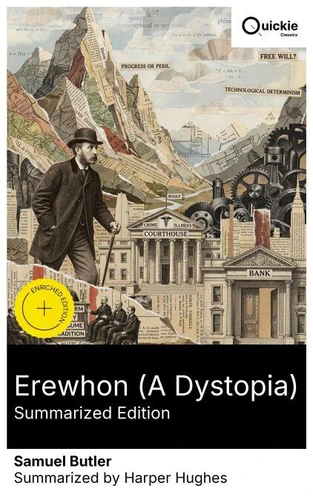
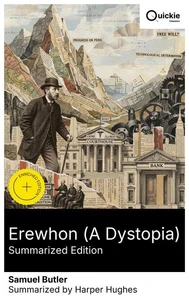
Erewhon (A Dystopia) stages a pseudo-travel narrative in which an unnamed explorer discovers a secluded society whose institutions invert Victorian common sense. Illness is punished, crime is treated, bankers preside over empty rites, and the deity Ydgrun (Conventionality) quietly governs conduct. In the 'Book of the Machines' Butler asks whether evolving technology might outstrip human control-anxieties voiced with Swiftian irony and measured prose.
Situated between More's Utopia and later dystopias, the novel probes progress, free will, and responsibility amid post-Darwinian and industrial ferment. Samuel Butler, an Anglican clergyman's son, rejected ordination, farmed sheep in New Zealand, then returned to London as a painter and polemicist. The colonial sojourn supplied the mountainous threshold and outsider's gaze; engagement with Darwin prompted reflections on habit and heredity.
Publishing Erewhon anonymously in 1872, and later extending it in Erewhon Revisited, he fused personal estrangement with philosophical dissent to probe the moral grammar of modernity. Recommended to readers of Swift, More, Huxley, and Orwell, this novel rewards anyone interested in Victorian culture, social theory, or the philosophy of technology. Its wit, lucid structure, and intellectual audacity anticipate today's debates about automation and biopolitics, making it a bracing, prescient study in the uses-and misuses-of progress. Quickie Classics summarizes timeless works with precision, preserving the author's voice and keeping the prose clear, fast, and readable-distilled, never diluted.
Enriched Edition extras: Introduction · Synopsis · Historical Context · Brief Analysis · 4 Reflection Q&As · Editorial Footnotes.
Situated between More's Utopia and later dystopias, the novel probes progress, free will, and responsibility amid post-Darwinian and industrial ferment. Samuel Butler, an Anglican clergyman's son, rejected ordination, farmed sheep in New Zealand, then returned to London as a painter and polemicist. The colonial sojourn supplied the mountainous threshold and outsider's gaze; engagement with Darwin prompted reflections on habit and heredity.
Publishing Erewhon anonymously in 1872, and later extending it in Erewhon Revisited, he fused personal estrangement with philosophical dissent to probe the moral grammar of modernity. Recommended to readers of Swift, More, Huxley, and Orwell, this novel rewards anyone interested in Victorian culture, social theory, or the philosophy of technology. Its wit, lucid structure, and intellectual audacity anticipate today's debates about automation and biopolitics, making it a bracing, prescient study in the uses-and misuses-of progress. Quickie Classics summarizes timeless works with precision, preserving the author's voice and keeping the prose clear, fast, and readable-distilled, never diluted.
Enriched Edition extras: Introduction · Synopsis · Historical Context · Brief Analysis · 4 Reflection Q&As · Editorial Footnotes.
Erewhon (A Dystopia) stages a pseudo-travel narrative in which an unnamed explorer discovers a secluded society whose institutions invert Victorian common sense. Illness is punished, crime is treated, bankers preside over empty rites, and the deity Ydgrun (Conventionality) quietly governs conduct. In the 'Book of the Machines' Butler asks whether evolving technology might outstrip human control-anxieties voiced with Swiftian irony and measured prose.
Situated between More's Utopia and later dystopias, the novel probes progress, free will, and responsibility amid post-Darwinian and industrial ferment. Samuel Butler, an Anglican clergyman's son, rejected ordination, farmed sheep in New Zealand, then returned to London as a painter and polemicist. The colonial sojourn supplied the mountainous threshold and outsider's gaze; engagement with Darwin prompted reflections on habit and heredity.
Publishing Erewhon anonymously in 1872, and later extending it in Erewhon Revisited, he fused personal estrangement with philosophical dissent to probe the moral grammar of modernity. Recommended to readers of Swift, More, Huxley, and Orwell, this novel rewards anyone interested in Victorian culture, social theory, or the philosophy of technology. Its wit, lucid structure, and intellectual audacity anticipate today's debates about automation and biopolitics, making it a bracing, prescient study in the uses-and misuses-of progress. Quickie Classics summarizes timeless works with precision, preserving the author's voice and keeping the prose clear, fast, and readable-distilled, never diluted.
Enriched Edition extras: Introduction · Synopsis · Historical Context · Brief Analysis · 4 Reflection Q&As · Editorial Footnotes.
Situated between More's Utopia and later dystopias, the novel probes progress, free will, and responsibility amid post-Darwinian and industrial ferment. Samuel Butler, an Anglican clergyman's son, rejected ordination, farmed sheep in New Zealand, then returned to London as a painter and polemicist. The colonial sojourn supplied the mountainous threshold and outsider's gaze; engagement with Darwin prompted reflections on habit and heredity.
Publishing Erewhon anonymously in 1872, and later extending it in Erewhon Revisited, he fused personal estrangement with philosophical dissent to probe the moral grammar of modernity. Recommended to readers of Swift, More, Huxley, and Orwell, this novel rewards anyone interested in Victorian culture, social theory, or the philosophy of technology. Its wit, lucid structure, and intellectual audacity anticipate today's debates about automation and biopolitics, making it a bracing, prescient study in the uses-and misuses-of progress. Quickie Classics summarizes timeless works with precision, preserving the author's voice and keeping the prose clear, fast, and readable-distilled, never diluted.
Enriched Edition extras: Introduction · Synopsis · Historical Context · Brief Analysis · 4 Reflection Q&As · Editorial Footnotes.
Les livres de Harper Hughes

1,99 €

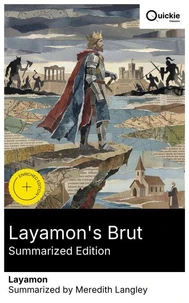
Layamon's Brut (Summarized Edition). Enriched edition. An alliterative Middle English poem of Arthurian legend, the Norman Conquest, and England's identity
Layamon, Eugene Mason, Meredith Langley, Harper Hughes
E-book
1,99 €

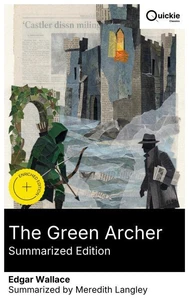
The Green Archer (Summarized Edition). Enriched edition. A fast-paced English countryside mystery as an early 20th-century detective unravels atmospheric manor-house deceptions, betrayal, and twists.
Edgar Wallace, Meredith Langley, Harper Hughes
E-book
1,99 €

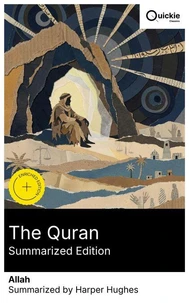
The Quran (Summarized Edition). Enriched edition. Divine revelation and prophetic guidance in Meccan and Medinan chapters, with ethical teachings, history, and resurrection doctrine
Allah, John Medows Rodwell, Harper Hughes
E-book
1,99 €

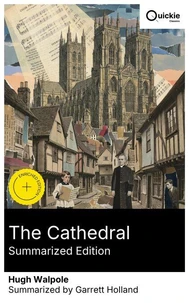
The Cathedral (Summarized Edition). Enriched edition. A gothic suspense of supernatural mystery and psychological peril in a mysterious cathedral, told in dark, intricate early 20th-century prose.
Hugh Walpole, Garrett Holland, Harper Hughes
E-book
1,99 €

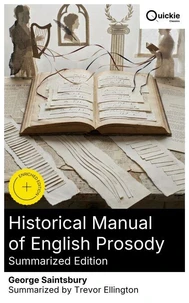
Historical Manual of English Prosody (Summarized Edition). Enriched edition. An English prosody guide to rhyme and meter, metrics and verse forms, with Victorian-era insights and historical evolution
George Saintsbury, Trevor Ellington, Harper Hughes
E-book
1,99 €


Gadsby (Summarized Edition). Enriched edition. An Experimental Narrative of Branton Hills: Innovative Storytelling, a Constrained Writing Challenge, Leadership, and Community Revitalization
Ernest Vincent Wright, Crispin Hargrove, Harper Hughes
E-book
1,99 €


Titanic and Other Ships (Summarized Edition). Enriched edition. A Titanic survivor's memoir of maritime adventure, shipwreck, and British naval history
Charles Herbert Lightoller, Harper Hughes
E-book
1,99 €