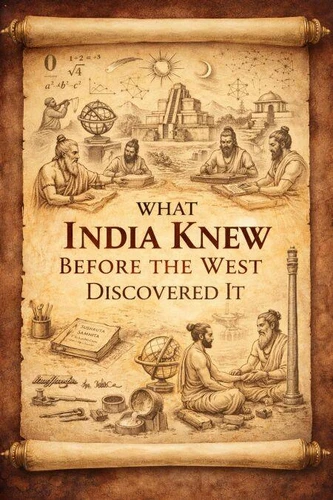
What India Knew Before the West Discovered It is a deeply researched yet accessible exploration of India's ancient intellectual legacy, written for modern readers across the world. This book challenges the popular belief that scientific, philosophical, and institutional knowledge emerged primarily in the West by presenting a clear, evidence-based account of what was known, practiced, and systematized in India centuries-and often millennia-earlier.
Spanning disciplines such as mathematics, astronomy, medicine, linguistics, governance, philosophy, architecture, and environmental science, the book shows that ancient India developed coherent systems of knowledge grounded in observation, logic, experimentation, and ethical reflection. From the invention of zero and the decimal system to advanced surgical techniques described in Ayurvedic texts, from precise astronomical calculations to sophisticated theories of language and cognition, the chapters reveal a civilization deeply engaged with understanding both the outer world and the inner mind.
Rather than treating Indian knowledge as mystical or purely spiritual, the book presents it as practical, rational, and often remarkably modern in spirit. Readers encounter organized education systems like gurukuls and universities such as Nalanda and Takshashila, detailed economic and administrative ideas found in texts like the Arthashastra, and vibrant traditions of debate and reasoning across philosophical schools.
The balance between ethics and realism, so central to Indian thought, is explored through discussions on governance, diplomacy, and social responsibility. Equally important is the story of transmission. The book traces how Indian ideas traveled beyond the subcontinent through trade, scholars, translations, and cultural exchange, influencing regions from Southeast Asia to the Islamic world and, eventually, Europe.
It also reflects on why much of this knowledge was later overlooked, minimized, or disconnected from its original sources in global narratives of progress. Written in a simple language, this work is designed for curious general readers, students, and anyone interested in history, civilization, or the roots of human knowledge. It does not argue for cultural superiority, but for historical balance and intellectual honesty.
By reconnecting readers with India's contributions to global knowledge, the book invites a broader rethinking of how civilizations learn, share, and remember. What India Knew Before the West Discovered It is both a journey into the past and a reflection on the present-showing why ancient knowledge still matters in shaping a more informed and inclusive understanding of the world.
What India Knew Before the West Discovered It is a deeply researched yet accessible exploration of India's ancient intellectual legacy, written for modern readers across the world. This book challenges the popular belief that scientific, philosophical, and institutional knowledge emerged primarily in the West by presenting a clear, evidence-based account of what was known, practiced, and systematized in India centuries-and often millennia-earlier.
Spanning disciplines such as mathematics, astronomy, medicine, linguistics, governance, philosophy, architecture, and environmental science, the book shows that ancient India developed coherent systems of knowledge grounded in observation, logic, experimentation, and ethical reflection. From the invention of zero and the decimal system to advanced surgical techniques described in Ayurvedic texts, from precise astronomical calculations to sophisticated theories of language and cognition, the chapters reveal a civilization deeply engaged with understanding both the outer world and the inner mind.
Rather than treating Indian knowledge as mystical or purely spiritual, the book presents it as practical, rational, and often remarkably modern in spirit. Readers encounter organized education systems like gurukuls and universities such as Nalanda and Takshashila, detailed economic and administrative ideas found in texts like the Arthashastra, and vibrant traditions of debate and reasoning across philosophical schools.
The balance between ethics and realism, so central to Indian thought, is explored through discussions on governance, diplomacy, and social responsibility. Equally important is the story of transmission. The book traces how Indian ideas traveled beyond the subcontinent through trade, scholars, translations, and cultural exchange, influencing regions from Southeast Asia to the Islamic world and, eventually, Europe.
It also reflects on why much of this knowledge was later overlooked, minimized, or disconnected from its original sources in global narratives of progress. Written in a simple language, this work is designed for curious general readers, students, and anyone interested in history, civilization, or the roots of human knowledge. It does not argue for cultural superiority, but for historical balance and intellectual honesty.
By reconnecting readers with India's contributions to global knowledge, the book invites a broader rethinking of how civilizations learn, share, and remember. What India Knew Before the West Discovered It is both a journey into the past and a reflection on the present-showing why ancient knowledge still matters in shaping a more informed and inclusive understanding of the world.