Dernière sortie
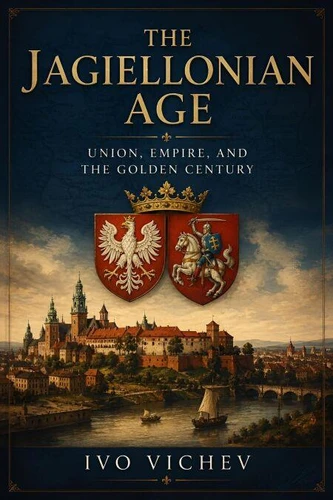
The Jagiellonian Age Union, Empire, and the Golden Century
The Jagiellonian Age tells the story of one of the most consequential dynastic periods in European history: the age in which Poland and Lithuania were drawn together, the power of the Teutonic Order was broken, Prussia was reshaped, noble liberty hardened into political habit, and the foundations of the Polish-Lithuanian Commonwealth were laid. Beginning with the death of Casimir the Great in 1370, Ivo Vichev follows a kingdom without a resident king, a succession crisis that brought Jadwiga to the Polish throne, and the bargain that joined her fate to Jogaila, Grand Duke of Lithuania.
The Union of Krewo did not create a finished state. It created a promise under seal: baptism, marriage, alliance, and an unresolved political question that would define Poland-Lithuania for generations. Jadwiga appears not as a decorative queen, but as a crowned ruler whose marriage changed the map of Europe. Jogaila becomes Wladyslaw Jagiello, king of Poland, while still carrying the burdens of Lithuania.
Vytautas emerges as rival, partner, grand duke, war leader, and internal alternative - the man without whom the union could neither stabilise nor expand. The story passes through baptism and civil war, Vilnius and Radom, the disaster at Vorskla, the road to Grunwald, and the destruction of the Teutonic field army in 1410. But victory did not end the struggle. The failed siege of Malbork, the wars that followed, the rise of Prussian cities, the Thirteen Years' War, and the creation of Royal Prussia show that power was not made by battle alone.
It was made by money, privilege, charters, cities, soldiers, taxation, and the crown's repeated need to bargain. The Jagiellonian Age is also the story of a political system taking shape. Noble privileges, sejmiks, the Sejm, and the principle later expressed in Nihil Novi changed the balance between crown and political nation. Poland-Lithuania became powerful, but not through royal absolutism. Its strength came through negotiation, compromise, and consent.
Its weakness grew from the same sources. Vichev follows the dynasty beyond Poland and Lithuania into Bohemia, Hungary, Prussia, Moldavia, Livonia, and the Baltic world. The Jagiellons rose to extraordinary European reach, but dynastic success carried danger. Mohács, Ottoman pressure, Habsburg rivalry, and the limits of royal war revealed how quickly a dynasty could stretch beyond what it could hold.
At home, the golden century was never simple. Renaissance Kraków flourished. The university, printing, law, humanist scholarship, architecture, and literature gave the kingdom cultural confidence. Copernicus studied in Kraków. Polish letters matured. Royal ceremony, noble politics, and learned culture created one of Europe's most vibrant political societies. The same age carried a harder underside.
The Baltic grain trade enriched nobles and cities while tightening the burden on peasants. The folwark economy expanded. Noble freedom grew beside rural unfreedom. Religious pluralism gave Poland-Lithuania a reputation for relative tolerance, but that tolerance existed inside a fragile political order. The Reformation, Catholic renewal, Orthodox interests, Jewish communities, Armenian merchants, and the many peoples of the Commonwealth lived within a state that was large, ambitious, and never simple.
The final movement leads to Sigismund Augustus and the Union of Lublin in 1569. There, the long argument first opened at Krewo was forced into a new settlement. Poland and Lithuania became a Commonwealth with shared institutions, yet Lithuania retained its own army, offices, treasury, and law. The union was both achievement and compromise.
The Union of Krewo did not create a finished state. It created a promise under seal: baptism, marriage, alliance, and an unresolved political question that would define Poland-Lithuania for generations. Jadwiga appears not as a decorative queen, but as a crowned ruler whose marriage changed the map of Europe. Jogaila becomes Wladyslaw Jagiello, king of Poland, while still carrying the burdens of Lithuania.
Vytautas emerges as rival, partner, grand duke, war leader, and internal alternative - the man without whom the union could neither stabilise nor expand. The story passes through baptism and civil war, Vilnius and Radom, the disaster at Vorskla, the road to Grunwald, and the destruction of the Teutonic field army in 1410. But victory did not end the struggle. The failed siege of Malbork, the wars that followed, the rise of Prussian cities, the Thirteen Years' War, and the creation of Royal Prussia show that power was not made by battle alone.
It was made by money, privilege, charters, cities, soldiers, taxation, and the crown's repeated need to bargain. The Jagiellonian Age is also the story of a political system taking shape. Noble privileges, sejmiks, the Sejm, and the principle later expressed in Nihil Novi changed the balance between crown and political nation. Poland-Lithuania became powerful, but not through royal absolutism. Its strength came through negotiation, compromise, and consent.
Its weakness grew from the same sources. Vichev follows the dynasty beyond Poland and Lithuania into Bohemia, Hungary, Prussia, Moldavia, Livonia, and the Baltic world. The Jagiellons rose to extraordinary European reach, but dynastic success carried danger. Mohács, Ottoman pressure, Habsburg rivalry, and the limits of royal war revealed how quickly a dynasty could stretch beyond what it could hold.
At home, the golden century was never simple. Renaissance Kraków flourished. The university, printing, law, humanist scholarship, architecture, and literature gave the kingdom cultural confidence. Copernicus studied in Kraków. Polish letters matured. Royal ceremony, noble politics, and learned culture created one of Europe's most vibrant political societies. The same age carried a harder underside.
The Baltic grain trade enriched nobles and cities while tightening the burden on peasants. The folwark economy expanded. Noble freedom grew beside rural unfreedom. Religious pluralism gave Poland-Lithuania a reputation for relative tolerance, but that tolerance existed inside a fragile political order. The Reformation, Catholic renewal, Orthodox interests, Jewish communities, Armenian merchants, and the many peoples of the Commonwealth lived within a state that was large, ambitious, and never simple.
The final movement leads to Sigismund Augustus and the Union of Lublin in 1569. There, the long argument first opened at Krewo was forced into a new settlement. Poland and Lithuania became a Commonwealth with shared institutions, yet Lithuania retained its own army, offices, treasury, and law. The union was both achievement and compromise.