Dernière sortie
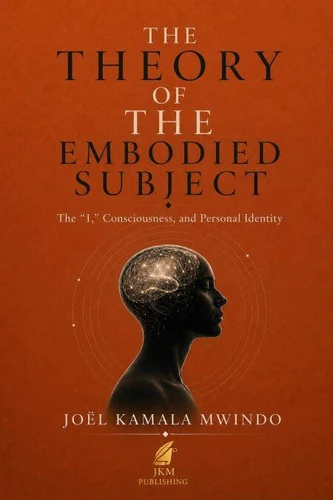
The Theory of the Embodied Subject
We are becoming increasingly capable of describing the brain, memory, emotions, behavior, and the mechanisms of consciousness, yet this knowledge still does not fully explain the one to whom experience happens. This book was written to explore precisely that gap between the functioning of a human being and the fact that this human being lives existence from a first-person perspective. Joël Kamala Mwindo develops a philosophical theory grounded in a distinction between body, soul, and spirit.
The body designates the material condition of our presence in the world; the soul, the personal and biographical form we acquire throughout our history; the spirit, the subject itself, the one to whom that history happens. The book examines this proposal through concrete and sometimes extreme situations, including anesthesia, brain lesions, Alzheimer's disease, memory loss, split-brain cases, artificial intelligence, death, will, and responsibility.
It also confronts the theory with physicalism, functionalism, emergentism, and illusionism in order to determine what each of these views is genuinely able to explain. The book introduces, among other concepts, the notions of ipseity, lived trace, architecture of embodiment, and amplitude of embodiment in order to think through the relationship between the subject, the brain, personal history, and the forms through which the subject manifests itself.
Its aim is to show that the profound dependence of experience on the brain does not, by itself, resolve the question of the subject's identity, and that any complete theory of consciousness must still make intelligible the existence of a particular first-person perspective. The Theory of the Embodied Subject is intended for readers interested in consciousness, identity, memory, artificial intelligence, the relationship between brain and spirit, and, more broadly, in what makes an existence become a history lived by someone.
The central idea of the book can be summarized in one formulathe soul is what I become, the spirit is the one who becomes.
The body designates the material condition of our presence in the world; the soul, the personal and biographical form we acquire throughout our history; the spirit, the subject itself, the one to whom that history happens. The book examines this proposal through concrete and sometimes extreme situations, including anesthesia, brain lesions, Alzheimer's disease, memory loss, split-brain cases, artificial intelligence, death, will, and responsibility.
It also confronts the theory with physicalism, functionalism, emergentism, and illusionism in order to determine what each of these views is genuinely able to explain. The book introduces, among other concepts, the notions of ipseity, lived trace, architecture of embodiment, and amplitude of embodiment in order to think through the relationship between the subject, the brain, personal history, and the forms through which the subject manifests itself.
Its aim is to show that the profound dependence of experience on the brain does not, by itself, resolve the question of the subject's identity, and that any complete theory of consciousness must still make intelligible the existence of a particular first-person perspective. The Theory of the Embodied Subject is intended for readers interested in consciousness, identity, memory, artificial intelligence, the relationship between brain and spirit, and, more broadly, in what makes an existence become a history lived by someone.
The central idea of the book can be summarized in one formulathe soul is what I become, the spirit is the one who becomes.
Les livres de JOËL KAMALA MWINDO

Les musulmans Chrétiens
E-book
6,99 €

Le Mystère Qu'elle Est
E-book
6,99 €

Cycle Invisible
E-book
6,99 €

The Invisible Cycle
E-book
6,99 €

Sang contre Sang
E-book
8,99 €

Le Mystère Féminin
E-book
8,99 €

The World Of The Small
E-book
8,99 €

La guerre des semences
E-book
7,49 €

2,99 €
9,49 €

Standard
E-book
5,99 €

Norme
E-book
5,49 €
7,99 €

7,99 €