OFFRE LISEUSES
Une liseuse achetée = une housse offerte* jusqu'au 21 juin
- Accueil /
- Julia Foster
Julia Foster

Dernière sortie
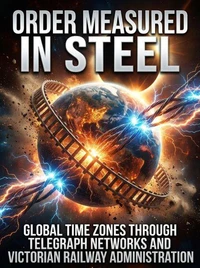
Order Measured in Steel
Modern bureaucracy began with a problem measured in minutes. As railway systems crossed borders and empires expanded their communication networks, governments discovered that local solar time could no longer sustain industrial civilization.
Throughout the nineteenth century, railway companies and telegraph agencies built a new form of authority rooted in synchronization. Schedules demanded precision that villages, churches, and municipal clocks had never required before.
In Britain, North America, and colonial territories, railway administrators imposed uniform time standards to reduce accidents, coordinate freight, and maintain commercial reliability. Historical newspapers captured public resentment toward "railway time, " while engineering journals defended standardization as essential to progress. The conflict revealed a deeper transformation in political power.
Timekeeping moved from local observation of the sun into centralized systems managed by corporations, observatories, and states. Proceedings from the International Meridian Conference of 1884 demonstrate how diplomacy, maritime navigation, and imperial competition converged around Greenwich as the prime meridian. Standardized time became an invisible technology of governance. The story of world time standardization is therefore not only transport history.
It is the history of how industrial states learned to regulate movement, labor, communication, and imperial coordination across enormous distances with unprecedented precision.
In Britain, North America, and colonial territories, railway administrators imposed uniform time standards to reduce accidents, coordinate freight, and maintain commercial reliability. Historical newspapers captured public resentment toward "railway time, " while engineering journals defended standardization as essential to progress. The conflict revealed a deeper transformation in political power.
Timekeeping moved from local observation of the sun into centralized systems managed by corporations, observatories, and states. Proceedings from the International Meridian Conference of 1884 demonstrate how diplomacy, maritime navigation, and imperial competition converged around Greenwich as the prime meridian. Standardized time became an invisible technology of governance. The story of world time standardization is therefore not only transport history.
It is the history of how industrial states learned to regulate movement, labor, communication, and imperial coordination across enormous distances with unprecedented precision.
Modern bureaucracy began with a problem measured in minutes. As railway systems crossed borders and empires expanded their communication networks, governments discovered that local solar time could no longer sustain industrial civilization.
Throughout the nineteenth century, railway companies and telegraph agencies built a new form of authority rooted in synchronization. Schedules demanded precision that villages, churches, and municipal clocks had never required before.
In Britain, North America, and colonial territories, railway administrators imposed uniform time standards to reduce accidents, coordinate freight, and maintain commercial reliability. Historical newspapers captured public resentment toward "railway time, " while engineering journals defended standardization as essential to progress. The conflict revealed a deeper transformation in political power.
Timekeeping moved from local observation of the sun into centralized systems managed by corporations, observatories, and states. Proceedings from the International Meridian Conference of 1884 demonstrate how diplomacy, maritime navigation, and imperial competition converged around Greenwich as the prime meridian. Standardized time became an invisible technology of governance. The story of world time standardization is therefore not only transport history.
It is the history of how industrial states learned to regulate movement, labor, communication, and imperial coordination across enormous distances with unprecedented precision.
In Britain, North America, and colonial territories, railway administrators imposed uniform time standards to reduce accidents, coordinate freight, and maintain commercial reliability. Historical newspapers captured public resentment toward "railway time, " while engineering journals defended standardization as essential to progress. The conflict revealed a deeper transformation in political power.
Timekeeping moved from local observation of the sun into centralized systems managed by corporations, observatories, and states. Proceedings from the International Meridian Conference of 1884 demonstrate how diplomacy, maritime navigation, and imperial competition converged around Greenwich as the prime meridian. Standardized time became an invisible technology of governance. The story of world time standardization is therefore not only transport history.
It is the history of how industrial states learned to regulate movement, labor, communication, and imperial coordination across enormous distances with unprecedented precision.
Les livres de Julia Foster
Nouveauté
9,99 €


9,99 €