OFFRE LISEUSES
Une liseuse achetée = une housse offerte* jusqu'au 21 juin
- Accueil /
- Bennett Stanhope
Bennett Stanhope

Dernière sortie
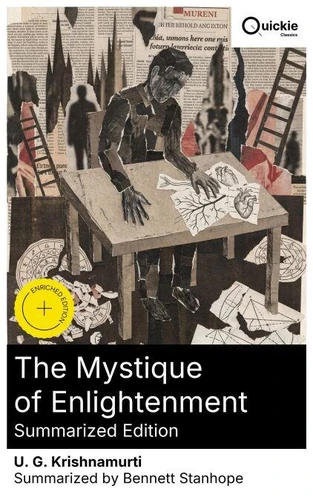
The Mystique of Enlightenment (Summarized Edition)
The Mystique of Enlightenment presents U. G. Krishnamurti's uncompromising demystification of spiritual attainment. Composed largely of conversations and reflections, the book dismantles the project of seeking by exposing "enlightenment" as a culturally manufactured ideal that feeds psychological conflict. The style is aphoristic, acerbic, yet rigorously literal: claims are pared to concrete sensations and bodily facts, with metaphysical language refused at the threshold.
Situated within late-twentieth-century critiques of guru-ism and therapeutic spirituality, the text reverses Vedantic and Buddhist teleologies, denying methods, maps, and authority while scrutinizing the subtle self-interest that sustains them. Indian-born and relentlessly itinerant, U. G. Krishnamurti rejected the teacher's pedestal, describing instead a mid-life "calamity" he insisted was a strictly physiological upheaval, not a mystical prize.
His decades of dialogues with seekers, scientists, and skeptics, and his refusal to found a school, cultivate disciples, or offer techniques, inform the book's abrasive clarity and its suspicion of institutional spirituality. This volume is recommended to readers willing to test cherished assumptions: scholars of religion and philosophy of mind, practitioners wary of consolation, and students of modern anti-guru literature.
It does not console or instruct; it disenchants, and in doing so, compels a more honest appraisal of why one seeks at all. Quickie Classics summarizes timeless works with precision, preserving the author's voice and keeping the prose clear, fast, and readable-distilled, never diluted. Enriched Edition extras: Introduction · Synopsis · Historical Context · Brief Analysis · 4 Reflection Q&As · Editorial Footnotes.

Situated within late-twentieth-century critiques of guru-ism and therapeutic spirituality, the text reverses Vedantic and Buddhist teleologies, denying methods, maps, and authority while scrutinizing the subtle self-interest that sustains them. Indian-born and relentlessly itinerant, U. G. Krishnamurti rejected the teacher's pedestal, describing instead a mid-life "calamity" he insisted was a strictly physiological upheaval, not a mystical prize.
His decades of dialogues with seekers, scientists, and skeptics, and his refusal to found a school, cultivate disciples, or offer techniques, inform the book's abrasive clarity and its suspicion of institutional spirituality. This volume is recommended to readers willing to test cherished assumptions: scholars of religion and philosophy of mind, practitioners wary of consolation, and students of modern anti-guru literature.
It does not console or instruct; it disenchants, and in doing so, compels a more honest appraisal of why one seeks at all. Quickie Classics summarizes timeless works with precision, preserving the author's voice and keeping the prose clear, fast, and readable-distilled, never diluted. Enriched Edition extras: Introduction · Synopsis · Historical Context · Brief Analysis · 4 Reflection Q&As · Editorial Footnotes.

The Mystique of Enlightenment presents U. G. Krishnamurti's uncompromising demystification of spiritual attainment. Composed largely of conversations and reflections, the book dismantles the project of seeking by exposing "enlightenment" as a culturally manufactured ideal that feeds psychological conflict. The style is aphoristic, acerbic, yet rigorously literal: claims are pared to concrete sensations and bodily facts, with metaphysical language refused at the threshold.
Situated within late-twentieth-century critiques of guru-ism and therapeutic spirituality, the text reverses Vedantic and Buddhist teleologies, denying methods, maps, and authority while scrutinizing the subtle self-interest that sustains them. Indian-born and relentlessly itinerant, U. G. Krishnamurti rejected the teacher's pedestal, describing instead a mid-life "calamity" he insisted was a strictly physiological upheaval, not a mystical prize.
His decades of dialogues with seekers, scientists, and skeptics, and his refusal to found a school, cultivate disciples, or offer techniques, inform the book's abrasive clarity and its suspicion of institutional spirituality. This volume is recommended to readers willing to test cherished assumptions: scholars of religion and philosophy of mind, practitioners wary of consolation, and students of modern anti-guru literature.
It does not console or instruct; it disenchants, and in doing so, compels a more honest appraisal of why one seeks at all. Quickie Classics summarizes timeless works with precision, preserving the author's voice and keeping the prose clear, fast, and readable-distilled, never diluted. Enriched Edition extras: Introduction · Synopsis · Historical Context · Brief Analysis · 4 Reflection Q&As · Editorial Footnotes.
Situated within late-twentieth-century critiques of guru-ism and therapeutic spirituality, the text reverses Vedantic and Buddhist teleologies, denying methods, maps, and authority while scrutinizing the subtle self-interest that sustains them. Indian-born and relentlessly itinerant, U. G. Krishnamurti rejected the teacher's pedestal, describing instead a mid-life "calamity" he insisted was a strictly physiological upheaval, not a mystical prize.
His decades of dialogues with seekers, scientists, and skeptics, and his refusal to found a school, cultivate disciples, or offer techniques, inform the book's abrasive clarity and its suspicion of institutional spirituality. This volume is recommended to readers willing to test cherished assumptions: scholars of religion and philosophy of mind, practitioners wary of consolation, and students of modern anti-guru literature.
It does not console or instruct; it disenchants, and in doing so, compels a more honest appraisal of why one seeks at all. Quickie Classics summarizes timeless works with precision, preserving the author's voice and keeping the prose clear, fast, and readable-distilled, never diluted. Enriched Edition extras: Introduction · Synopsis · Historical Context · Brief Analysis · 4 Reflection Q&As · Editorial Footnotes.
Les livres de Bennett Stanhope

Twelve Types. Enriched edition. Insightful Analysis of Literary and Philosophical Figures
G. K. Chesterton, Bennett Stanhope
E-book
0,99 €

Fancies Versus Fads. Enriched edition. Championing Tradition in a Modern World
G. K. Chesterton, Bennett Stanhope
E-book
1,99 €

A Short History of England. Enriched edition. An Engaging Journey Through England's Past and Literature
G. K. Chesterton, Bennett Stanhope
E-book
0,99 €

The Narrative of Arthur Gordon Pym of Nantucket. Enriched edition. A Suspenseful Sea Voyage of Survival and Mystery
EDGAR ALLAN POE, Bennett Stanhope
E-book
1,99 €

The Will to Believe, and Other Essays in Popular Philosophy. Enriched edition. Exploring the Depths of Belief and Free Will
William James, Bennett Stanhope
E-book
1,99 €

The Napoleon of Notting Hill. Enriched edition. A Satirical Journey Through Power, Identity, and Community in Edwardian London
G. K. Chesterton, Bennett Stanhope
E-book
1,99 €

1,99 €

The Ballad of the White Horse. Enriched edition. A Poetic Tale of Heroism and Faith in Old England
G. K. Chesterton, Bennett Stanhope
E-book
0,99 €

The Innocence of Father Brown. Enriched edition. Unraveling Mysteries with Father Brown
G. K. Chesterton, Bennett Stanhope
E-book
0,99 €

Pragmatism: A New Name for Some Old Ways of Thinking. Enriched edition. A Philosophical Exploration of Practical Thinking
William James, Bennett Stanhope
E-book
0,99 €