OFFRE LISEUSES
Une liseuse achetée = une housse offerte* jusqu'au 21 juin
- Accueil /
- William Hastie
William Hastie

Dernière sortie
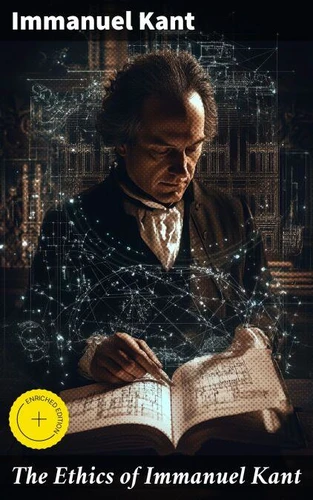
The Ethics of Immanuel Kant
In "The Ethics of Immanuel Kant, " the philosopher presents a rigorous exploration of moral philosophy rooted in the principles of duty and the categorical imperative. Kant meticulously delineates a framework that prioritizes rationality and autonomy, positioning ethics not merely as a series of prescribed morals but as an imperative grounded in reason. His literary style is characterized by precision and a systematic approach, as he engages with the works of his predecessors and contemporaries to refine his philosophical stance.
The text stands as a pivotal work in the Enlightenment tradition, inviting readers to contemplate the universality of ethical laws applicable to all rational beings. Immanuel Kant (1724-1804), a central figure in modern philosophy, was profoundly influenced by the tumultuous political landscape of his time, alongside the emerging scientific thought. His experiences in the Prussian Enlightenment and the struggles between rationalism and empiricism served as a backdrop that inspired his inquiry.
These intellectual currents informed his quest for a foundational moral philosophy that transcends empirical inclinations, leading to the formulation of his ethical theories. Readers seeking to understand the critical underpinnings of modern ethical thought will find "The Ethics of Immanuel Kant" an indispensable text. Kant's work remains vital in contemporary moral discourse, fostering an understanding of the importance of reason in ethical deliberations.
It is a profound invitation to engage with the philosophical underpinnings of morality and the ongoing quest for a rational ethical framework. In this enriched edition, we have carefully created added value for your reading experience: - A comprehensive Introduction outlines these selected works' unifying features, themes, or stylistic evolutions. - The Author Biography highlights personal milestones and literary influences that shape the entire body of writing. - A Historical Context section situates the works in their broader era-social currents, cultural trends, and key events that underpin their creation. - A concise Synopsis (Selection) offers an accessible overview of the included texts, helping readers navigate plotlines and main ideas without revealing critical twists. - A unified Analysis examines recurring motifs and stylistic hallmarks across the collection, tying the stories together while spotlighting the different work's strengths. - Reflection questions inspire deeper contemplation of the author's overarching message, inviting readers to draw connections among different texts and relate them to modern contexts. - Lastly, our hand-picked Memorable Quotes distill pivotal lines and turning points, serving as touchstones for the collection's central themes.
The text stands as a pivotal work in the Enlightenment tradition, inviting readers to contemplate the universality of ethical laws applicable to all rational beings. Immanuel Kant (1724-1804), a central figure in modern philosophy, was profoundly influenced by the tumultuous political landscape of his time, alongside the emerging scientific thought. His experiences in the Prussian Enlightenment and the struggles between rationalism and empiricism served as a backdrop that inspired his inquiry.
These intellectual currents informed his quest for a foundational moral philosophy that transcends empirical inclinations, leading to the formulation of his ethical theories. Readers seeking to understand the critical underpinnings of modern ethical thought will find "The Ethics of Immanuel Kant" an indispensable text. Kant's work remains vital in contemporary moral discourse, fostering an understanding of the importance of reason in ethical deliberations.
It is a profound invitation to engage with the philosophical underpinnings of morality and the ongoing quest for a rational ethical framework. In this enriched edition, we have carefully created added value for your reading experience: - A comprehensive Introduction outlines these selected works' unifying features, themes, or stylistic evolutions. - The Author Biography highlights personal milestones and literary influences that shape the entire body of writing. - A Historical Context section situates the works in their broader era-social currents, cultural trends, and key events that underpin their creation. - A concise Synopsis (Selection) offers an accessible overview of the included texts, helping readers navigate plotlines and main ideas without revealing critical twists. - A unified Analysis examines recurring motifs and stylistic hallmarks across the collection, tying the stories together while spotlighting the different work's strengths. - Reflection questions inspire deeper contemplation of the author's overarching message, inviting readers to draw connections among different texts and relate them to modern contexts. - Lastly, our hand-picked Memorable Quotes distill pivotal lines and turning points, serving as touchstones for the collection's central themes.
In "The Ethics of Immanuel Kant, " the philosopher presents a rigorous exploration of moral philosophy rooted in the principles of duty and the categorical imperative. Kant meticulously delineates a framework that prioritizes rationality and autonomy, positioning ethics not merely as a series of prescribed morals but as an imperative grounded in reason. His literary style is characterized by precision and a systematic approach, as he engages with the works of his predecessors and contemporaries to refine his philosophical stance.
The text stands as a pivotal work in the Enlightenment tradition, inviting readers to contemplate the universality of ethical laws applicable to all rational beings. Immanuel Kant (1724-1804), a central figure in modern philosophy, was profoundly influenced by the tumultuous political landscape of his time, alongside the emerging scientific thought. His experiences in the Prussian Enlightenment and the struggles between rationalism and empiricism served as a backdrop that inspired his inquiry.
These intellectual currents informed his quest for a foundational moral philosophy that transcends empirical inclinations, leading to the formulation of his ethical theories. Readers seeking to understand the critical underpinnings of modern ethical thought will find "The Ethics of Immanuel Kant" an indispensable text. Kant's work remains vital in contemporary moral discourse, fostering an understanding of the importance of reason in ethical deliberations.
It is a profound invitation to engage with the philosophical underpinnings of morality and the ongoing quest for a rational ethical framework. In this enriched edition, we have carefully created added value for your reading experience: - A comprehensive Introduction outlines these selected works' unifying features, themes, or stylistic evolutions. - The Author Biography highlights personal milestones and literary influences that shape the entire body of writing. - A Historical Context section situates the works in their broader era-social currents, cultural trends, and key events that underpin their creation. - A concise Synopsis (Selection) offers an accessible overview of the included texts, helping readers navigate plotlines and main ideas without revealing critical twists. - A unified Analysis examines recurring motifs and stylistic hallmarks across the collection, tying the stories together while spotlighting the different work's strengths. - Reflection questions inspire deeper contemplation of the author's overarching message, inviting readers to draw connections among different texts and relate them to modern contexts. - Lastly, our hand-picked Memorable Quotes distill pivotal lines and turning points, serving as touchstones for the collection's central themes.
The text stands as a pivotal work in the Enlightenment tradition, inviting readers to contemplate the universality of ethical laws applicable to all rational beings. Immanuel Kant (1724-1804), a central figure in modern philosophy, was profoundly influenced by the tumultuous political landscape of his time, alongside the emerging scientific thought. His experiences in the Prussian Enlightenment and the struggles between rationalism and empiricism served as a backdrop that inspired his inquiry.
These intellectual currents informed his quest for a foundational moral philosophy that transcends empirical inclinations, leading to the formulation of his ethical theories. Readers seeking to understand the critical underpinnings of modern ethical thought will find "The Ethics of Immanuel Kant" an indispensable text. Kant's work remains vital in contemporary moral discourse, fostering an understanding of the importance of reason in ethical deliberations.
It is a profound invitation to engage with the philosophical underpinnings of morality and the ongoing quest for a rational ethical framework. In this enriched edition, we have carefully created added value for your reading experience: - A comprehensive Introduction outlines these selected works' unifying features, themes, or stylistic evolutions. - The Author Biography highlights personal milestones and literary influences that shape the entire body of writing. - A Historical Context section situates the works in their broader era-social currents, cultural trends, and key events that underpin their creation. - A concise Synopsis (Selection) offers an accessible overview of the included texts, helping readers navigate plotlines and main ideas without revealing critical twists. - A unified Analysis examines recurring motifs and stylistic hallmarks across the collection, tying the stories together while spotlighting the different work's strengths. - Reflection questions inspire deeper contemplation of the author's overarching message, inviting readers to draw connections among different texts and relate them to modern contexts. - Lastly, our hand-picked Memorable Quotes distill pivotal lines and turning points, serving as touchstones for the collection's central themes.
Les livres de William Hastie
The Ethics of Immanuel Kant. Enriched edition. Metaphysics of Morals - Philosophy of Law & The Doctrine of Virtue + Perpetual Peace + The Critique of Practical Reason: Theory of Moral Reasoning
Immanuel Kant, Thomas Kingsmill Abbott, William Hastie, Meredith Langley
E-book
1,99 €

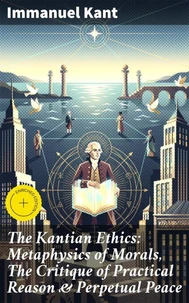
The Kantian Ethics: Metaphysics of Morals, The Critique of Practical Reason & Perpetual Peace. Enriched edition. Exploring the Moral Foundations of Reason and Autonomy
Immanuel Kant, Thomas Kingsmill Abbott, William Hastie, Maxwell Clark
E-book
0,99 €

0,49 €

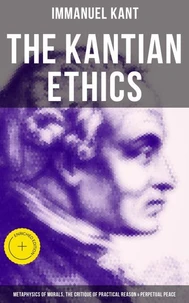
The Kantian Ethics: Metaphysics of Morals, The Critique of Practical Reason & Perpetual Peace. Enriched edition.
Immanuel Kant, Thomas Kingsmill Abbott, William Hastie, Grant McNeil
E-book
0,99 €

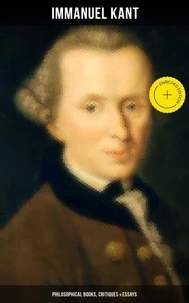
IMMANUEL KANT: Philosophical Books, Critiques & Essays. Enriched edition. The Critique of Pure Reason, Practical Reason and Judgment; Philosophy of Law…
Immanuel Kant, J. M. D. Meiklejohn, T. K. Abbott, J. H. Bernard, William Hastie
E-book
0,99 €

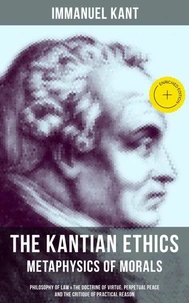
The Kantian Ethics: Metaphysics of Morals. Enriched edition. Philosophy of Law & The Doctrine of Virtue; Perpetual Peace; The Critique of Practical Reason
Immanuel Kant, Thomas Kingsmill Abbott, William Hastie, Grant McNeil
E-book
0,49 €