OFFRE LISEUSES
Une liseuse achetée = une housse offerte* jusqu'au 21 juin
- Accueil /
- Petra Mayrhofer
Petra Mayrhofer

Dernière sortie
Diplomacy in Southeastern Europe
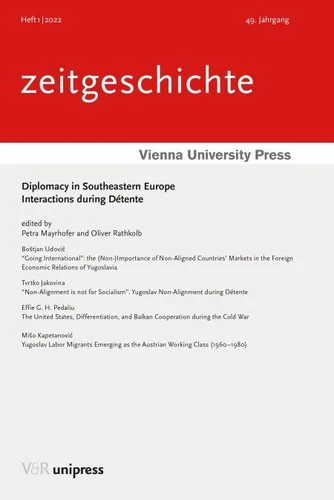
This issue of zeitgeschichte off ers a comprehensive survey of aspects of Yugoslav foreign policy during Cold War détente. Due to its geostrategic location on the Balkan peninsula, Yugoslavia became an important focus for the U. S. S. R. and the United States during the East-West confl ict. After the break with Stalin in 1948, the Yugoslav "leader" Tito sought to position Yugoslavia as a non-aligned state on the international level and played a hegemonic role in the Non-Aligned Movement (NAM).
The articles analyze Yugoslav policy in the 1960s and 1970s, examining its intentions, its developments, its strategic advantages, and its limits in the context of (geo-)political, economic, and cultural circumstances, with a focus on non-alignment as a leitmotiv of Yugoslav political ambitions, political and economic relations between Yugoslavia and countries of the NAM, the role of the Balkans in U.
S. Cold War policy, and aspects of Yugoslav labor migration.
The articles analyze Yugoslav policy in the 1960s and 1970s, examining its intentions, its developments, its strategic advantages, and its limits in the context of (geo-)political, economic, and cultural circumstances, with a focus on non-alignment as a leitmotiv of Yugoslav political ambitions, political and economic relations between Yugoslavia and countries of the NAM, the role of the Balkans in U.
S. Cold War policy, and aspects of Yugoslav labor migration.

This issue of zeitgeschichte off ers a comprehensive survey of aspects of Yugoslav foreign policy during Cold War détente. Due to its geostrategic location on the Balkan peninsula, Yugoslavia became an important focus for the U. S. S. R. and the United States during the East-West confl ict. After the break with Stalin in 1948, the Yugoslav "leader" Tito sought to position Yugoslavia as a non-aligned state on the international level and played a hegemonic role in the Non-Aligned Movement (NAM).
The articles analyze Yugoslav policy in the 1960s and 1970s, examining its intentions, its developments, its strategic advantages, and its limits in the context of (geo-)political, economic, and cultural circumstances, with a focus on non-alignment as a leitmotiv of Yugoslav political ambitions, political and economic relations between Yugoslavia and countries of the NAM, the role of the Balkans in U.
S. Cold War policy, and aspects of Yugoslav labor migration.

The articles analyze Yugoslav policy in the 1960s and 1970s, examining its intentions, its developments, its strategic advantages, and its limits in the context of (geo-)political, economic, and cultural circumstances, with a focus on non-alignment as a leitmotiv of Yugoslav political ambitions, political and economic relations between Yugoslavia and countries of the NAM, the role of the Balkans in U.
S. Cold War policy, and aspects of Yugoslav labor migration.
Les livres de Petra Mayrhofer

Die revolutionären Umbrüche in Europa 1989/91. Deutungen und Repräsentationen
Jörg Ganzenmüller, Ralph Jessen, Axel Doßmann, Petra Mayrhofer
E-book
35,00 €

The Memory of Guilt Revisited. The Slovenian Post-Socialist Remembrance Landscape in Transition
Oto Luthar, Heidemarie Uhl, Petra Mayrhofer
E-book
23,00 €
