OFFRE LISEUSES
Une liseuse achetée = une housse offerte* jusqu'au 21 juin
- Accueil /
- Samuel Hahnemann
Samuel Hahnemann

Dernière sortie
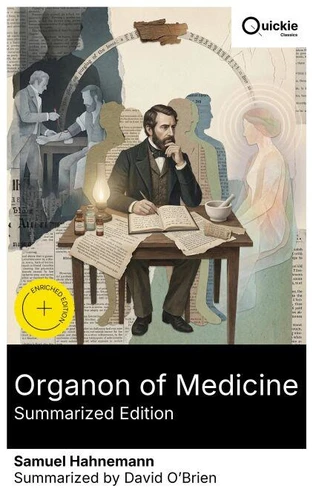
Organon of Medicine (Summarized Edition)
Organon of Medicine distills Hahnemann's homeopathic doctrine into aphorisms that outline a radical therapeutic program: rigorous case-taking, individualization, single remedies in minimum doses, and remedies selected by the law of similars. Combining polemical prefaces with marginalia and observations, the treatise argues for a dynamic vital force and the primacy of provings. Composed against the backdrop of early nineteenth-century heroic medicine, it offers a systematic alternative to bleeding, purging, and polypharmacy.
Samuel Hahnemann (1755-1843), a German physician, chemist, and prolific translator, wrote from disenchantment with prevailing practice. His linguistic and chemical erudition fed a methodological rigor rare among contemporaries; his self-experiment with cinchona bark crystallized the similitude principle. Reworking successive editions, he refined posology and clinical method, guided by a humane imperative to reduce iatrogenic harm and by Enlightenment ideals of observation and reproducibility.
This book rewards readers in medical history, therapeutics, and the sociology of knowledge, whether sympathetic or skeptical of homeopathy. Read it to understand a formative, controversial attempt to reconstruct medicine on experiential grounds, and to trace enduring debates about evidence, individuality, and ethics in care. Scholars should consult a critical edition and attend to the revisions culminating in the sixth edition's subtle shifts in potency and practice. Quickie Classics summarizes timeless works with precision, preserving the author's voice and keeping the prose clear, fast, and readable-distilled, never diluted.
Enriched Edition extras: Introduction · Synopsis · Historical Context · Brief Analysis · 4 Reflection Q&As · Editorial Footnotes.
Samuel Hahnemann (1755-1843), a German physician, chemist, and prolific translator, wrote from disenchantment with prevailing practice. His linguistic and chemical erudition fed a methodological rigor rare among contemporaries; his self-experiment with cinchona bark crystallized the similitude principle. Reworking successive editions, he refined posology and clinical method, guided by a humane imperative to reduce iatrogenic harm and by Enlightenment ideals of observation and reproducibility.
This book rewards readers in medical history, therapeutics, and the sociology of knowledge, whether sympathetic or skeptical of homeopathy. Read it to understand a formative, controversial attempt to reconstruct medicine on experiential grounds, and to trace enduring debates about evidence, individuality, and ethics in care. Scholars should consult a critical edition and attend to the revisions culminating in the sixth edition's subtle shifts in potency and practice. Quickie Classics summarizes timeless works with precision, preserving the author's voice and keeping the prose clear, fast, and readable-distilled, never diluted.
Enriched Edition extras: Introduction · Synopsis · Historical Context · Brief Analysis · 4 Reflection Q&As · Editorial Footnotes.
Organon of Medicine distills Hahnemann's homeopathic doctrine into aphorisms that outline a radical therapeutic program: rigorous case-taking, individualization, single remedies in minimum doses, and remedies selected by the law of similars. Combining polemical prefaces with marginalia and observations, the treatise argues for a dynamic vital force and the primacy of provings. Composed against the backdrop of early nineteenth-century heroic medicine, it offers a systematic alternative to bleeding, purging, and polypharmacy.
Samuel Hahnemann (1755-1843), a German physician, chemist, and prolific translator, wrote from disenchantment with prevailing practice. His linguistic and chemical erudition fed a methodological rigor rare among contemporaries; his self-experiment with cinchona bark crystallized the similitude principle. Reworking successive editions, he refined posology and clinical method, guided by a humane imperative to reduce iatrogenic harm and by Enlightenment ideals of observation and reproducibility.
This book rewards readers in medical history, therapeutics, and the sociology of knowledge, whether sympathetic or skeptical of homeopathy. Read it to understand a formative, controversial attempt to reconstruct medicine on experiential grounds, and to trace enduring debates about evidence, individuality, and ethics in care. Scholars should consult a critical edition and attend to the revisions culminating in the sixth edition's subtle shifts in potency and practice. Quickie Classics summarizes timeless works with precision, preserving the author's voice and keeping the prose clear, fast, and readable-distilled, never diluted.
Enriched Edition extras: Introduction · Synopsis · Historical Context · Brief Analysis · 4 Reflection Q&As · Editorial Footnotes.

Samuel Hahnemann (1755-1843), a German physician, chemist, and prolific translator, wrote from disenchantment with prevailing practice. His linguistic and chemical erudition fed a methodological rigor rare among contemporaries; his self-experiment with cinchona bark crystallized the similitude principle. Reworking successive editions, he refined posology and clinical method, guided by a humane imperative to reduce iatrogenic harm and by Enlightenment ideals of observation and reproducibility.
This book rewards readers in medical history, therapeutics, and the sociology of knowledge, whether sympathetic or skeptical of homeopathy. Read it to understand a formative, controversial attempt to reconstruct medicine on experiential grounds, and to trace enduring debates about evidence, individuality, and ethics in care. Scholars should consult a critical edition and attend to the revisions culminating in the sixth edition's subtle shifts in potency and practice. Quickie Classics summarizes timeless works with precision, preserving the author's voice and keeping the prose clear, fast, and readable-distilled, never diluted.
Enriched Edition extras: Introduction · Synopsis · Historical Context · Brief Analysis · 4 Reflection Q&As · Editorial Footnotes.
Les livres de Samuel Hahnemann

1,99 €

Doctrine of Homeopathy – Premium Colllection. Organon of Medicine, Of the Homoeopathic Doctrines, Homoeopathy as a Science…
Samuel Hahnemann, JOHN ELLIS, J. G. Millingen, Edward Bayard, William Boericke
E-book
1,99 €

0,99 €

Organon der Heilkunst. Bereicherte Ausgabe. 291 Sprichwörter über die Heilung und Medizin
Samuel Hahnemann, Christoph Wilhelm
E-book
0,49 €

Organon of Medicine: The Principles of Homeopathy. Exploring the Holistic Principles of Classical Homeopathy
Samuel Hahnemann, William Boericke
E-book
0,99 €

Doctrine of Homeopathy – The Art of Healing. Organon of Medicine, Of the Homoeopathic Doctrines, Homoeopathy as a Science…
Samuel Hahnemann, JOHN ELLIS, J. G. Millingen, Edward Bayard, William Boericke
E-book
0,99 €

0,49 €

Organon der Heilkunst. Bereicherte Ausgabe. 291 Sprichwörter über die Heilung und Medizin
Samuel Hahnemann, Everett Cole
E-book
0,99 €

0,99 €

Doctrine of Homeopathy – Premium Colllection. Organon of Medicine, Of the Homoeopathic Doctrines, Homoeopathy as a Science…
Samuel Hahnemann, JOHN ELLIS, J. G. Millingen, Edward Bayard, William Boericke
E-book
1,99 €

Doctrine of Homeopathy. Organon of Medicine, Of the Homoeopathic Doctrines, Homoeopathy as a Science…
Samuel Hahnemann, J. G. Millingen, Edward Bayard, JOHN ELLIS, William Boericke
E-book
0,49 €

0,99 €

Organon der Heilkunst. Bereicherte Ausgabe. 291 Sprichwörter über die Heilung und Medizin
Samuel Hahnemann, Isabella Heinrich
E-book
0,49 €