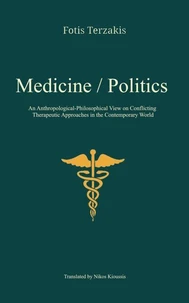
This book is a comprehensive examination of the field of medicine today from a philosophical, epistemological, socio-anthropological, and political perspective. It contains several layers, unified by a persistent question about health, disease, and healing and the political relevance of how we understand them. One layer of the book is the critique of current affairs, from which it begins: the medicalization of repression, starting with the so-called "covid-pandemic" and its political management.
However, to comprehend the significance of the abovementioned events, a much broader perspective opens up, the perspective of a world-history of medical concepts and practices from antiquity to the modern Western (mechanistic-Cartesian) science. The point of view is socio-anthropological in that it attempts a relativization of the "truth" of the Western biomedical epistemological paradigm in the light of different cultural approaches ("primitive", ancient, Medieval, Eastern, etc.).
Through this extensive cultural comparison, the main epistemological-philosophical question emerges: how will disease be centrally signaled - as an exogenous invasion or as a breakdown of the innate immunity system? Part of the book is an extensive discussion of modern so called "alternative" therapies, like psychanalysis and existential analysis, homeopathy and acupuncture, consisting a current "therapeutic opposition".
Since they are quite different from each other at first glance, the possibility of their theoretical unification is also explored, towards a deeper epistemological model, compatible with the political project of a transcendence of capitalism and a non-dominant relationship of civilization with nature, upon which humanity's ongoing pursuit for happiness depends.
This book is a comprehensive examination of the field of medicine today from a philosophical, epistemological, socio-anthropological, and political perspective. It contains several layers, unified by a persistent question about health, disease, and healing and the political relevance of how we understand them. One layer of the book is the critique of current affairs, from which it begins: the medicalization of repression, starting with the so-called "covid-pandemic" and its political management.
However, to comprehend the significance of the abovementioned events, a much broader perspective opens up, the perspective of a world-history of medical concepts and practices from antiquity to the modern Western (mechanistic-Cartesian) science. The point of view is socio-anthropological in that it attempts a relativization of the "truth" of the Western biomedical epistemological paradigm in the light of different cultural approaches ("primitive", ancient, Medieval, Eastern, etc.).
Through this extensive cultural comparison, the main epistemological-philosophical question emerges: how will disease be centrally signaled - as an exogenous invasion or as a breakdown of the innate immunity system? Part of the book is an extensive discussion of modern so called "alternative" therapies, like psychanalysis and existential analysis, homeopathy and acupuncture, consisting a current "therapeutic opposition".
Since they are quite different from each other at first glance, the possibility of their theoretical unification is also explored, towards a deeper epistemological model, compatible with the political project of a transcendence of capitalism and a non-dominant relationship of civilization with nature, upon which humanity's ongoing pursuit for happiness depends.