OFFRE LISEUSES
Une liseuse achetée = une housse offerte* jusqu'au 21 juin
- Accueil /
- Sameer Shaikh
Sameer Shaikh

Dernière sortie
SAS Credit Risk EAD Modelling- A to Z of EAD Modelling using SAS
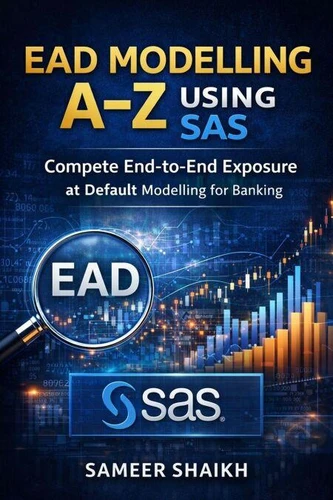
?? EAD Modelling A-Z Using SASComplete End-to-End Exposure at Default Modelling Framework Used by BanksExposure at Default (EAD) is one of the most misunderstood and poorly documented components of credit risk modelling. While extensive material exists on PD and LGD, very few resources explain how EAD is actually built, validated, governed, and deployed in real banking environments. This book fills that gap."EAD Modelling A-Z Using SAS" is a comprehensive, practitioner-first guide that walks through the entire EAD lifecycle exactly as implemented in banks, using 100% SAS-based workflows.
It goes far beyond theory to show how EAD models are built in practice-from raw data to production deployment. This is one of the very few books globally that: Treats EAD as a standalone behavioural model, not a balance proxy Explains Credit Conversion Factor (CCF) modelling in depth Demonstrates bank-realistic panel construction, default alignment, and target creation Covers variable engineering, reduction, modelling, validation, stress, deployment, and governance in one integrated framework Uses fully replicable SAS code and bank-style logic, not academic shortcuts ?? What This Book Covers? Product scoping and eligibility rules used by banks? Observation window design and default alignment? Monthly facility-level panel construction? EAD target creation and validation? Behavioural CCF modelling (windows, caps, constraints)? Utilisation, drawdown, payment, and limit behaviour variables? Data quality, outliers, and missing value treatment? Variable screening, IV, correlation, and multicollinearity handling? Segment-wise EAD and CCF models? Constrained and bounded EAD models? Model validation, backtesting, and monitoring? Downturn and stress EAD overlays? Production deployment and audit-ready governance? A full end-to-end bank case study with real-number examples?? Who This Book Is ForThis book is written for: Credit risk modellers and analysts IFRS-9 and Basel practitioners Model validation and model risk teams SAS professionals working in banking and finance Risk managers, auditors, and regulators seeking clarity on EAD practices It assumes basic familiarity with credit risk concepts, but no prior EAD expertise.?? Why This Book Is DifferentMost resources describe what EAD is.
This book shows how EAD is actually done in banks. There is no filler, no generic theory, and no black-box explanations. Every step is grounded in real banking logic, governance expectations, and SAS implementation practices used in live production environments. If PD and LGD modelling already have "A-Z" references, this book finally does the same for EAD.
It goes far beyond theory to show how EAD models are built in practice-from raw data to production deployment. This is one of the very few books globally that: Treats EAD as a standalone behavioural model, not a balance proxy Explains Credit Conversion Factor (CCF) modelling in depth Demonstrates bank-realistic panel construction, default alignment, and target creation Covers variable engineering, reduction, modelling, validation, stress, deployment, and governance in one integrated framework Uses fully replicable SAS code and bank-style logic, not academic shortcuts ?? What This Book Covers? Product scoping and eligibility rules used by banks? Observation window design and default alignment? Monthly facility-level panel construction? EAD target creation and validation? Behavioural CCF modelling (windows, caps, constraints)? Utilisation, drawdown, payment, and limit behaviour variables? Data quality, outliers, and missing value treatment? Variable screening, IV, correlation, and multicollinearity handling? Segment-wise EAD and CCF models? Constrained and bounded EAD models? Model validation, backtesting, and monitoring? Downturn and stress EAD overlays? Production deployment and audit-ready governance? A full end-to-end bank case study with real-number examples?? Who This Book Is ForThis book is written for: Credit risk modellers and analysts IFRS-9 and Basel practitioners Model validation and model risk teams SAS professionals working in banking and finance Risk managers, auditors, and regulators seeking clarity on EAD practices It assumes basic familiarity with credit risk concepts, but no prior EAD expertise.?? Why This Book Is DifferentMost resources describe what EAD is.
This book shows how EAD is actually done in banks. There is no filler, no generic theory, and no black-box explanations. Every step is grounded in real banking logic, governance expectations, and SAS implementation practices used in live production environments. If PD and LGD modelling already have "A-Z" references, this book finally does the same for EAD.
?? EAD Modelling A-Z Using SASComplete End-to-End Exposure at Default Modelling Framework Used by BanksExposure at Default (EAD) is one of the most misunderstood and poorly documented components of credit risk modelling. While extensive material exists on PD and LGD, very few resources explain how EAD is actually built, validated, governed, and deployed in real banking environments. This book fills that gap."EAD Modelling A-Z Using SAS" is a comprehensive, practitioner-first guide that walks through the entire EAD lifecycle exactly as implemented in banks, using 100% SAS-based workflows.
It goes far beyond theory to show how EAD models are built in practice-from raw data to production deployment. This is one of the very few books globally that: Treats EAD as a standalone behavioural model, not a balance proxy Explains Credit Conversion Factor (CCF) modelling in depth Demonstrates bank-realistic panel construction, default alignment, and target creation Covers variable engineering, reduction, modelling, validation, stress, deployment, and governance in one integrated framework Uses fully replicable SAS code and bank-style logic, not academic shortcuts ?? What This Book Covers? Product scoping and eligibility rules used by banks? Observation window design and default alignment? Monthly facility-level panel construction? EAD target creation and validation? Behavioural CCF modelling (windows, caps, constraints)? Utilisation, drawdown, payment, and limit behaviour variables? Data quality, outliers, and missing value treatment? Variable screening, IV, correlation, and multicollinearity handling? Segment-wise EAD and CCF models? Constrained and bounded EAD models? Model validation, backtesting, and monitoring? Downturn and stress EAD overlays? Production deployment and audit-ready governance? A full end-to-end bank case study with real-number examples?? Who This Book Is ForThis book is written for: Credit risk modellers and analysts IFRS-9 and Basel practitioners Model validation and model risk teams SAS professionals working in banking and finance Risk managers, auditors, and regulators seeking clarity on EAD practices It assumes basic familiarity with credit risk concepts, but no prior EAD expertise.?? Why This Book Is DifferentMost resources describe what EAD is.
This book shows how EAD is actually done in banks. There is no filler, no generic theory, and no black-box explanations. Every step is grounded in real banking logic, governance expectations, and SAS implementation practices used in live production environments. If PD and LGD modelling already have "A-Z" references, this book finally does the same for EAD.
It goes far beyond theory to show how EAD models are built in practice-from raw data to production deployment. This is one of the very few books globally that: Treats EAD as a standalone behavioural model, not a balance proxy Explains Credit Conversion Factor (CCF) modelling in depth Demonstrates bank-realistic panel construction, default alignment, and target creation Covers variable engineering, reduction, modelling, validation, stress, deployment, and governance in one integrated framework Uses fully replicable SAS code and bank-style logic, not academic shortcuts ?? What This Book Covers? Product scoping and eligibility rules used by banks? Observation window design and default alignment? Monthly facility-level panel construction? EAD target creation and validation? Behavioural CCF modelling (windows, caps, constraints)? Utilisation, drawdown, payment, and limit behaviour variables? Data quality, outliers, and missing value treatment? Variable screening, IV, correlation, and multicollinearity handling? Segment-wise EAD and CCF models? Constrained and bounded EAD models? Model validation, backtesting, and monitoring? Downturn and stress EAD overlays? Production deployment and audit-ready governance? A full end-to-end bank case study with real-number examples?? Who This Book Is ForThis book is written for: Credit risk modellers and analysts IFRS-9 and Basel practitioners Model validation and model risk teams SAS professionals working in banking and finance Risk managers, auditors, and regulators seeking clarity on EAD practices It assumes basic familiarity with credit risk concepts, but no prior EAD expertise.?? Why This Book Is DifferentMost resources describe what EAD is.
This book shows how EAD is actually done in banks. There is no filler, no generic theory, and no black-box explanations. Every step is grounded in real banking logic, governance expectations, and SAS implementation practices used in live production environments. If PD and LGD modelling already have "A-Z" references, this book finally does the same for EAD.
Les livres de Sameer Shaikh

6,99 €

2,99 €

5,49 €

2,99 €

6,99 €