SOLDES
Jusqu'à -70% sur une sélection d'articles*
Dernière sortie
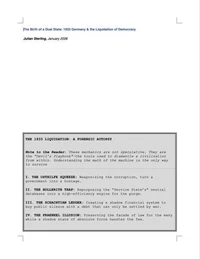
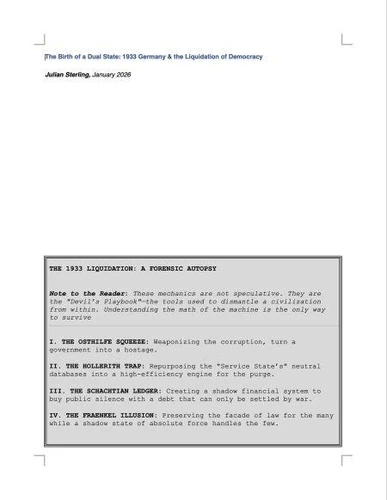
The Birth of a Dual State: 1933 Germany & the Liquidation of Democracy
History likes a good street fight. Torches. Boots. Men shouting into the night. That's the story they tell the children. But nations don't usually die in the open. They die indoors. While the crowds watched the rise of the Bohemian Corporal, a smaller gathering was taking place-men in tailored grey wool, seated comfortably in paneled rooms, speaking softly, signing carefully. No speeches. No salutes.
Just the patient work of professionals. A country was being taken apart one clause at a time. This was not good versus evil. It was business. In The 1933 Liquidation, Julian Sterling delivers a cold-eyed autopsy of Germany's administrative capture, revealing the Four Pillars of Liquidation-the operating system of a hostile takeover disguised as governance: The Squeeze - a private scandal, leveraged just enough to make guardians pliable.
The Trap - neutral ledgers quietly bridged, creating the first true administrative snare. The Ledger - shadow debt, weaponized, turning insolvency into obedience. The Great Bifurcation - law preserved for appearances, power rerouted elsewhere. By 1938, the machine ran beautifully. It was efficient. Solvent. Untouchable. And like all perfect machines, it had no soul. The 1933 Liquidation is not a warning shouted from the streets.
It's a conversation held in a low voice, over polished wood. A briefing for those who understand that the most dangerous men don't carry rifles-they carry authority. And that a signature, placed in the right sub-clause, can do what a thousand bayonets never could. History doesn't repeat itself. But the men who know how to make an offer-one the state can't refuse-are always with us.
Just the patient work of professionals. A country was being taken apart one clause at a time. This was not good versus evil. It was business. In The 1933 Liquidation, Julian Sterling delivers a cold-eyed autopsy of Germany's administrative capture, revealing the Four Pillars of Liquidation-the operating system of a hostile takeover disguised as governance: The Squeeze - a private scandal, leveraged just enough to make guardians pliable.
The Trap - neutral ledgers quietly bridged, creating the first true administrative snare. The Ledger - shadow debt, weaponized, turning insolvency into obedience. The Great Bifurcation - law preserved for appearances, power rerouted elsewhere. By 1938, the machine ran beautifully. It was efficient. Solvent. Untouchable. And like all perfect machines, it had no soul. The 1933 Liquidation is not a warning shouted from the streets.
It's a conversation held in a low voice, over polished wood. A briefing for those who understand that the most dangerous men don't carry rifles-they carry authority. And that a signature, placed in the right sub-clause, can do what a thousand bayonets never could. History doesn't repeat itself. But the men who know how to make an offer-one the state can't refuse-are always with us.