- Accueil /
- Chrispen Dee
Chrispen Dee

Dernière sortie
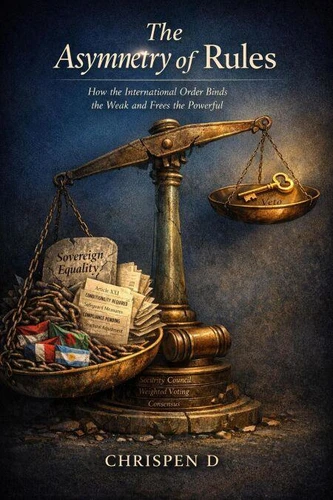
The Asymmetry of Rules
The "rules-based international order" is the defining mantra of our era. Western leaders invoke it to distinguish their vision from authoritarian alternatives. International institutions claim it as their foundational purpose. Scholars treat it as the unquestioned architecture of global politics. But what if this promise of universal law and impartial governance has always been a carefully constructed illusion?"The Asymmetry of Rules" exposes the uncomfortable reality that lies beneath the veneer of global cooperation: a system that constrains the weak while licensing the powerful.
This is not a story of occasional hypocrisy but of a designed hierarchy, where legal forms and institutional procedures camouflage enduring dominance. From the IMF's conditional lending to the WTO's paralyzed Appellate Body, and from the UN Security Council's veto to the weaponization of dollar dominance and supply chains, this book traces the deep architecture of power that rules are built to serve.
Drawing on international political economy, critical legal theory, and Gramscian concepts of hegemony, this work reveals how the international order functions as a subtle apparatus of control. It dissects the mechanisms of "asymmetric multilateralism, " where rules are applied, interpreted, and enforced unevenly. It shows how "predictability" was once used as a compensation for inequality, and how the erosion of that predictability is now fracturing the global consensus.
This is more than a critique. As the illusions of impartiality crumble under the pressure of financial crises, selective enforcement, and the rise of alternative powers, "The Asymmetry of Rules" examines what comes next. It argues that the emerging global order will be neither universal anarchy nor a simple return to great-power rivalry. Instead, it will be a fragmented landscape of overlapping regimes, where states pursue "predictability without equality" through hedging, minilateralism, and competing institutional affiliations.

This is not a story of occasional hypocrisy but of a designed hierarchy, where legal forms and institutional procedures camouflage enduring dominance. From the IMF's conditional lending to the WTO's paralyzed Appellate Body, and from the UN Security Council's veto to the weaponization of dollar dominance and supply chains, this book traces the deep architecture of power that rules are built to serve.
Drawing on international political economy, critical legal theory, and Gramscian concepts of hegemony, this work reveals how the international order functions as a subtle apparatus of control. It dissects the mechanisms of "asymmetric multilateralism, " where rules are applied, interpreted, and enforced unevenly. It shows how "predictability" was once used as a compensation for inequality, and how the erosion of that predictability is now fracturing the global consensus.
This is more than a critique. As the illusions of impartiality crumble under the pressure of financial crises, selective enforcement, and the rise of alternative powers, "The Asymmetry of Rules" examines what comes next. It argues that the emerging global order will be neither universal anarchy nor a simple return to great-power rivalry. Instead, it will be a fragmented landscape of overlapping regimes, where states pursue "predictability without equality" through hedging, minilateralism, and competing institutional affiliations.

The "rules-based international order" is the defining mantra of our era. Western leaders invoke it to distinguish their vision from authoritarian alternatives. International institutions claim it as their foundational purpose. Scholars treat it as the unquestioned architecture of global politics. But what if this promise of universal law and impartial governance has always been a carefully constructed illusion?"The Asymmetry of Rules" exposes the uncomfortable reality that lies beneath the veneer of global cooperation: a system that constrains the weak while licensing the powerful.
This is not a story of occasional hypocrisy but of a designed hierarchy, where legal forms and institutional procedures camouflage enduring dominance. From the IMF's conditional lending to the WTO's paralyzed Appellate Body, and from the UN Security Council's veto to the weaponization of dollar dominance and supply chains, this book traces the deep architecture of power that rules are built to serve.
Drawing on international political economy, critical legal theory, and Gramscian concepts of hegemony, this work reveals how the international order functions as a subtle apparatus of control. It dissects the mechanisms of "asymmetric multilateralism, " where rules are applied, interpreted, and enforced unevenly. It shows how "predictability" was once used as a compensation for inequality, and how the erosion of that predictability is now fracturing the global consensus.
This is more than a critique. As the illusions of impartiality crumble under the pressure of financial crises, selective enforcement, and the rise of alternative powers, "The Asymmetry of Rules" examines what comes next. It argues that the emerging global order will be neither universal anarchy nor a simple return to great-power rivalry. Instead, it will be a fragmented landscape of overlapping regimes, where states pursue "predictability without equality" through hedging, minilateralism, and competing institutional affiliations.

This is not a story of occasional hypocrisy but of a designed hierarchy, where legal forms and institutional procedures camouflage enduring dominance. From the IMF's conditional lending to the WTO's paralyzed Appellate Body, and from the UN Security Council's veto to the weaponization of dollar dominance and supply chains, this book traces the deep architecture of power that rules are built to serve.
Drawing on international political economy, critical legal theory, and Gramscian concepts of hegemony, this work reveals how the international order functions as a subtle apparatus of control. It dissects the mechanisms of "asymmetric multilateralism, " where rules are applied, interpreted, and enforced unevenly. It shows how "predictability" was once used as a compensation for inequality, and how the erosion of that predictability is now fracturing the global consensus.
This is more than a critique. As the illusions of impartiality crumble under the pressure of financial crises, selective enforcement, and the rise of alternative powers, "The Asymmetry of Rules" examines what comes next. It argues that the emerging global order will be neither universal anarchy nor a simple return to great-power rivalry. Instead, it will be a fragmented landscape of overlapping regimes, where states pursue "predictability without equality" through hedging, minilateralism, and competing institutional affiliations.

Les livres de Chrispen Dee

5,99 €

1,99 €

4,99 €

6,49 €

5,99 €

5,49 €

5,99 €

6,49 €

5,99 €

2,99 €