- Accueil /
- Norbert Condoros
Norbert Condoros

Dernière sortie
Lottery Analysis
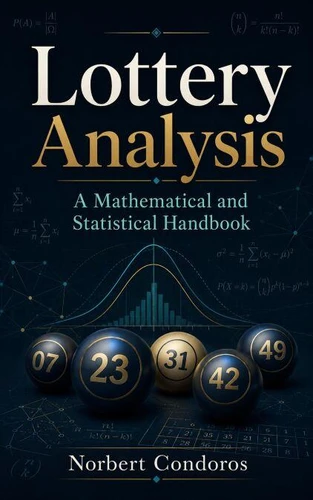
Can a lottery be analyzed rigorously without pretending that it can be predicted?Lottery Analysis: A Mathematical and Statistical Handbook examines what lottery data can-and cannot-tell us. Using the 6/49 format as its main case study, the book moves from the fundamentals of probability and combinatorics to full-field enumeration, structural analysis, waiting times, temporal diagnostics, Monte Carlo simulation, multiple-testing controls, player number-selection bias, and portfolio coverage.
Rather than treating every apparent pattern as meaningful, the book repeatedly asks a stricter question:Would the same pattern be surprising under a fair random model?Hot numbers, overdue numbers, streaks, clustering, periodicity, Hurst behavior, and other commonly discussed effects are examined against appropriate statistical baselines. When a result does not survive stronger testing, it is reported as such.
The book also separates two questions that are often confused: whether one valid lottery combination is more likely to be drawn than another; whether some combinations may be more popular among players, affecting prize-sharing risk if they win. This is not a winning system and does not claim to predict future draws. Instead, it is a detailed investigation of randomness, statistical validation, combination structure, player behavior, and mathematically defensible ways to analyze a lottery without crossing the line into superstition.
The analysis is supported by exact calculations, reproducible computational checks, sensitivity analysis, and a transparent discussion of the role of AI-assisted research and writing in the development of the book.
Rather than treating every apparent pattern as meaningful, the book repeatedly asks a stricter question:Would the same pattern be surprising under a fair random model?Hot numbers, overdue numbers, streaks, clustering, periodicity, Hurst behavior, and other commonly discussed effects are examined against appropriate statistical baselines. When a result does not survive stronger testing, it is reported as such.
The book also separates two questions that are often confused: whether one valid lottery combination is more likely to be drawn than another; whether some combinations may be more popular among players, affecting prize-sharing risk if they win. This is not a winning system and does not claim to predict future draws. Instead, it is a detailed investigation of randomness, statistical validation, combination structure, player behavior, and mathematically defensible ways to analyze a lottery without crossing the line into superstition.
The analysis is supported by exact calculations, reproducible computational checks, sensitivity analysis, and a transparent discussion of the role of AI-assisted research and writing in the development of the book.

Can a lottery be analyzed rigorously without pretending that it can be predicted?Lottery Analysis: A Mathematical and Statistical Handbook examines what lottery data can-and cannot-tell us. Using the 6/49 format as its main case study, the book moves from the fundamentals of probability and combinatorics to full-field enumeration, structural analysis, waiting times, temporal diagnostics, Monte Carlo simulation, multiple-testing controls, player number-selection bias, and portfolio coverage.
Rather than treating every apparent pattern as meaningful, the book repeatedly asks a stricter question:Would the same pattern be surprising under a fair random model?Hot numbers, overdue numbers, streaks, clustering, periodicity, Hurst behavior, and other commonly discussed effects are examined against appropriate statistical baselines. When a result does not survive stronger testing, it is reported as such.
The book also separates two questions that are often confused: whether one valid lottery combination is more likely to be drawn than another; whether some combinations may be more popular among players, affecting prize-sharing risk if they win. This is not a winning system and does not claim to predict future draws. Instead, it is a detailed investigation of randomness, statistical validation, combination structure, player behavior, and mathematically defensible ways to analyze a lottery without crossing the line into superstition.
The analysis is supported by exact calculations, reproducible computational checks, sensitivity analysis, and a transparent discussion of the role of AI-assisted research and writing in the development of the book.

Rather than treating every apparent pattern as meaningful, the book repeatedly asks a stricter question:Would the same pattern be surprising under a fair random model?Hot numbers, overdue numbers, streaks, clustering, periodicity, Hurst behavior, and other commonly discussed effects are examined against appropriate statistical baselines. When a result does not survive stronger testing, it is reported as such.
The book also separates two questions that are often confused: whether one valid lottery combination is more likely to be drawn than another; whether some combinations may be more popular among players, affecting prize-sharing risk if they win. This is not a winning system and does not claim to predict future draws. Instead, it is a detailed investigation of randomness, statistical validation, combination structure, player behavior, and mathematically defensible ways to analyze a lottery without crossing the line into superstition.
The analysis is supported by exact calculations, reproducible computational checks, sensitivity analysis, and a transparent discussion of the role of AI-assisted research and writing in the development of the book.

Les livres de Norbert Condoros

4,99 €

6,99 €

5,49 €

4,99 €