SOLDES
Jusqu'à -70% sur une sélection d'articles*
- Accueil /
- Erich Wolfgang Korngold
Erich Wolfgang Korngold

Dernière sortie
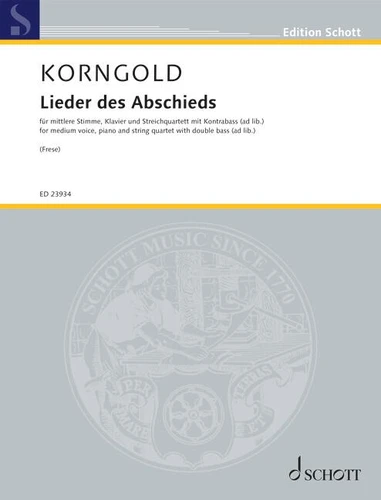
Lieder des Abschieds
Erich Wolfgang Korngold's Lieder des Abschieds op. 14 were composed in 1920-1921, immediately after his most famous opera Die tote Stadt and in close proximity to the Piano Quintet, op. 15. The close relationship to the Piano Quintet is especially visible in the second movement of the quintet, which Korngold himself described as "free variations on the 'Songs of Farewell', op. 14" and which was based in particular on the third song, Mond, so gehst du wieder auf.
Korngold orchestrated his songs for large orchestra shortly after completing the piano version. The present arrangement of the Lieder des Abschieds op. 14 was written for a concert in which the songs were followed by the Piano Quintet. Inspired by the second movement of the quintet, an arrangement for voice and piano quintet was an obvious choice, further emphasising the close relationship between the songs, op.
14, and the Piano Quintet. The double bass added to the piano quintet is ad libitum, as its part is almost completely doubled by the piano. Nevertheless, it lends the sound of the ensemble additional warmth and contour. The chamber music arrangement gives the songs an additional tonal dimension, which differentiates and intensifies the intimacy of the original piano part through extraordinary timbres.
- Andreas Frese Instrumentation : medium voice, 2 violins, viola, cello, double bass (ad lib.) and piano op. 14
Korngold orchestrated his songs for large orchestra shortly after completing the piano version. The present arrangement of the Lieder des Abschieds op. 14 was written for a concert in which the songs were followed by the Piano Quintet. Inspired by the second movement of the quintet, an arrangement for voice and piano quintet was an obvious choice, further emphasising the close relationship between the songs, op.
14, and the Piano Quintet. The double bass added to the piano quintet is ad libitum, as its part is almost completely doubled by the piano. Nevertheless, it lends the sound of the ensemble additional warmth and contour. The chamber music arrangement gives the songs an additional tonal dimension, which differentiates and intensifies the intimacy of the original piano part through extraordinary timbres.
- Andreas Frese Instrumentation : medium voice, 2 violins, viola, cello, double bass (ad lib.) and piano op. 14
Erich Wolfgang Korngold's Lieder des Abschieds op. 14 were composed in 1920-1921, immediately after his most famous opera Die tote Stadt and in close proximity to the Piano Quintet, op. 15. The close relationship to the Piano Quintet is especially visible in the second movement of the quintet, which Korngold himself described as "free variations on the 'Songs of Farewell', op. 14" and which was based in particular on the third song, Mond, so gehst du wieder auf.
Korngold orchestrated his songs for large orchestra shortly after completing the piano version. The present arrangement of the Lieder des Abschieds op. 14 was written for a concert in which the songs were followed by the Piano Quintet. Inspired by the second movement of the quintet, an arrangement for voice and piano quintet was an obvious choice, further emphasising the close relationship between the songs, op.
14, and the Piano Quintet. The double bass added to the piano quintet is ad libitum, as its part is almost completely doubled by the piano. Nevertheless, it lends the sound of the ensemble additional warmth and contour. The chamber music arrangement gives the songs an additional tonal dimension, which differentiates and intensifies the intimacy of the original piano part through extraordinary timbres.
- Andreas Frese Instrumentation : medium voice, 2 violins, viola, cello, double bass (ad lib.) and piano op. 14
Korngold orchestrated his songs for large orchestra shortly after completing the piano version. The present arrangement of the Lieder des Abschieds op. 14 was written for a concert in which the songs were followed by the Piano Quintet. Inspired by the second movement of the quintet, an arrangement for voice and piano quintet was an obvious choice, further emphasising the close relationship between the songs, op.
14, and the Piano Quintet. The double bass added to the piano quintet is ad libitum, as its part is almost completely doubled by the piano. Nevertheless, it lends the sound of the ensemble additional warmth and contour. The chamber music arrangement gives the songs an additional tonal dimension, which differentiates and intensifies the intimacy of the original piano part through extraordinary timbres.
- Andreas Frese Instrumentation : medium voice, 2 violins, viola, cello, double bass (ad lib.) and piano op. 14
Les livres de Erich Wolfgang Korngold

16,99 €


Edition Schott
Das Wunder der Heliane. “Ich ging zu ihm”. op. 20. piano. Edition séparée.
Erich Wolfgang Korngold
Partition
18,00 €

Edition Schott
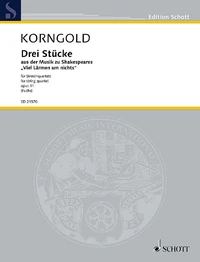
Drei Stücke. aus der Musik zu Shakespeares "Viel Lärmen um nichts". op. 11. string quartet. Partition et parties.
Erich Wolfgang Korngold
Partition
42,00 €

22,00 €

Edition Schott
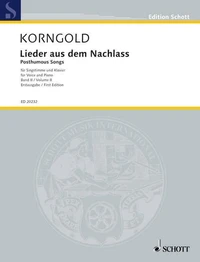
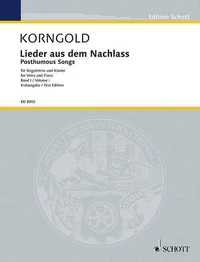
Mélodies posthumes. Première édition. medium voice and piano. moyenne.
Erich Wolfgang Korngold
32,50 €

Edition Schott
String Quartet No. 3. D major. op. 34. string quartet. Partition et parties.
Erich Wolfgang Korngold
65,00 €

Edition Schott
Mélodies posthumes. Première édition. medium voice and piano. moyenne.
Erich Wolfgang Korngold
34,00 €


Eulenburg Miniature Scores
Symphonie in Fa dièse. op. 40. orchestra. Partition d'étude.
Erich Wolfgang Korngold
49,00 €