SOLDES
Jusqu'à -70% sur une sélection d'articles*
Dernière sortie
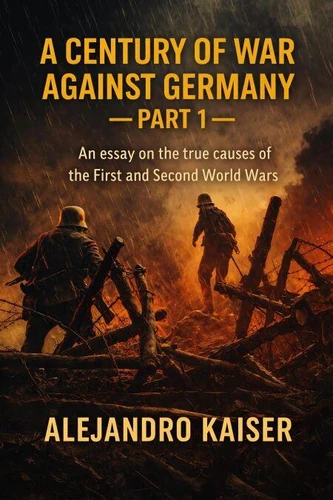
A Century of War Against Germany — Part 1: An essay on the true causes of the First and Second World Wars
EDITORIAL WARNING - HISTORICAL INVESTIGATION AND CRITICAL REVIEW OF SOURCESThis book does not seek to impose an alternative truth nor to deny established facts. Its purpose is to question, contrast, and critically examine the hegemonic historical narrative, returning to the reader the power to evaluate for themselves the real role of the powers involved in the world conflicts. Here there is no dogma: there are data, archives, primary quotations, and comparative evidence. "This is an English war, and its goal is the destruction of Germany."- Winston Churchill, September 3, 1939"Now we must move from defense to attack."- Joseph Stalin, May 5, 1941"Poland wants war with Germany, and Germany will not be able to avoid it even if it wants to."- Rydz-Smigly, Commander of the Polish Army, summer 1939"We did not go to war to save Germany from Hitler [.], but because we could not accept German supremacy in Europe."- The Sunday Correspondent, London, 17/09/1989"He who tells only half the truth is already a complete liar."- Wilhelm Heinrich Riehl What this book is really aboutFor more than a century, the dominant explanation for the origin of the World Wars has rested on an unquestionable pillar: Germany as the sole culprit.
However, this thesis -turned into political, educational, and cultural dogma- is rarely contrasted with British, Soviet, Polish, or American primary documents, or with military memoirs that suggest a reality far more complex than the simplified version disseminated after 1945. This book analyzes evidence that is public, verifiable, and accessible, yet remains marginal in school textbooks and media discourse. What is hidden when history is simplified.
The Allies openly planned and debated war long before 1914.. The Treaty of Versailles, far from closing the conflict, sowed resentment, misery, and radicalization.. Hitler's rise was a consequence -not an isolated starting point- of prior international decisions.. Millions of German civilians died in bombings, expulsions, and famines, episodes documented but rarely disseminated.. Historical memory was consolidated under the rules of the victor, fixing a single narrative as if it were unquestionable.
This is not about absolving -that would be another form of propaganda- but about looking at what is not told, comparing sources, and examining what was deliberately silenced. Why read this essay?Because no civilization can understand itself while living inside myths. Because history is not dogma; it is archive, context, and contrast. Because truth -the whole truth, not just the useful half- is the only path to historical maturity.
This book offers the reader the opportunity to revisit the official consensus, not to destroy it, but to verify it. If history is stable, it will withstand criticism. If it is not -criticism is indispensable.
However, this thesis -turned into political, educational, and cultural dogma- is rarely contrasted with British, Soviet, Polish, or American primary documents, or with military memoirs that suggest a reality far more complex than the simplified version disseminated after 1945. This book analyzes evidence that is public, verifiable, and accessible, yet remains marginal in school textbooks and media discourse. What is hidden when history is simplified.
The Allies openly planned and debated war long before 1914.. The Treaty of Versailles, far from closing the conflict, sowed resentment, misery, and radicalization.. Hitler's rise was a consequence -not an isolated starting point- of prior international decisions.. Millions of German civilians died in bombings, expulsions, and famines, episodes documented but rarely disseminated.. Historical memory was consolidated under the rules of the victor, fixing a single narrative as if it were unquestionable.
This is not about absolving -that would be another form of propaganda- but about looking at what is not told, comparing sources, and examining what was deliberately silenced. Why read this essay?Because no civilization can understand itself while living inside myths. Because history is not dogma; it is archive, context, and contrast. Because truth -the whole truth, not just the useful half- is the only path to historical maturity.
This book offers the reader the opportunity to revisit the official consensus, not to destroy it, but to verify it. If history is stable, it will withstand criticism. If it is not -criticism is indispensable.