OFFRE LISEUSES
Une liseuse achetée = une housse offerte* jusqu'au 21 juin
- Accueil /
- Sinclair Lewis
Sinclair Lewis

Dernière sortie
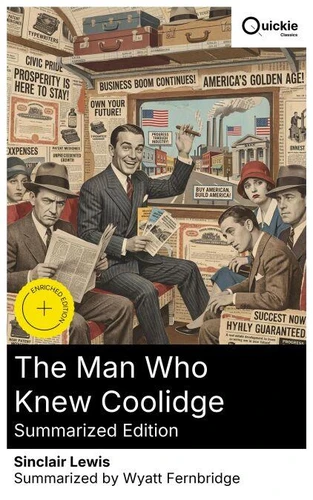
The Man Who Knew Coolidge (Summarized Edition)
Published in 1928, The Man Who Knew Coolidge is a sequence of comic monologues in which Lowell Schmaltz-a tireless salesman and civic booster-fills train compartments, lobbies, and Rotary luncheons with unstoppable patter. Claiming acquaintance with President Calvin Coolidge, Schmaltz touts self-made virtue, efficiency, and "constructive" citizenship, exposing the buzzwords and anxieties of Coolidge-era prosperity.
Lewis's ventriloquism captures American vernacular: run-on boasts, malapropisms, and moral evasions continue the satire of Babbitt and Elmer Gantry, but in a more compressed, oral, vaudevillian form. Sinclair Lewis, Minnesota-born journalist-turned-novelist and first American Nobel laureate (1930), built his fame by anatomizing myths of business success and small-town virtue. His lecture tours, newsroom stints, and notebooks of salesmen's jargon supplied material for Schmaltz's voice.
Writing after Babbitt and amid Coolidge's celebrated taciturnity, Lewis condenses a culture of boosterism into one garrulous speaker who cannot stop selling-least of all himself. Readers of American satire, cultural historians of the 1920s, and students of rhetoric will find this book an exacting, hilarious primer in how language manufactures consent. Read it alongside Babbitt for a sharper profile of the era's business creed, or aloud to savor the timing.
Few works more economically expose the comic pathos of the Coolidge age. Quickie Classics summarizes timeless works with precision, preserving the author's voice and keeping the prose clear, fast, and readable-distilled, never diluted. Enriched Edition extras: Introduction · Synopsis · Historical Context · Author Biography · Brief Analysis · 4 Reflection Q&As · Editorial Footnotes.
Lewis's ventriloquism captures American vernacular: run-on boasts, malapropisms, and moral evasions continue the satire of Babbitt and Elmer Gantry, but in a more compressed, oral, vaudevillian form. Sinclair Lewis, Minnesota-born journalist-turned-novelist and first American Nobel laureate (1930), built his fame by anatomizing myths of business success and small-town virtue. His lecture tours, newsroom stints, and notebooks of salesmen's jargon supplied material for Schmaltz's voice.
Writing after Babbitt and amid Coolidge's celebrated taciturnity, Lewis condenses a culture of boosterism into one garrulous speaker who cannot stop selling-least of all himself. Readers of American satire, cultural historians of the 1920s, and students of rhetoric will find this book an exacting, hilarious primer in how language manufactures consent. Read it alongside Babbitt for a sharper profile of the era's business creed, or aloud to savor the timing.
Few works more economically expose the comic pathos of the Coolidge age. Quickie Classics summarizes timeless works with precision, preserving the author's voice and keeping the prose clear, fast, and readable-distilled, never diluted. Enriched Edition extras: Introduction · Synopsis · Historical Context · Author Biography · Brief Analysis · 4 Reflection Q&As · Editorial Footnotes.
Published in 1928, The Man Who Knew Coolidge is a sequence of comic monologues in which Lowell Schmaltz-a tireless salesman and civic booster-fills train compartments, lobbies, and Rotary luncheons with unstoppable patter. Claiming acquaintance with President Calvin Coolidge, Schmaltz touts self-made virtue, efficiency, and "constructive" citizenship, exposing the buzzwords and anxieties of Coolidge-era prosperity.
Lewis's ventriloquism captures American vernacular: run-on boasts, malapropisms, and moral evasions continue the satire of Babbitt and Elmer Gantry, but in a more compressed, oral, vaudevillian form. Sinclair Lewis, Minnesota-born journalist-turned-novelist and first American Nobel laureate (1930), built his fame by anatomizing myths of business success and small-town virtue. His lecture tours, newsroom stints, and notebooks of salesmen's jargon supplied material for Schmaltz's voice.
Writing after Babbitt and amid Coolidge's celebrated taciturnity, Lewis condenses a culture of boosterism into one garrulous speaker who cannot stop selling-least of all himself. Readers of American satire, cultural historians of the 1920s, and students of rhetoric will find this book an exacting, hilarious primer in how language manufactures consent. Read it alongside Babbitt for a sharper profile of the era's business creed, or aloud to savor the timing.
Few works more economically expose the comic pathos of the Coolidge age. Quickie Classics summarizes timeless works with precision, preserving the author's voice and keeping the prose clear, fast, and readable-distilled, never diluted. Enriched Edition extras: Introduction · Synopsis · Historical Context · Author Biography · Brief Analysis · 4 Reflection Q&As · Editorial Footnotes.
Lewis's ventriloquism captures American vernacular: run-on boasts, malapropisms, and moral evasions continue the satire of Babbitt and Elmer Gantry, but in a more compressed, oral, vaudevillian form. Sinclair Lewis, Minnesota-born journalist-turned-novelist and first American Nobel laureate (1930), built his fame by anatomizing myths of business success and small-town virtue. His lecture tours, newsroom stints, and notebooks of salesmen's jargon supplied material for Schmaltz's voice.
Writing after Babbitt and amid Coolidge's celebrated taciturnity, Lewis condenses a culture of boosterism into one garrulous speaker who cannot stop selling-least of all himself. Readers of American satire, cultural historians of the 1920s, and students of rhetoric will find this book an exacting, hilarious primer in how language manufactures consent. Read it alongside Babbitt for a sharper profile of the era's business creed, or aloud to savor the timing.
Few works more economically expose the comic pathos of the Coolidge age. Quickie Classics summarizes timeless works with precision, preserving the author's voice and keeping the prose clear, fast, and readable-distilled, never diluted. Enriched Edition extras: Introduction · Synopsis · Historical Context · Author Biography · Brief Analysis · 4 Reflection Q&As · Editorial Footnotes.
Les livres de Sinclair Lewis

Main Street & Babbitt. Enriched edition. Exploring Small-Town Struggles and Middle-Class Dreams in Early 20th Century America
Sinclair Lewis, Brielle Kestridge
E-book
0,99 €

0,49 €

0,49 €

0,49 €

Die Hauptstraße. Bereicherte Ausgabe. Satire auf Kleinstadtkultur, Konformität und Frauenrolle im Gopher Prairie der 1920er Jahre
Sinclair Lewis, Franz Fein
E-book
0,49 €

1,99 €

0,99 €

0,49 €

Sinclair Lewis - Ultimate Collection. Enriched edition. 40 + Titles: Complete Novels & Short Stories
Sinclair Lewis, Hannah Mead
E-book
0,49 €

0,49 €

Elmer Gantry. Enriched edition. A Satirical Exploration of Faith, Power, and Greed in 1920s America
Sinclair Lewis, Brielle Kestridge
E-book
0,99 €

0,99 €


0,99 €

The Job. Enriched edition. The Struggles of an Unconventional Woman in a Man's World
Sinclair Lewis, Brielle Kestridge
E-book
0,99 €


0,49 €

2,99 €