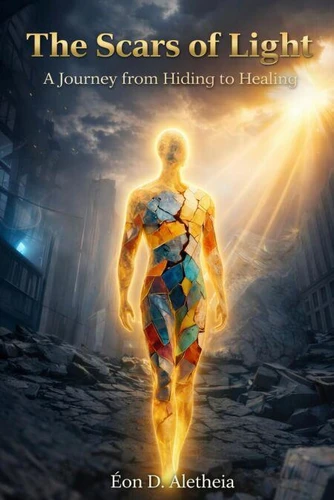
Not a passive read. Scars of Light is a sensory, literary, allegorical novel inspired by real emotions-not a factual memoir. It explores post-burnout healing, synesthesia, and spiritual transformation-where the world sings in color. For Michael, the universe speaks a secret language. Numbers glow, voices have textures, and the bedroom radiator hums a deep, warm orange. This synesthetic world is his sanctuary-until the adult world of "facts and figures" demands silence.
Branded "strange" and shamed into conformity, he builds the mask of "Mike, " a ghost in the machine who thrives in the coldest environment imaginable: Wall Street. The soul refuses to die quietly. Decades of suppression surface as a tiny hairline fracture on his forehead-the visible proof the mask is cracking. After closing the biggest deal of his career, one question detonates everything: What was the point? The collapse that follows becomes a descent into The Void, stripping away the armor until, at rock bottom-washing dishes in a chaotic Greek diner-Michael begins the only work that matters: coming home to himself.
This novel moves through five arcs-The Breaking, The Hiding, The Climbing, The Falling, The Rising-not as episodes of failure and recovery, but as stations in a single movement from gray to color. Michael discovers he is not a static label (a noun) but a living process (a verb); his synesthesia is not a defect but a key to The Art of Seeing. For readers who love: the spiritual pilgrimage of The Alchemist, the raw honesty of When Things Fall Apart, and the embodied insight of The Body Keeps the Score.
Core themes: visionary & metaphysical fiction, autofiction, synesthesia, burnout recovery, inner-child reconciliation, sensory storytelling, emotional resilience, authenticity. Remember: your scars are not marks of shame-they are where the light enters. Included: a concise, practical section-The Art of Seeing-to transform personal wounds into sources of clarity, compassion, and strength. This is a work of fiction (autofiction).
Names, characters, places, and incidents are products of the author's imagination or are used fictitiously.
Not a passive read. Scars of Light is a sensory, literary, allegorical novel inspired by real emotions-not a factual memoir. It explores post-burnout healing, synesthesia, and spiritual transformation-where the world sings in color. For Michael, the universe speaks a secret language. Numbers glow, voices have textures, and the bedroom radiator hums a deep, warm orange. This synesthetic world is his sanctuary-until the adult world of "facts and figures" demands silence.
Branded "strange" and shamed into conformity, he builds the mask of "Mike, " a ghost in the machine who thrives in the coldest environment imaginable: Wall Street. The soul refuses to die quietly. Decades of suppression surface as a tiny hairline fracture on his forehead-the visible proof the mask is cracking. After closing the biggest deal of his career, one question detonates everything: What was the point? The collapse that follows becomes a descent into The Void, stripping away the armor until, at rock bottom-washing dishes in a chaotic Greek diner-Michael begins the only work that matters: coming home to himself.
This novel moves through five arcs-The Breaking, The Hiding, The Climbing, The Falling, The Rising-not as episodes of failure and recovery, but as stations in a single movement from gray to color. Michael discovers he is not a static label (a noun) but a living process (a verb); his synesthesia is not a defect but a key to The Art of Seeing. For readers who love: the spiritual pilgrimage of The Alchemist, the raw honesty of When Things Fall Apart, and the embodied insight of The Body Keeps the Score.
Core themes: visionary & metaphysical fiction, autofiction, synesthesia, burnout recovery, inner-child reconciliation, sensory storytelling, emotional resilience, authenticity. Remember: your scars are not marks of shame-they are where the light enters. Included: a concise, practical section-The Art of Seeing-to transform personal wounds into sources of clarity, compassion, and strength. This is a work of fiction (autofiction).
Names, characters, places, and incidents are products of the author's imagination or are used fictitiously.