SOLDES
Jusqu'à -70% sur une sélection d'articles*
- Accueil /
- Thomas Hörnig
Thomas Hörnig

Dernière sortie
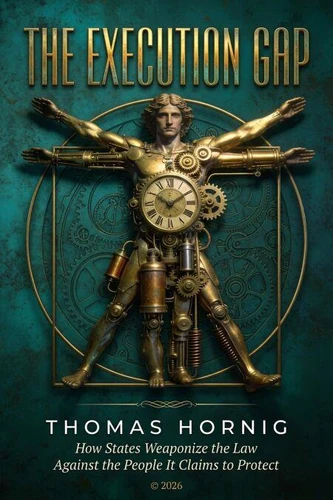
The Execution Gap: When Law Exists But Rights Don't Attach
When law exists but your rights do not attach, the failure is not bureaucratic. It is architectural.*The Execution Gap* begins with a documented fact. In 2015, Lebanon's Ministry of Labor issued Opinion 1266/2015, classifying the author as a Category I civil servant - the highest classification in the Lebanese administrative hierarchy. The underlying legislation was unambiguous. The parity command was mandatory.
The classification was irrevocable under established administrative doctrine. For thirty-two years, the state declined to execute its own determination. By 2025, deliberate manipulation of working hours produced negative net salaries. This is not a story about Lebanon. It is a forensic autopsy of a global mechanism. From gig economy contractors in California denied benefits through deliberate misclassification, to migrant workers trapped under the kafala sponsorship system across the Middle East, to public-sector employees across Europe stripped of permanent status through administrative reclassification - the architecture is identical.
Labor is real. Legal acknowledgment exists. Rights are withheld by structural design. The crisis of modern work is not an economic accident. It is a deliberate legal construction.*The Execution Gap* identifies this mechanism with precision and dismantles it with three original forensic frameworks:**The Personhood Master Key Theory (PMKT).** Drawing on the Roman legal distinction between *persona* (the legal mask through which rights attach) and *res* (the human reality beneath it), PMKT proves that modern institutions systematically decouple legal visibility from enforcement capacity.
Gig economy misclassification, the kafala system, and corporate personhood are applications of a single mechanism that legal doctrine can reverse.**The Personhood Attachment Index (PAI).** Built on the formula P = L × C (Personhood equals Legal recognition multiplied by Capacity to enforce), the PAI quantifies exactly where institutions sever rights across seven critical vectors: Legal, Fiscal, Medical, Judicial, Administrative, Political, and Social.
It converts invisible institutional exclusion into measurable, evidentiary data for litigation.**The Execution Audit (EA-30-60-90).** Diagnosis without remedy is observation, not advocacy. The EA-30-60-90 is a binding procedural protocol that converts administrative acknowledgment into compelled enforcement: formal status audit by Day 30, judicial mandamus relief by Day 60, international litigation by Day 90.
By establishing inescapable legal jeopardy for deliberate non-execution, the audit makes the structural maintenance of the execution gap legally untenable. Three arguments anchor these tools. First: Roman law created the legal mask through which rights attach-and always retained the capacity to withdraw it. Citizens United extending full personhood to corporations while contracting it for workers is the predictable logic of this doctrine.
Second: the kafala system, gig economy contractor fiction, and public-sector contract chains share one architecture-labor acknowledged, rights withheld. Third: traditional human rights advocacy assumes naming a violation triggers remedy. This book demonstrates why that fails when law is not absent but deliberately unexecuted. Written from inside the execution gap by someone who inhabited it for three decades, this book is simultaneously a legal treatise, comparative analysis, and firsthand testimony.
It combines doctrinal precision with embodied witness. Essential reading for labor rights attorneys, employment law practitioners, human rights advocates, anti-corruption investigators, legal philosophers, labor economists, policymakers, and anyone who has suspected the law's failure to protect them was not an oversight. Stop analyzing the problem. Equip yourself with the forensic tools to solve it.
The classification was irrevocable under established administrative doctrine. For thirty-two years, the state declined to execute its own determination. By 2025, deliberate manipulation of working hours produced negative net salaries. This is not a story about Lebanon. It is a forensic autopsy of a global mechanism. From gig economy contractors in California denied benefits through deliberate misclassification, to migrant workers trapped under the kafala sponsorship system across the Middle East, to public-sector employees across Europe stripped of permanent status through administrative reclassification - the architecture is identical.
Labor is real. Legal acknowledgment exists. Rights are withheld by structural design. The crisis of modern work is not an economic accident. It is a deliberate legal construction.*The Execution Gap* identifies this mechanism with precision and dismantles it with three original forensic frameworks:**The Personhood Master Key Theory (PMKT).** Drawing on the Roman legal distinction between *persona* (the legal mask through which rights attach) and *res* (the human reality beneath it), PMKT proves that modern institutions systematically decouple legal visibility from enforcement capacity.
Gig economy misclassification, the kafala system, and corporate personhood are applications of a single mechanism that legal doctrine can reverse.**The Personhood Attachment Index (PAI).** Built on the formula P = L × C (Personhood equals Legal recognition multiplied by Capacity to enforce), the PAI quantifies exactly where institutions sever rights across seven critical vectors: Legal, Fiscal, Medical, Judicial, Administrative, Political, and Social.
It converts invisible institutional exclusion into measurable, evidentiary data for litigation.**The Execution Audit (EA-30-60-90).** Diagnosis without remedy is observation, not advocacy. The EA-30-60-90 is a binding procedural protocol that converts administrative acknowledgment into compelled enforcement: formal status audit by Day 30, judicial mandamus relief by Day 60, international litigation by Day 90.
By establishing inescapable legal jeopardy for deliberate non-execution, the audit makes the structural maintenance of the execution gap legally untenable. Three arguments anchor these tools. First: Roman law created the legal mask through which rights attach-and always retained the capacity to withdraw it. Citizens United extending full personhood to corporations while contracting it for workers is the predictable logic of this doctrine.
Second: the kafala system, gig economy contractor fiction, and public-sector contract chains share one architecture-labor acknowledged, rights withheld. Third: traditional human rights advocacy assumes naming a violation triggers remedy. This book demonstrates why that fails when law is not absent but deliberately unexecuted. Written from inside the execution gap by someone who inhabited it for three decades, this book is simultaneously a legal treatise, comparative analysis, and firsthand testimony.
It combines doctrinal precision with embodied witness. Essential reading for labor rights attorneys, employment law practitioners, human rights advocates, anti-corruption investigators, legal philosophers, labor economists, policymakers, and anyone who has suspected the law's failure to protect them was not an oversight. Stop analyzing the problem. Equip yourself with the forensic tools to solve it.
When law exists but your rights do not attach, the failure is not bureaucratic. It is architectural.*The Execution Gap* begins with a documented fact. In 2015, Lebanon's Ministry of Labor issued Opinion 1266/2015, classifying the author as a Category I civil servant - the highest classification in the Lebanese administrative hierarchy. The underlying legislation was unambiguous. The parity command was mandatory.
The classification was irrevocable under established administrative doctrine. For thirty-two years, the state declined to execute its own determination. By 2025, deliberate manipulation of working hours produced negative net salaries. This is not a story about Lebanon. It is a forensic autopsy of a global mechanism. From gig economy contractors in California denied benefits through deliberate misclassification, to migrant workers trapped under the kafala sponsorship system across the Middle East, to public-sector employees across Europe stripped of permanent status through administrative reclassification - the architecture is identical.
Labor is real. Legal acknowledgment exists. Rights are withheld by structural design. The crisis of modern work is not an economic accident. It is a deliberate legal construction.*The Execution Gap* identifies this mechanism with precision and dismantles it with three original forensic frameworks:**The Personhood Master Key Theory (PMKT).** Drawing on the Roman legal distinction between *persona* (the legal mask through which rights attach) and *res* (the human reality beneath it), PMKT proves that modern institutions systematically decouple legal visibility from enforcement capacity.
Gig economy misclassification, the kafala system, and corporate personhood are applications of a single mechanism that legal doctrine can reverse.**The Personhood Attachment Index (PAI).** Built on the formula P = L × C (Personhood equals Legal recognition multiplied by Capacity to enforce), the PAI quantifies exactly where institutions sever rights across seven critical vectors: Legal, Fiscal, Medical, Judicial, Administrative, Political, and Social.
It converts invisible institutional exclusion into measurable, evidentiary data for litigation.**The Execution Audit (EA-30-60-90).** Diagnosis without remedy is observation, not advocacy. The EA-30-60-90 is a binding procedural protocol that converts administrative acknowledgment into compelled enforcement: formal status audit by Day 30, judicial mandamus relief by Day 60, international litigation by Day 90.
By establishing inescapable legal jeopardy for deliberate non-execution, the audit makes the structural maintenance of the execution gap legally untenable. Three arguments anchor these tools. First: Roman law created the legal mask through which rights attach-and always retained the capacity to withdraw it. Citizens United extending full personhood to corporations while contracting it for workers is the predictable logic of this doctrine.
Second: the kafala system, gig economy contractor fiction, and public-sector contract chains share one architecture-labor acknowledged, rights withheld. Third: traditional human rights advocacy assumes naming a violation triggers remedy. This book demonstrates why that fails when law is not absent but deliberately unexecuted. Written from inside the execution gap by someone who inhabited it for three decades, this book is simultaneously a legal treatise, comparative analysis, and firsthand testimony.
It combines doctrinal precision with embodied witness. Essential reading for labor rights attorneys, employment law practitioners, human rights advocates, anti-corruption investigators, legal philosophers, labor economists, policymakers, and anyone who has suspected the law's failure to protect them was not an oversight. Stop analyzing the problem. Equip yourself with the forensic tools to solve it.
The classification was irrevocable under established administrative doctrine. For thirty-two years, the state declined to execute its own determination. By 2025, deliberate manipulation of working hours produced negative net salaries. This is not a story about Lebanon. It is a forensic autopsy of a global mechanism. From gig economy contractors in California denied benefits through deliberate misclassification, to migrant workers trapped under the kafala sponsorship system across the Middle East, to public-sector employees across Europe stripped of permanent status through administrative reclassification - the architecture is identical.
Labor is real. Legal acknowledgment exists. Rights are withheld by structural design. The crisis of modern work is not an economic accident. It is a deliberate legal construction.*The Execution Gap* identifies this mechanism with precision and dismantles it with three original forensic frameworks:**The Personhood Master Key Theory (PMKT).** Drawing on the Roman legal distinction between *persona* (the legal mask through which rights attach) and *res* (the human reality beneath it), PMKT proves that modern institutions systematically decouple legal visibility from enforcement capacity.
Gig economy misclassification, the kafala system, and corporate personhood are applications of a single mechanism that legal doctrine can reverse.**The Personhood Attachment Index (PAI).** Built on the formula P = L × C (Personhood equals Legal recognition multiplied by Capacity to enforce), the PAI quantifies exactly where institutions sever rights across seven critical vectors: Legal, Fiscal, Medical, Judicial, Administrative, Political, and Social.
It converts invisible institutional exclusion into measurable, evidentiary data for litigation.**The Execution Audit (EA-30-60-90).** Diagnosis without remedy is observation, not advocacy. The EA-30-60-90 is a binding procedural protocol that converts administrative acknowledgment into compelled enforcement: formal status audit by Day 30, judicial mandamus relief by Day 60, international litigation by Day 90.
By establishing inescapable legal jeopardy for deliberate non-execution, the audit makes the structural maintenance of the execution gap legally untenable. Three arguments anchor these tools. First: Roman law created the legal mask through which rights attach-and always retained the capacity to withdraw it. Citizens United extending full personhood to corporations while contracting it for workers is the predictable logic of this doctrine.
Second: the kafala system, gig economy contractor fiction, and public-sector contract chains share one architecture-labor acknowledged, rights withheld. Third: traditional human rights advocacy assumes naming a violation triggers remedy. This book demonstrates why that fails when law is not absent but deliberately unexecuted. Written from inside the execution gap by someone who inhabited it for three decades, this book is simultaneously a legal treatise, comparative analysis, and firsthand testimony.
It combines doctrinal precision with embodied witness. Essential reading for labor rights attorneys, employment law practitioners, human rights advocates, anti-corruption investigators, legal philosophers, labor economists, policymakers, and anyone who has suspected the law's failure to protect them was not an oversight. Stop analyzing the problem. Equip yourself with the forensic tools to solve it.
Les livres de Thomas Hörnig

Was ist Diakoniewissenschaft?. Wahrnehmungen zwischen Dienst, Dialog und Diversität
Bernhard Mutschler, Thomas Hörnig
E-book
22,99 €
