- Accueil /
- Csongor Lörincz
Csongor Lörincz

Dernière sortie
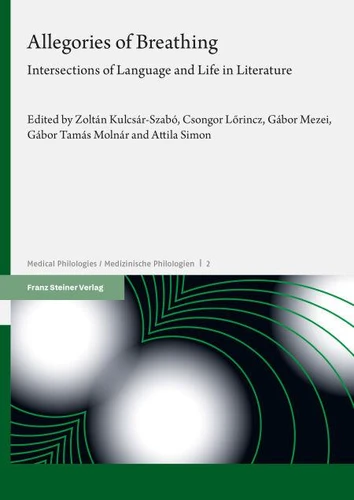
Allegories of Breathing
The aim of this volume is to present a quite recent focus on the ways biological materiality of bodily existence comes into closest contact with literary or cultural communication. The studies examine not only how breathing, understood as a complex site of intersections between life and language, is thematised, but also how it becomes a textual factor in literary writing. The topicality of the subject, given the broader cultural, social, and political context, is obvious: the climate crisis and the pandemic in recent years, or even a sentence that occupied the political public for months in 2020 ("I can't breathe"), have confronted us with the fact that breathing has become a visible medium.
Literature's interest in breathing is of course nothing new: as the fundamental intersection of the linguistic and biological conceptions of life, it has been present in ideas about the creation, transmission, and reception of literature since the beginnings of European culture. Breathing, therefore, must clearly be a starting point for all examinations of literature and language in cultural studies, as it bears witness to the dependence of language on life in a biological context.
The aim of this volume is to present a quite recent focus on the ways biological materiality of bodily existence comes into closest contact with literary or cultural communication. The studies examine not only how breathing, understood as a complex site of intersections between life and language, is thematised, but also how it becomes a textual factor in literary writing. The topicality of the subject, given the broader cultural, social, and political context, is obvious: the climate crisis and the pandemic in recent years, or even a sentence that occupied the political public for months in 2020 ("I can't breathe"), have confronted us with the fact that breathing has become a visible medium.
Literature's interest in breathing is of course nothing new: as the fundamental intersection of the linguistic and biological conceptions of life, it has been present in ideas about the creation, transmission, and reception of literature since the beginnings of European culture. Breathing, therefore, must clearly be a starting point for all examinations of literature and language in cultural studies, as it bears witness to the dependence of language on life in a biological context.
Les livres de Csongor Lörincz

An den Rändern der Literatur. Dokument und Literatur in zentraleuropäischen Kulturen. Tracing the Edges of Literature. Documentary Fiction in Central European Cultures
Milka Car, Csongor Lörincz, Danijela Lugarić, Gábor Tamás Molnár
E-book
55,00 €
