- Accueil /
- Edith O'Shaughnessy
Edith O'Shaughnessy

Dernière sortie
My Lorraine journal
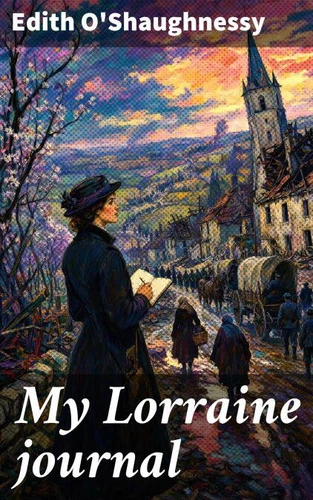
My Lorraine Journal is Edith O'Shaughnessy's vivid record of life in the French borderlands during the First World War, blending memoir, travel writing, and wartime observation. Set in Lorraine, a region laden with contested history and symbolic importance, the book captures the emotional and material realities of war at close range: military movement, civilian endurance, ruined landscapes, and the uneasy tension between beauty and devastation.
O'Shaughnessy writes in an elegant, reflective prose style characteristic of early twentieth-century literary journalism, balancing immediacy of witness with cultivated sensitivity to place, politics, and human character. O'Shaughnessy, an American writer and diplomat's wife, was especially positioned to interpret European upheaval for Anglophone readers. Her international experience and proximity to diplomatic circles sharpened her awareness of the war's political dimensions, while her personal encounters with occupied and threatened communities gave her work moral urgency.
As in her other writings on conflict and foreign affairs, she joins observational precision to a cosmopolitan intelligence, making private testimony resonate with larger historical significance. This journal will especially reward readers interested in women's wartime writing, borderland history, and eyewitness accounts of the Great War. It is recommended both as a compelling personal narrative and as a valuable cultural document illuminating how war was seen, felt, and interpreted in real time.
O'Shaughnessy writes in an elegant, reflective prose style characteristic of early twentieth-century literary journalism, balancing immediacy of witness with cultivated sensitivity to place, politics, and human character. O'Shaughnessy, an American writer and diplomat's wife, was especially positioned to interpret European upheaval for Anglophone readers. Her international experience and proximity to diplomatic circles sharpened her awareness of the war's political dimensions, while her personal encounters with occupied and threatened communities gave her work moral urgency.
As in her other writings on conflict and foreign affairs, she joins observational precision to a cosmopolitan intelligence, making private testimony resonate with larger historical significance. This journal will especially reward readers interested in women's wartime writing, borderland history, and eyewitness accounts of the Great War. It is recommended both as a compelling personal narrative and as a valuable cultural document illuminating how war was seen, felt, and interpreted in real time.
My Lorraine Journal is Edith O'Shaughnessy's vivid record of life in the French borderlands during the First World War, blending memoir, travel writing, and wartime observation. Set in Lorraine, a region laden with contested history and symbolic importance, the book captures the emotional and material realities of war at close range: military movement, civilian endurance, ruined landscapes, and the uneasy tension between beauty and devastation.
O'Shaughnessy writes in an elegant, reflective prose style characteristic of early twentieth-century literary journalism, balancing immediacy of witness with cultivated sensitivity to place, politics, and human character. O'Shaughnessy, an American writer and diplomat's wife, was especially positioned to interpret European upheaval for Anglophone readers. Her international experience and proximity to diplomatic circles sharpened her awareness of the war's political dimensions, while her personal encounters with occupied and threatened communities gave her work moral urgency.
As in her other writings on conflict and foreign affairs, she joins observational precision to a cosmopolitan intelligence, making private testimony resonate with larger historical significance. This journal will especially reward readers interested in women's wartime writing, borderland history, and eyewitness accounts of the Great War. It is recommended both as a compelling personal narrative and as a valuable cultural document illuminating how war was seen, felt, and interpreted in real time.
O'Shaughnessy writes in an elegant, reflective prose style characteristic of early twentieth-century literary journalism, balancing immediacy of witness with cultivated sensitivity to place, politics, and human character. O'Shaughnessy, an American writer and diplomat's wife, was especially positioned to interpret European upheaval for Anglophone readers. Her international experience and proximity to diplomatic circles sharpened her awareness of the war's political dimensions, while her personal encounters with occupied and threatened communities gave her work moral urgency.
As in her other writings on conflict and foreign affairs, she joins observational precision to a cosmopolitan intelligence, making private testimony resonate with larger historical significance. This journal will especially reward readers interested in women's wartime writing, borderland history, and eyewitness accounts of the Great War. It is recommended both as a compelling personal narrative and as a valuable cultural document illuminating how war was seen, felt, and interpreted in real time.