OFFRE LISEUSES
Une liseuse achetée = une housse offerte* jusqu'au 21 juin
- Accueil /
- François Briois
François Briois

Dernière sortie
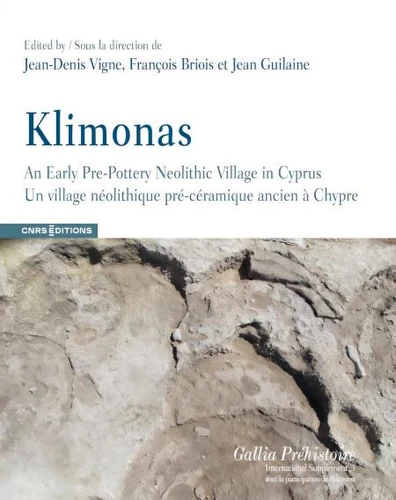
Klimonas
Klimonas is the oldest Mediterranean island village. Occupied ca. 8 800 cal BC, it postpones by several centuries the Neolithic presence in Cyprus, at that time located more than 80 km offshore. The village extended over more than 5, 500 m2, facing the sea, 2 km from the famous pre-pottery site of Shillourokambos and near rich flint outcrops. Excavations (2009-2016) revealed that it was composed of circular or oval earthen buildings 3-6 m in diameter, notched into the slope, modestly fitted out and organised around a semi-buried 10 m communal building.
The construction techniques, the abundance of either knapped or polished stone material, together with ornaments, symbolic objects, and plants and animal remains, as well as the 52 radiometric dates, point to the end of the Levantine Pre-Pottery Neolithic A (PPNA). The presence of a communal building, rebuilt numerous times over the course of several decades, also points to the same conclusion. The villagers gathered seeds and fruits and cultivated wild starch and einkorn, recently imported from the continent.
They primarily hunted small endemic wild boar, the only large mammal species attested on the island at that time and, secondarily, birds. They did not eat fish or marine shellfish. Domestic dogs, mice and cats brought from the continent also lived in the village. The remains of this cultivator-hunter community testify to the early extension of the Near Eastern Neolithic and to unsuspected seafaring skills, substantially improving our knowledge of the Neolithic transition in the Mediterranean.
The construction techniques, the abundance of either knapped or polished stone material, together with ornaments, symbolic objects, and plants and animal remains, as well as the 52 radiometric dates, point to the end of the Levantine Pre-Pottery Neolithic A (PPNA). The presence of a communal building, rebuilt numerous times over the course of several decades, also points to the same conclusion. The villagers gathered seeds and fruits and cultivated wild starch and einkorn, recently imported from the continent.
They primarily hunted small endemic wild boar, the only large mammal species attested on the island at that time and, secondarily, birds. They did not eat fish or marine shellfish. Domestic dogs, mice and cats brought from the continent also lived in the village. The remains of this cultivator-hunter community testify to the early extension of the Near Eastern Neolithic and to unsuspected seafaring skills, substantially improving our knowledge of the Neolithic transition in the Mediterranean.
Klimonas is the oldest Mediterranean island village. Occupied ca. 8 800 cal BC, it postpones by several centuries the Neolithic presence in Cyprus, at that time located more than 80 km offshore. The village extended over more than 5, 500 m2, facing the sea, 2 km from the famous pre-pottery site of Shillourokambos and near rich flint outcrops. Excavations (2009-2016) revealed that it was composed of circular or oval earthen buildings 3-6 m in diameter, notched into the slope, modestly fitted out and organised around a semi-buried 10 m communal building.
The construction techniques, the abundance of either knapped or polished stone material, together with ornaments, symbolic objects, and plants and animal remains, as well as the 52 radiometric dates, point to the end of the Levantine Pre-Pottery Neolithic A (PPNA). The presence of a communal building, rebuilt numerous times over the course of several decades, also points to the same conclusion. The villagers gathered seeds and fruits and cultivated wild starch and einkorn, recently imported from the continent.
They primarily hunted small endemic wild boar, the only large mammal species attested on the island at that time and, secondarily, birds. They did not eat fish or marine shellfish. Domestic dogs, mice and cats brought from the continent also lived in the village. The remains of this cultivator-hunter community testify to the early extension of the Near Eastern Neolithic and to unsuspected seafaring skills, substantially improving our knowledge of the Neolithic transition in the Mediterranean.
The construction techniques, the abundance of either knapped or polished stone material, together with ornaments, symbolic objects, and plants and animal remains, as well as the 52 radiometric dates, point to the end of the Levantine Pre-Pottery Neolithic A (PPNA). The presence of a communal building, rebuilt numerous times over the course of several decades, also points to the same conclusion. The villagers gathered seeds and fruits and cultivated wild starch and einkorn, recently imported from the continent.
They primarily hunted small endemic wild boar, the only large mammal species attested on the island at that time and, secondarily, birds. They did not eat fish or marine shellfish. Domestic dogs, mice and cats brought from the continent also lived in the village. The remains of this cultivator-hunter community testify to the early extension of the Near Eastern Neolithic and to unsuspected seafaring skills, substantially improving our knowledge of the Neolithic transition in the Mediterranean.
Les livres de François Briois
Shillourokambos. Un établissement néolithique pré-céramique à Chypre - Les fouilles du secteur 3
Jean Guilaine, Jean-Denis Vigne, François Briois
E-book
34,99 €

Systèmes techniques et communautés du Néolithique précéramique au Proche-Orient. Actes du 5e colloque international, Fréjus, 2004
Laurence Astruc, Didier Binder, François Briois
Grand Format
30,00 €

Klimonas. Un village néolithique pré-céramique ancien à Chypre
Jean-Denis Vigne, François Briois, Jean Guilaine
Grand Format
79,00 €

Shillourokambos. Un établissement néolithique pré-céramique à Chypre - Les fouilles du secteur 3
Jean Guilaine, Jean-Denis Vigne, François Briois
Grand Format
49,00 €

Shillourokambos. Un établissement néolithique pré-céramique à Chypre, les fouilles du secteur 1
Jean Guilaine, François Briois, Jean-Denis Vigne
49,70 €

Ouadi El-Jarfi. Les installations du Littoral. Pack en 2 volumes Tomes 1, Texte ; Tome 2, Planches
Pierre Tallet, Grégory Marouard, Damien Laisney
Grand Format
123,00 €

84,80 €

35,00 €