OFFRE LISEUSES
Une liseuse achetée = une housse offerte* jusqu'au 21 juin
- Accueil /
- Jean de La Bruyère
Jean de La Bruyère

Dernière sortie
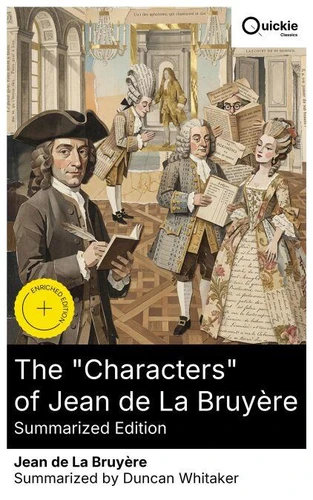
The "Characters" of Jean de La Bruyère (Summarized Edition)
The Characters (Les Caractères) is both a translation of Theophrastus and a boldly original anatomy of seventeenth-century French mores. In aphorisms, portraits à clef, and brief essays grouped by themes-of the Court, of Women, of Greatness, of Personal Merit-La Bruyère's lapidary prose wields antithesis and irony to expose vanity, servility, and pretension from Versailles to the salons. Revised across editions after 1688, it perfects social types-the courtier, pedant, financier, précieuse-where the moraliste tradition meets theatrical satire, and numbered fragments probe the rift between public performance and inner motive.
A jurist by training, Jean de La Bruyère (1645-1696) bought a financial office before serving as tutor in the Condé household, a vantage that opened Chantilly and Versailles. Immersed in Greek moralism and French classicism, he married keen observation to Christian ethical concern; the quarrels provoked by his portraits, and his election to the Académie française in 1693, attest to the book's sharpness and its authority.
Scholars of literature, philosophy, and history will find in this book a precise instrument for reading society-then and now. Read it for its style as much as its insight: an exacting mirror that corrects by delight and disenchants without despair. Quickie Classics summarizes timeless works with precision, preserving the author's voice and keeping the prose clear, fast, and readable-distilled, never diluted.
Enriched Edition extras: Introduction · Synopsis · Historical Context · Brief Analysis · 4 Reflection Q&As · Editorial Footnotes.
A jurist by training, Jean de La Bruyère (1645-1696) bought a financial office before serving as tutor in the Condé household, a vantage that opened Chantilly and Versailles. Immersed in Greek moralism and French classicism, he married keen observation to Christian ethical concern; the quarrels provoked by his portraits, and his election to the Académie française in 1693, attest to the book's sharpness and its authority.
Scholars of literature, philosophy, and history will find in this book a precise instrument for reading society-then and now. Read it for its style as much as its insight: an exacting mirror that corrects by delight and disenchants without despair. Quickie Classics summarizes timeless works with precision, preserving the author's voice and keeping the prose clear, fast, and readable-distilled, never diluted.
Enriched Edition extras: Introduction · Synopsis · Historical Context · Brief Analysis · 4 Reflection Q&As · Editorial Footnotes.
The Characters (Les Caractères) is both a translation of Theophrastus and a boldly original anatomy of seventeenth-century French mores. In aphorisms, portraits à clef, and brief essays grouped by themes-of the Court, of Women, of Greatness, of Personal Merit-La Bruyère's lapidary prose wields antithesis and irony to expose vanity, servility, and pretension from Versailles to the salons. Revised across editions after 1688, it perfects social types-the courtier, pedant, financier, précieuse-where the moraliste tradition meets theatrical satire, and numbered fragments probe the rift between public performance and inner motive.
A jurist by training, Jean de La Bruyère (1645-1696) bought a financial office before serving as tutor in the Condé household, a vantage that opened Chantilly and Versailles. Immersed in Greek moralism and French classicism, he married keen observation to Christian ethical concern; the quarrels provoked by his portraits, and his election to the Académie française in 1693, attest to the book's sharpness and its authority.
Scholars of literature, philosophy, and history will find in this book a precise instrument for reading society-then and now. Read it for its style as much as its insight: an exacting mirror that corrects by delight and disenchants without despair. Quickie Classics summarizes timeless works with precision, preserving the author's voice and keeping the prose clear, fast, and readable-distilled, never diluted.
Enriched Edition extras: Introduction · Synopsis · Historical Context · Brief Analysis · 4 Reflection Q&As · Editorial Footnotes.
A jurist by training, Jean de La Bruyère (1645-1696) bought a financial office before serving as tutor in the Condé household, a vantage that opened Chantilly and Versailles. Immersed in Greek moralism and French classicism, he married keen observation to Christian ethical concern; the quarrels provoked by his portraits, and his election to the Académie française in 1693, attest to the book's sharpness and its authority.
Scholars of literature, philosophy, and history will find in this book a precise instrument for reading society-then and now. Read it for its style as much as its insight: an exacting mirror that corrects by delight and disenchants without despair. Quickie Classics summarizes timeless works with precision, preserving the author's voice and keeping the prose clear, fast, and readable-distilled, never diluted.
Enriched Edition extras: Introduction · Synopsis · Historical Context · Brief Analysis · 4 Reflection Q&As · Editorial Footnotes.
Les livres de Jean de La Bruyère


The "Characters" of Jean de La Bruyère. Enriched edition.
Jean de La Bruyère, Henri Van Laun, Colin Finch
E-book
0,99 €

2,99 €

0,99 €

1,99 €

The "Characters" of Jean de La Bruyère. Enriched edition. Insightful Character Studies and Satirical Observations on Human Nature
Jean de La Bruyère, Henri Van Laun, Duncan Whitaker
E-book
1,99 €