OFFRE LISEUSES
Une liseuse achetée = une housse offerte* jusqu'au 21 juin

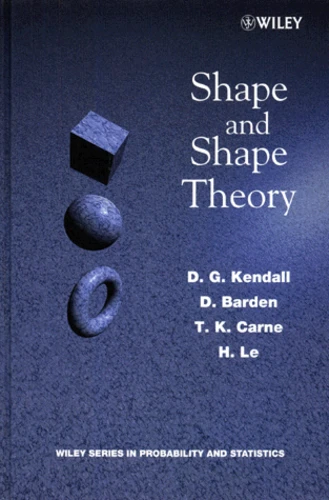
Shape And Shape Theory
Par : , , ,Formats :
Expédié sous 127 jours
Cet article sera commandé chez un fournisseur et vous sera envoyé 127 jours après la date de votre commande.
- Paiement en ligne :
- Livraison à domicile ou en point Mondial Relay estimée à partir du 28 octobreCet article sera commandé chez un fournisseur et vous sera envoyé 127 jours après la date de votre commande.
- Retrait Click and Collect en magasin gratuit
- Livraison à domicile ou en point Mondial Relay estimée à partir du 28 octobre
- Réservation en ligne avec paiement en magasin :
- Indisponible pour réserver et payer en magasin
- Nombre de pages306
- PrésentationRelié
- Poids0.59 kg
- Dimensions15,8 cm × 23,6 cm × 2,2 cm
- ISBN0-471-96823-4
- EAN9780471968238
- Date de parution01/09/1999
- CollectionProbability and Statistics
- ÉditeurWiley
Résumé
The statistical theory of shape is a relatively new topic and is generating a great deal of interest and comment by statisticians, engineers and computer scientists. Mathematically, 'shape' is the geometrical information required to describe an object when location, scale and rotational effects are removed. The theory was pioneered by Professor David Kendall to solve practical problems concerning shape. This text presents an elegant account of the theory of shape that has evolved from Kendall's work. Features include:
• A comprehensive account of Kendall's shape spaces
• A variety of topological and geometric invariants of these spaces
• Emphasis on the mathematical aspects of shape analysis
• Coverage of the mathematical issues for a wide range of applications
The early chapters provide all the necessary background information, including the history and applications of shape theory. The authors then go on to analyse the topic, in brilliant detail, in a variety of different shape spaces. Kendall's own procedures for visualising distributions of shapes and shape processes are covered at length. Implications from other branches of mathematics are explored, along with more advanced applications, incorporating statistics and stochastic analysis. Applied statisticians, applied mathematicians, engineers and computer scientists working and researching in the fields of archaeology, astronomy, biology, geography and physical chemistry will find this book of great benefit. The theories presented are used today in a wide range of subjects from archaeology through to physics, and will provide fascinating reading to anyone engaged in such research.