OFFRE LISEUSES
Une liseuse achetée = une housse offerte* jusqu'au 21 juin

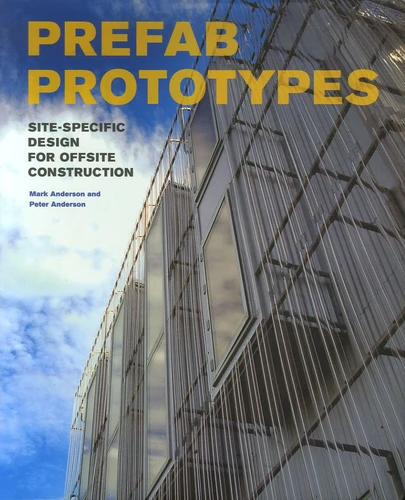
Prefab Prototypes. Site-Specific Design for Offsite Construction
Par : ,Formats :
Définitivement indisponible
Cet article ne peut plus être commandé sur notre site (ouvrage épuisé ou plus commercialisé). Il se peut néanmoins que l'éditeur imprime une nouvelle édition de cet ouvrage à l'avenir. Nous vous invitons donc à revenir périodiquement sur notre site.
- Nombre de pages262
- FormatBeau Livre
- PrésentationRelié
- Poids1.78 kg
- Dimensions25,5 cm × 30,5 cm × 2,6 cm
- ISBN978-1-56898-560-2
- EAN9781568985602
- Date de parution01/05/2007
- ÉditeurPrinceton Architectural Press
Résumé
Prefabricated construction has celebrated a renewed popularity over the last few years, and for good reason. Thanks to continually refined offsite production techniques, architects, engineers, builders, and the general public have embraced a way to reconcile high-quality architecture with increasing regulatory pressure, economic considerations, and environmental consciousness. No longer does the term "prefab" call to mind bland cookie-cutter housing, temporary classroom bungalows, or undifferentiated precast building blocks.
As architects Mark and Peter Anderson have demonstrated in more than twenty years of practice as Anderson Anderson Architecture, a perceptive and creative approach to prefabricated construction makes possible affordable, well-designed buildings in harmony with their natural and public environments. With Prefab Prototypes, the authors provide a thorough overview of the driving forces behind prefabrication, highlighting ways in which applied logic and design efficiency result in lower costs, quicker construction time, higher-quality buildings, and environmentally smarter use of resources.
The Andersons outline six different construction approaches common to current prefabrication practice - panelized 2x4, CNC timber framing, precast and panelized concrete systems, steel framing, sandwich panels, and modular systems - exploring potentials and appropriate applications for each, illustrated with real-world applications drawn from their projects in the U.S. and Japan. Using residential, commercial, and public examples, the case studies demonstrate that flexible prefabrication technologies, paired with imagination and a sensitivity to local conditions, are as applicable on the side of a cliff, on a remote island, or in the middle of an apple orchard as they are in the heart of downtown or in a dense suburban neighborhood. The many plans, sections, exploded-component drawings, and photographs, coupled with the Andersons' detailed and illuminating text, provide a thorough theoretical foundation and imaginative examples for describing site-specific prefabrication's vast potential to harness advancing production technologies and revolutionize architecture and the construction industry.
As architects Mark and Peter Anderson have demonstrated in more than twenty years of practice as Anderson Anderson Architecture, a perceptive and creative approach to prefabricated construction makes possible affordable, well-designed buildings in harmony with their natural and public environments. With Prefab Prototypes, the authors provide a thorough overview of the driving forces behind prefabrication, highlighting ways in which applied logic and design efficiency result in lower costs, quicker construction time, higher-quality buildings, and environmentally smarter use of resources.
The Andersons outline six different construction approaches common to current prefabrication practice - panelized 2x4, CNC timber framing, precast and panelized concrete systems, steel framing, sandwich panels, and modular systems - exploring potentials and appropriate applications for each, illustrated with real-world applications drawn from their projects in the U.S. and Japan. Using residential, commercial, and public examples, the case studies demonstrate that flexible prefabrication technologies, paired with imagination and a sensitivity to local conditions, are as applicable on the side of a cliff, on a remote island, or in the middle of an apple orchard as they are in the heart of downtown or in a dense suburban neighborhood. The many plans, sections, exploded-component drawings, and photographs, coupled with the Andersons' detailed and illuminating text, provide a thorough theoretical foundation and imaginative examples for describing site-specific prefabrication's vast potential to harness advancing production technologies and revolutionize architecture and the construction industry.